

A stylish, skilled but violent period tale from South Korea.
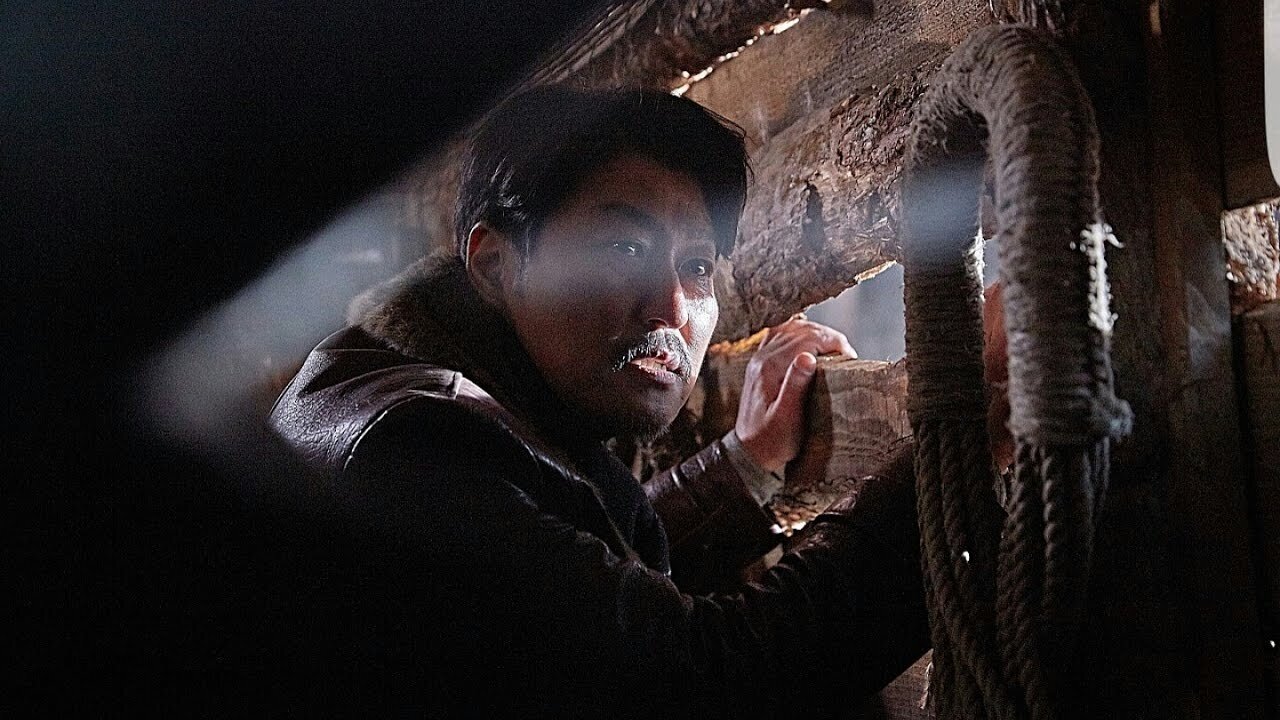
Song Kang-ho
This film by the South Korean director Kim Jee-woon describes itself as a fictionalised tale although it draws on actual events in the 1920s. That was when Korea was under Japanese control and resistance fighters went into action in a bid for Korea's independence. Against this background The Age of Shadows tells the story of a Korean police captain, Lee Jing-chool (Song Kang-ho), working for the Japanese police force who send him on a mission to infiltrate the resistance group by getting close to one of its leaders, Kim Woo-jin (Gong Yoo). Earlier Lee had been involved with the resistance himself as an interpreter so what his real feelings are is open to question. In any case the head of the resistance movement, Jung Che-san (Lee Byung-hun), believes that if Lee changed sides once he can be turned again.
With this film its director turns to what for him is new territory since this period drama is an action movie that plays like a spy thriller. Early on there is one scene which plays as a reminder that Kim's previous work has often featured horror elements, but The Age of Shadows soon settles down to offer a suspenseful adventure tale notably well made (credit here to Kim and to his editor Yang Jin-mo). This is also a work possessed of excellent production values. The tale shifts between Seoul and Shanghai and features a big set-piece on a train as the resistance group seek to return to Seoul with explosives acquired from abroad. By this stage the sometimes rather complex narrative has clearly gone over the top, but present-day action movies can do that without displeasing fans and the train sequence in particular is great fun with the cast well chosen for what is required of them.
But in my case approval of this film as a highly adept and professional work of popular appeal loses out to dismay when the later scenes incorporate several gory scenes of torture. They are plain nasty and have no place in a work which has by then established its character as an entertainment rather than anything more serious despite making use of a specific historical background. Although it lasts for all of 141 minutes the film is well enough made to hold up as a fast-moving narrative and I would add that anyone who takes the view that I am being unduly sensitive over the film's brutality can justifiably add another star to my rating above.
MANSEL STIMPSON
Cast: Song Kang-ho, Gong Yoo, Han Ji-min, Shingo Tsurumi, Um Tae-goo, Shin Sung-rok, Lee Byung-hun, Park Hee-soon.
Dir Kim Jee-woon, Pro Kim Jee-woon and Choi Jae-weon, Screenplay Lee Ji-min and Park Jong-dae, adapted by Kim Jee-woon, Ph Kim Ji-yong, Pro Des Cho Hwa-sung, Ed Yang Jin-mo, Music Mowg, Costumes Cho Sang-kyung.
Grimm Pictures/Warner Bros. Korea/Harbin Films-Soda Pictures.
141 mins. South Korea/People's Republic of China/USA. 2016. Rel: 24 March 2017. Cert. 15.