
This documentary puts the focus on American Land Art at a time when many of its key figures have recently passed away.
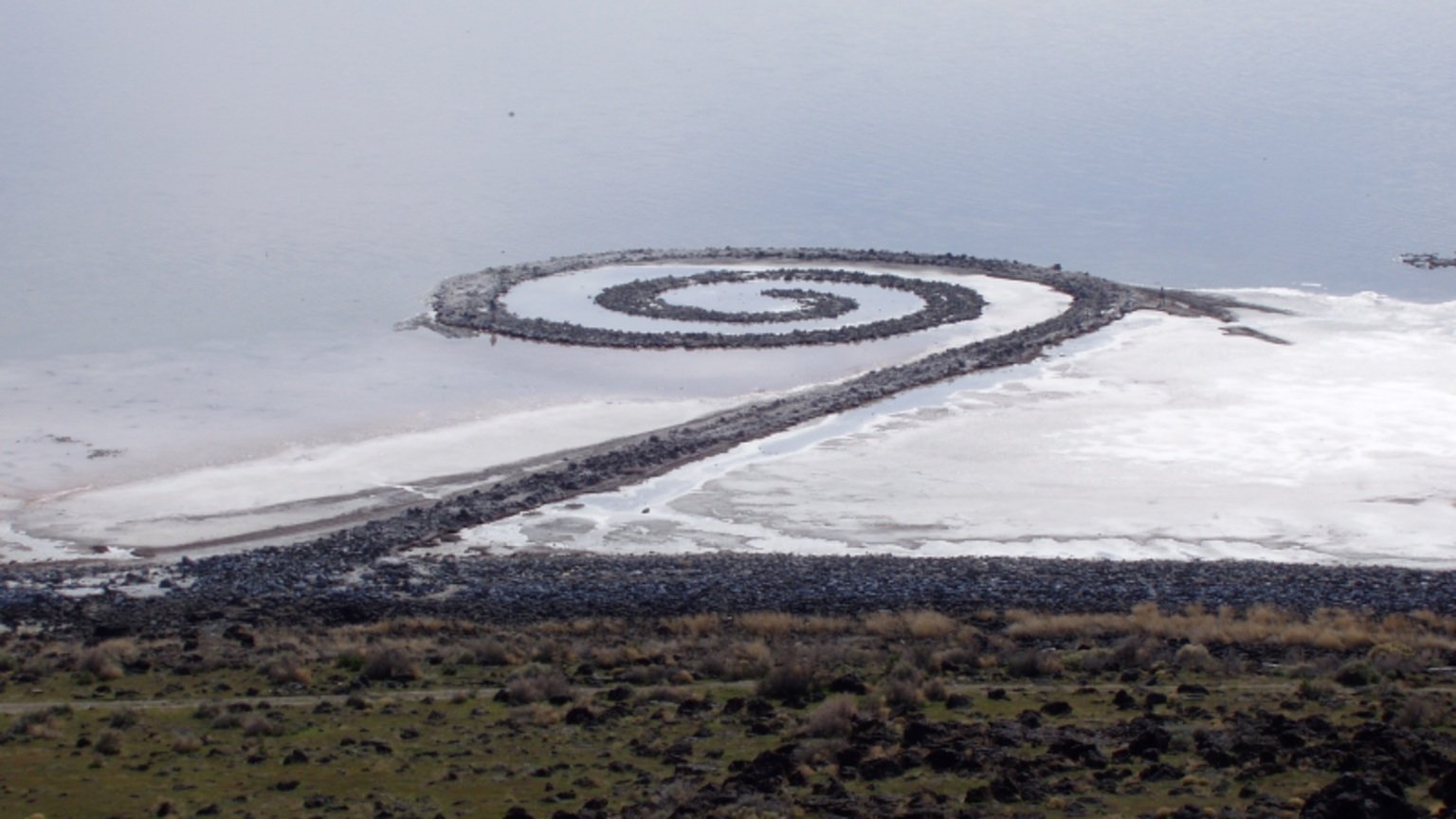
Robert Smithson's Spiral Jetty near Rozel Point in Utah
James Crump’s Troublemakers looks back on the Land Art movement, an American phenomenon of the 1960s and 1970s when a number of artists first took the line that creating art for exhibition in galleries was too confining in more ways than one. In an age when space exploration was in the news, they felt the need for art that was born of wide open spaces and it was the American southwest that provided them with the landscape ideally suited to their ambitions.
In telling this story, the film pays special attention to seven artists: Robert Smithson, Nancy Holt, Walter De Maria, Charles Ross, Willoughby Sharp, Dennis Oppenheimer and Michael Heizer. The latter is still working (as is Ross) and, although he does not contribute directly, it is he who is put forward as the most undervalued of these artists. Smithson’s contribution was cut short when he was killed in a plane crash in 1973 and Sharp died in 2008, while De Maria, Holt and Oppenheim all died in recent times. The elderly gallery owner Virginia Dwan, born in 1931, contributes substantially here as does the art historian and curator Germano Celant born nine years later.
In the circumstances getting all of these people to comment on film was valuable and, indeed, of historical worth. But in most cases the artists themselves are reluctant to explain their work and the blend of old and new footage, direct testimony and voice overs, makes for a somewhat confusing mix. Those already familiar with these artists and their work may be more appreciative than a viewer like myself with next to no knowledge about them. The extent to which they interacted as a group remains rather vague and, while the use of the ’Scope format (relatively rare in documentaries) provides some great landscape shots, I found it difficult to know how much of the ‘work’ we see is down to nature and how much to interventions by the particular artist (we gather that Heizer and Ross continue to work on pieces started in the 1970s, but what that means is never explained). We do learn that in using existing landscapes as their canvas they are hoping to create something that will endure. Consequently that makes this art very different from the ephemeral sculptures created by Andy Goldsworthy out of elements found in nature. Even so, I was reminded of how Rivers and Tides (2001) gave a wonderful insight into what Goldsworthy does, and that is far removed from what one is enabled to understand of Land Art through this film.
MANSEL STIMPSON
Featuring Virginia Dwan, Germano Celant, Charles Ross, Carl Andre, the voice of James Crump.
Dir James Crump, Pro James Crump, Farley Ziegler and Michael Comte, Ph Alex Themistocleous and Robert O’Hare, Ed Nick Tamburri.
Summitridge Pictures-Dogwoof.
72 mins. USA. 2015. Rel: 13 May 2016. No Cert.