
BRIGITTE BARDOT
(28 September 1934 – 28 December 2025)
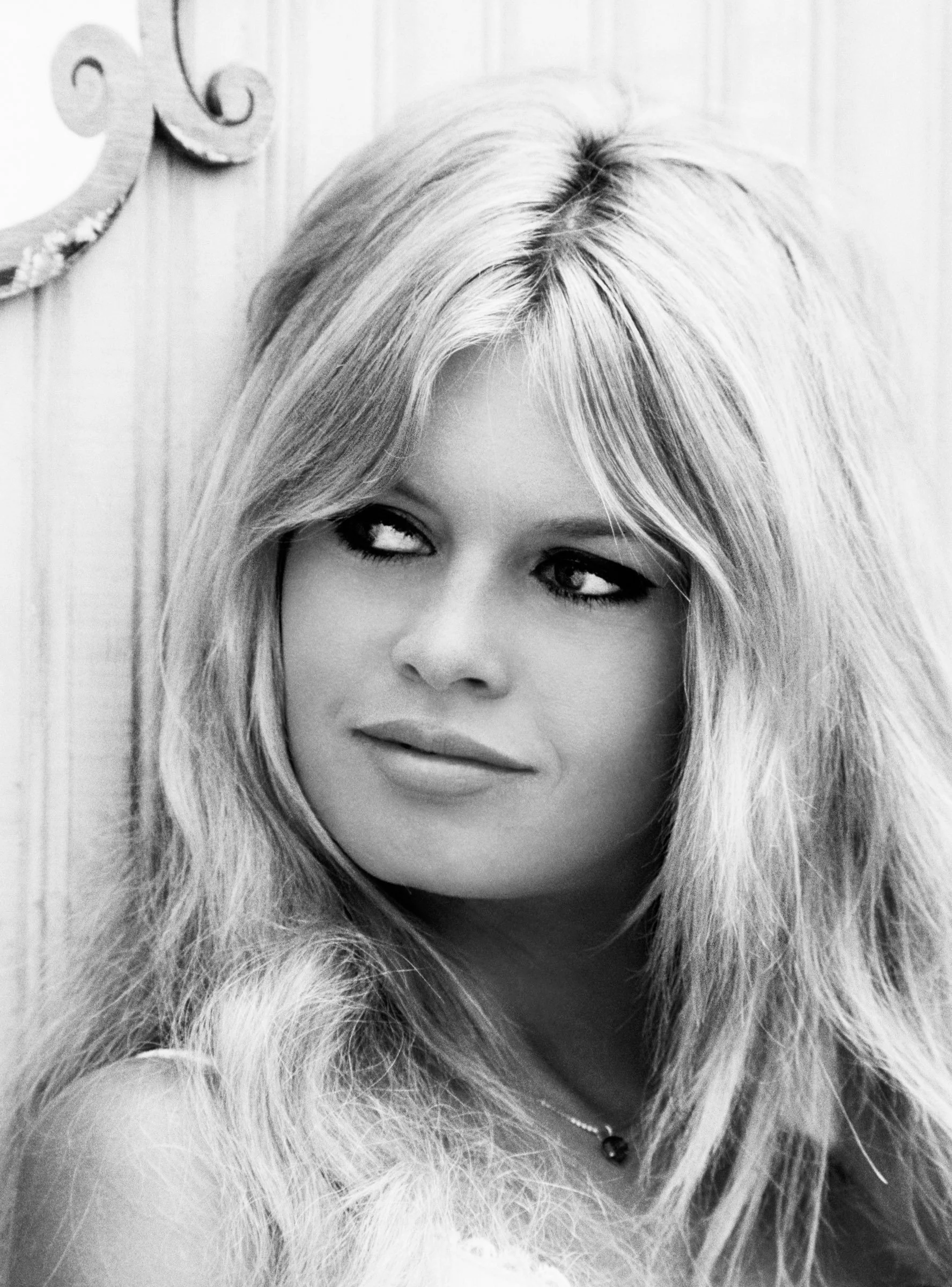
For a time in the late 1950s and early ‘60s, the French actress Brigitte Bardot (aka ‘B.B’) was possibly the most celebrated film star of her age. Perhaps not originally lauded for her acting prowess, she was an international personality on account of her stunning good looks and sexual magnetism.
Brigitte Anne-Marie Bardot was born in Paris to Louis Bardot, a factory owner, and his wife Anne-Marie Mucel. Hers was a rich family but Brigitte’s life was a sheltered one as her father was a strict disciplinarian and her mother chose her daughter’s friends carefully, leading Brigitte to become something of a rebel. An interest in music and dancing led to ballet classes, but she abandoned these for modelling work and at the age of fifteen her photograph appeared in Elle and offers of film work came along. At an audition for a film part in 1950, she met Roger Vadim which was to seal her future as a film star. They married two years later. Her first screen appearance was a small role in Le Trou normand (1952), a comedy starring Bourvil, followed by more French films and her first taste of Hollywood a year later in Anatole Litvak’s Act of Love, with Kirk Douglas.
Next, Bardot went to Italy to co-star in the historical melodrama Concert of Intrigue and then to Pinewood Studios for Doctor at Sea (1955), in which she starred opposite Dirk Bogarde as Simon Sparrow, neophyte to the medical profession. Both actors seemed to be all at sea, as comedy was not Bogarde’s strength as an actor, although the film was immensely popular. Bardot then had a role in René Clair’s Les Grandes Manoeuvres, a romantic drama with Michèlle Morgan and Gérard Philippe. She was in Robert Wise’s Helen of Troy, an international historical epic with Rosannà Podesta and Stanley Baker in which she played Helen’s handmaiden, Andraste. Most of these early appearances were minor roles until Naughty Girl (1956), a musical co-written by Roger Vadim and starring Alain Delon. Then came another Vadim script and his debut as a director, And God Created Women. With Jean-Louis Trintignant and Curt Jurgens, it was the film for which the world remembers Bardot in her feisty youthful days. It was a global success and the actress was given the name of ‘sex kitten’.
Bardot’s career blossomed and she carried on making film after film although not all of them received worldwide distribution. Always emphasising her gender, there were titles such as The Female, Babette Goes to War and Come Dance With Me, although her biggest hit The Truth (Henri-Georges Clouzot, 1960) saw the actress in her own love affair and an attempt at real-life suicide. It received an Oscar nomination for best foreign language film. Bardot continued to work with Vadim as well as Louis Malle and even Jean-Luc Godard for whom she did Le Mépris (Contempt) with Jack Palance and Michel Piccoli, and later on Masculin Feminin. She co-starred with Anthony Perkins in Une ravissante idiote and then made her first real Hollywood film, Dear Brigitte, in 1965, a comedy with James Stewart. A better bet was Louis Malle’s Viva Maria!, a comedy Western with fellow French actress Jeanne Moreau. She was in the portmanteau Spirits of the Dead, three tales by Edgar Allan Poe, directed by Vadim, Malle and Fellini. With Sean Connery she was in Shalako, an Anglo-American Western, but not a successful one.
Bardot also took up singing with Serge Gainsbourg, Bob Zagury and Sasha Distel. She disliked her duet with Gainsbourg on ‘Je t’aime... moi non plus’, so he withdrew it and later recorded it with Jane Birkin when it became one big hit. From the 1970s her acting career slowed down, working with Lino Ventura, Claudia Cardinale and, for the last time, Roger Vadim on the erotic drama Don Juan, or If Don Juan Were a Woman. Perhaps tiring of films and men, Bardot turned her interest to other species when she joined the animal rights movement and set up the Brigitte Bardot Foundation for the welfare and protection of animals, raising millions of francs by selling off her jewellery. She became a vegetarian and fought against the consumption of horse meat, a move that brought her death threats. She tried protecting bears, tigers and rhinos from torture, abhorred the killing of dolphins and fought against bullfighting and endangered species of cats and stray dogs. The film industry’s loss was very much animal rights’ gain.
Brigitte Bardot married four times – Roger Vadim from 1952 to 1956. She lived with Jean-Louis Trintignant before and after her divorce from Vadim. In 1959 she married the actor Jacques Charrier with whom she had her only child, a son, Nicolas-Jacques Charrier, but they were never close until the latter became a grandfather. In 1966 she married the German millionaire Gunter Sachs, but they separated in 1968 and divorced in 1969. Her fourth husband was Bernard d’Ormale, a political advisor, whom she married in 1992 and they were together until her death. Bardot’s other relationships included the singer Sacha Distel, singer-songwriter Serge Gainsbourg, the actors Glenn Ford, Warren Beatty and Patrick Giles, the bartender and ski instructor Christian Kalt, nightclub owner Luigi Rizzi, and the writer John Gilmore. Apparently, she turned down Sean Connery as she was not, she claimed, a James Bond girl. Brigitte Bardot was a strong, passionate woman who, when a relationship began to cool, would call it a day. She always looked for passion which is why she was often unfaithful. But along the way she became a fine actress.
MICHAEL DARVELL