
ADA: My Mother the Architect

The daughter of the architect Ada Karmi-Melamede puts her mother screen centre in an interesting but misjudged documentary.
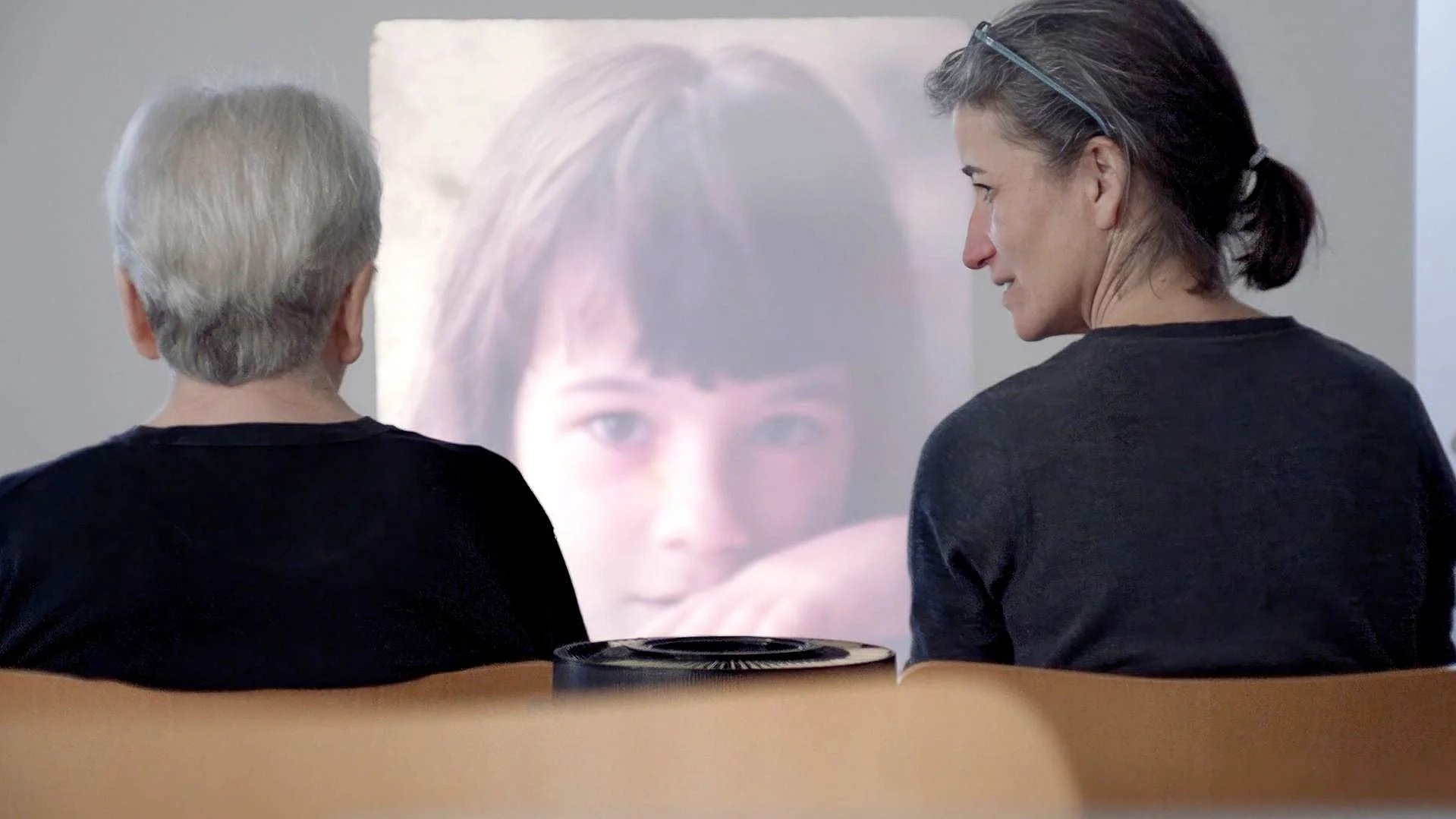
Image courtesy of Verve Pictures.
by MANSEL STIMPSON
Before viewing this documentary featuring the celebrated architect Ada Karmi-Melamede, I viewed the trailer and it gave me high expectations. Admittedly I am somebody who knows very little about architecture but that had in no way limited my appreciation of Sydney Pollock's film Sketches of Frank Gehry (2006) nor of My Architect the portrait of the late Louis I. Kahn by his son Nathaniel made in 2003. The personal element present in both those films added to their appeal (Pollock was a friend of Gehry). This new film echoes the set-up in My Architect in that Yael Melamede, Ada's daughter, is the filmmaker here, but with the vital difference that her mother is still alive and very much present in person in this film. This piece is Yael Melamede's third feature as director, but she is more widely known for her work on the production side and, indeed, she was a co-producer on My Architect. Consequently, that film may well have been in her mind when she started out to film Ada as well as providing encouragement to proceed.
The good intentions here are, of course, obvious and to have this record on film of Ada Karmi-Melamede talking about her life and work has real value - and all the more so because she was in her late eighties during the three years or more over which this project grew. Ada is one of Israel's most distinguished architects and comes from a family which had that in their blood. Her father, Dov Karmi, had found fame bringing modern architecture to Tel Aviv in the 1930s and her brother Ram, who died in 2013, followed in his footsteps and became known for his use of the Brutalist style. Indeed, Yael herself was initially drawn to architecture before turning instead to film. The main focus here is on Ada talking direct to Yael and responding to her questions. Linked in with this are contributory comments from others including a number of architects among them Moshe Safdie, Doug Suisman, Dan Price and briefly Frank Gehry himself. Another family member who appears – and she too is an architect! – is Rivka Karmi, Ram’s widow.
As for Ada's own life, it took an unconventional form which could not have been anticipated. She was born in Tel Aviv in 1936 but in 1961 she married Amos Melamede and to further his career they moved to New York City where Ada taught in Columbia University for some fourteen years. Given that the couple had three children – the filmmaker, her sister Michal and her brother Gur – it might have been expected that Ada would live out her life in America, but two things combined to reverse that. First, Columbia unexpectedly failed to give Ada security of tenure and secondly the opportunity arose for her to return to Israel and to be involved in the design of the Supreme Court building in Jerusalem, this being the one project on which she worked alongside her brother Ram. To do that work she had to relocate there and in the event this became not a temporary measure but the start of forty years or so creating architectural designs in that country. The work opportunities were there rather than in America and, having earlier felt disadvantaged as a female working in a largely male field, she decided that she had to commit herself to this even though Amos and the children would remain in America.
But, while this makes for a striking story, the film is first and foremost centred on her architectural achievements and on her own particular approach to the design of buildings. To cover this ground the film is divided into five chapters. The headings are ‘Roots’, ‘Routes’, ‘Heart’, ‘Light’ and ‘Time’ and, while each of them is considered in connection with her work, the ideas they bring up often connect with her life too. The vast range of her work is indicated including as it does museums, apartment buildings, an airport and a concert hall, but two examples stand out. One of these is the Visitor Centre at Ramat HaNiv Nature Park where her concern to fit in with the setting plays a prominent part and the other is that key item, the Supreme Court building. Here we hear from other contributors including the court’s former president Aharon Barak.
Ada’s comments on her work extend to referencing the architecture of past ages when in the section ‘Light’ she picks the Pantheon as the most outstanding of buildings, but the final section ‘Time’ leads to her thoughts on the present day. Earlier the architecture critic Paul Goldberger has stressed the democratic outlook that existed when the Supreme Court building opened in 1992 and Ada when comparing Israel today with the country that had drawn her back sees a place that is sadly now very different. She still goes to her office daily but this is not a place where she would wish her children to live. When commenting on her personal life, Ada Karmi-Melamede makes it clear that there are limits to what she wishes to discuss. But she readily speaks about her art and about all that informs it, so there is much here that is decidedly of interest and which readily fills out a film lasting 81 minutes.
That being so, the question that arises is what has gone wrong. It starts with the fact that the filmmaker has not adequately allowed for the fact that her mother speaks quickly. Some of the ideas that she expresses come over clearly and are markedly individual. One example relates to the Supreme Court building for which she rejects what can be considered the standard approach of favouring a big, imposing entranceway because she wants those who come inside to feel that this palace of justice is their court, their place to seek help. Another such belief is found in the notion that routes within big buildings should be concerned not with providing the shortest distance to reach one's destination but with offering the individual passing along them an experience pleasing in itself. But, in contrast to these particular ideas and concepts, many others call out for further time in which we can take them in fully. If the words had been written in a book, the reader would pause to consider them, but Yael Melamede allows us no time to consider and reflect allowing her mother to race on with other thoughts.
Partly linked to this but even more crucial is the mode of shooting chosen by the director: by no means infrequently she opts for split-screen images. I see little point in presenting two contrasting images of Ada as she speaks, one a sideways view and the other facing the camera. But it is not only that: Melamede goes further and offers a three-way split. Although some of the words are spoken in English, a far greater number are in Hebrew and require subtitles which would normally be at the bottom of the screen, a position which enables viewers to simultaneously be aware of the words and of the picture above them. Here the subtitles appear midway up the screen in the otherwise blank third of the screen thus appearing on the far left and to the side of the two images. Reading these words allows one no time to properly take in the accompanying pictures and choosing to film in this mode strikes me as being the most ridiculous decision by a filmmaker that I have ever come across. It is infuriating to a degree that cannot be overstated.
Featuring Ada Karmi-Melamede, Yael Melamede, Rivka Karmi, Doug Suisman, Kenneth Frampton, Moshe Safdie, Dan Price, Sharon Harari, Arthur Fried, Frank Gehry, Eran Neuman, Paul Goldberger, Chen Kaneri, Meir Dresner, Aharon Barak, Shaike Bareket, Jacob Rothschild.
Dir Yael Melamede, Pro Yael Melamede and Hilla Medalia, Ph Daniel Kedem and Guy Raz, Ed Sharon Yash, Music Haim Frank Ilfman, Design and Animation Noam Amir and Molly Schwartz.
Yes Doc/Salty Features/Medalia Productions-Verve Pictures.
81 mins. USA/Israel. 2024. US Rel: 9 May 2025. UK Rel: 1 May 2026. No Cert.
