
All That’s Left of You

Cherien Dabis’ third feature examines the suffering of one Palestinian family.
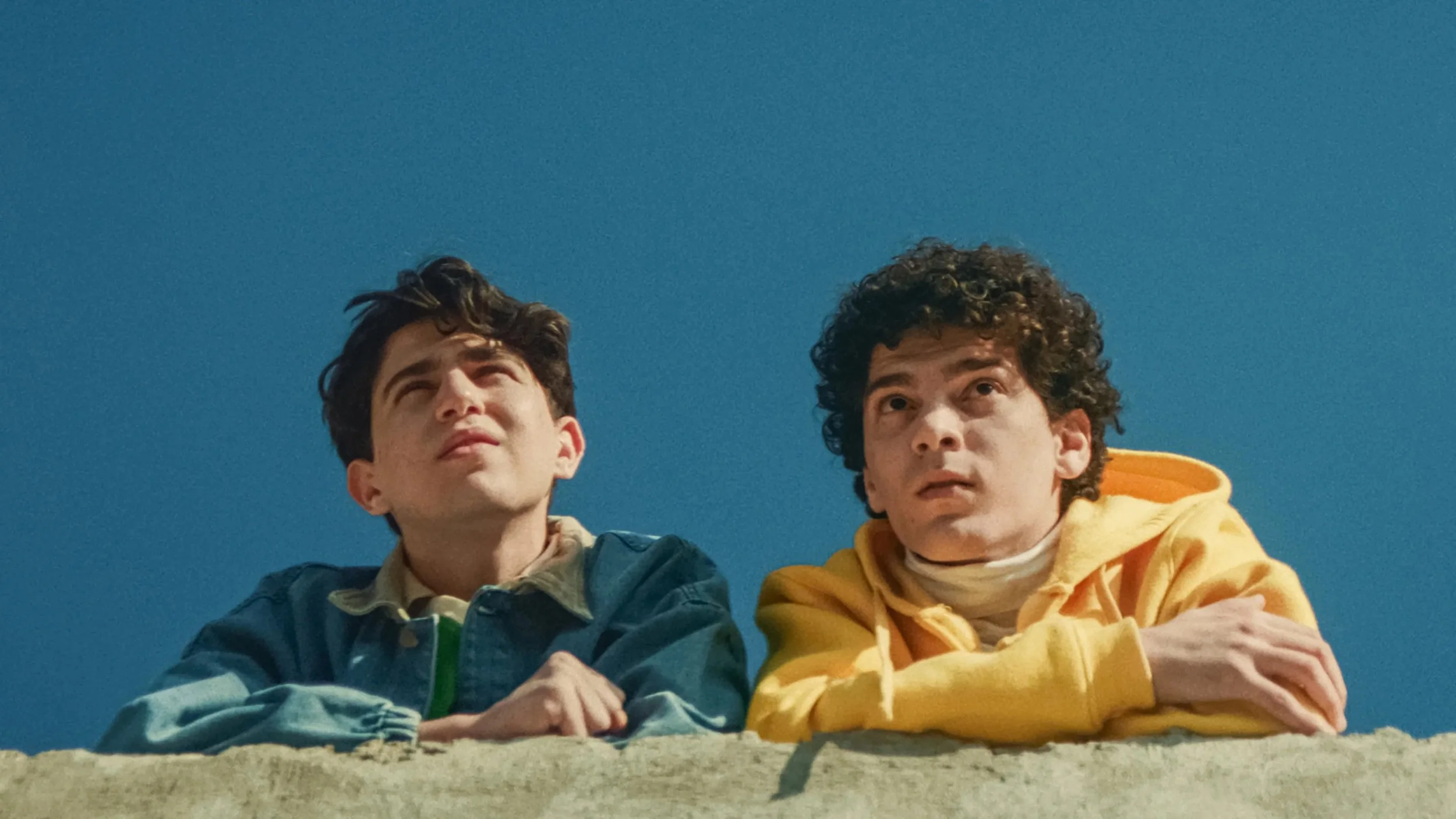
Image courtesy of Tape Collective.
by MANSEL STIMPSON
One of the most memorable films of 2025 was Palestine 36 made by Annemarie Jacir and now we have another work directly related to the sufferings of the Palestinians. Cherien Dabis is Palestinian American and like Jacir is the writer as well as the director of her film. However, in contrast to Jacir she has chosen to focus not on one particular year but to tell instead a family tale which covers three generations and which extends from 1948 to 2022. The one figure present throughout is Salim since he is seen first as a child in Jaffa in 1948 and the film concludes when in old age he returns to that city on a visit accompanied by his wife Hanan. It is through her that the story is told and she is the other central character. Dabis is here directing her third feature but she is also an established actress and it is she who plays Hanan. The role of Salim as an adult is played by Saleh Bakri who also appeared in Palestine 36 and, indeed, All That's Left of You is notable for bringing together on screen no less than three members of the Bakri family: Saleh's brother Adam appears in the 1948 scenes as Salim's father, Sharif, and their father, Mohammad, who sadly died in December 2025, plays Sharif in the scenes set in 1978.
By opting to portray a family saga, Dabis is adopting a format associated with popular appeal and that characterises the film even though it derives in part from her own family’s history. At the outset there are two short sequences that draw us in: one shows Salim’s son Noor as a youngster playing around in the West Bank with his friend Malek and the other, set ten years later in 1988, finds Noor caught up in street violence. At this point, we cut to a shot of Hanan in close-up. She is talking to somebody whose identity will only be made clear late on when it proves to be highly significant. Nevertheless, it actually looks as though she is talking direct to us and indeed one can take it that way since she declares that to talk about her son, Noor, and to make one understand his story she must first describe what happened to his grandfather, Sharif. This comment becomes the lead in to a chronological narration that divides the film into four sections set in 1948, 1978, 1988 and 2022 respectively.
At the outset the film is declared to be based on historical facts. Consequently, one finds that the way in which the family's departure from Jaffa in 1948 arises is linked to them being driven out when their land and its orange groves are seized. This occurs when the city falls to Zionist forces and illustrates the impact of the ethnic cleansing known as the Nakba. Similarly, the later scenes when the family have long been settled in the West Bank show how they are affected by the severe responses of the Israeli military at the time of the First Intifada as Palestinians rose up in protest against Israeli rule. But, while these actual events crucially shape the narrative, the personal dramas and tensions experienced by the three generations of this fictional family play out very much in line with those elements – death and marriages included – which feature regularly in such sagas.
Most of the characters portrayed in Palestine 36 were similarly fictional but, by concentrating on a short specific period of time and by making the people illustrative of different viewpoints and backgrounds rather than letting them become figures whose individuals stories were being told, Jacir minimised the fiction and underlined the actuality. In contrast to that, All That's Left of You for all its references to historical events comes across as a genre piece and nowhere more so than in the lengthy section dealing with an unexpected tragedy that strikes the family in 1988. The cause of this does indeed lie in the real-life situation but what then unfolds save for its ultimate resolution is in essence a personal drama of the kind which in a more generalised context could be described as a weepie. It is also the case that the earlier 1978 section turns on a sudden strain put on the relationship between Salim and his son Noor who at that stage is still a boy. That is caused by an incident in which the child sees his father humiliated by Israelis during a chance encounter. It's by no means an impossible incident, yet in this context it does carry the air of something that has been contrived to make the family tale yet more dramatic rather than feeling an all too likely occurrence.
There is, of course, no doubt about the deep sincerity of Cherien Dabis in making this film and audiences who in any case enjoy this kind of saga when it is presented without a significant real-life backcloth will probably be ready to embrace All That's Left of You. Despite utilising a popular genre to put its tale across, the fact that its portrayal of the suffering imposed on Palestinians is moving and heartfelt might be felt to render irrelevant any criticism of scenes which can suggest the stuff of fiction. But, with Palestine's history having reached its most devastating period in the fate of Gaza, the need to be wholly persuasive in depth when treating past history of this kind could be considered a necessity. Furthermore, at 146 minutes All That's Left of You does seem overlong in its second half. The last scenes of all feel unnecessary since a dramatic climax has been reached just before that. When it is revealed to whom Hanan has been talking the film leads directly into what could and should have provided an effective conclusion in itself. Doubtless it is my admiration for Palestine 36 and its ability to let historical events take the weight which make me more aware of what I regard as the weaker elements in this film. In any case it would be wrong not to stress the respect that Cherien Dabis and her very able cast deserve for undertaking this large-scale work which clearly comes from the heart.
Original title: Ally Bali mink.
Cast: Saleh Bakri, Cherien Dabis, Adam Bakri, Maria Zreik, Mohammad Bakri, Mohamed Abel Elrahman, Sanad Alkabarete, Dominik Maringer, Rida Sulkeiman, Yousef Zaalok, Nabil Alraee, Marwin Hamdan.
Dir Cherien Dabis, Pro Thanassis Karathanos, Cherien Dabis, Martin Hampel and Karim Amer, Screenplay Cherien Dabis, Ph Christopher Aoun, Pro Des Bashar Hassuneh, Ed Tim Baz, Music Amine Bouhafa, Costumes Chris Issa and Zeina Soufan.
AMP Filmworks/Pallas Film/Twenty Twenty Vision Filmproduktion/Displaced Pictures/ZDF-Tape Collective.
146 mins. Germany/Cyprus/Occupied Palestinian Territory/Jordan/Greece/Qatar/Saudi Arabia/USA/Egypt. 2025. UK Rel: 6 February 2026. Cert. 12A.
