
Animalia

Sofia Alaoui’s Moroccan sci-fi drama reveals considerable merit but is unclear as to its intent.
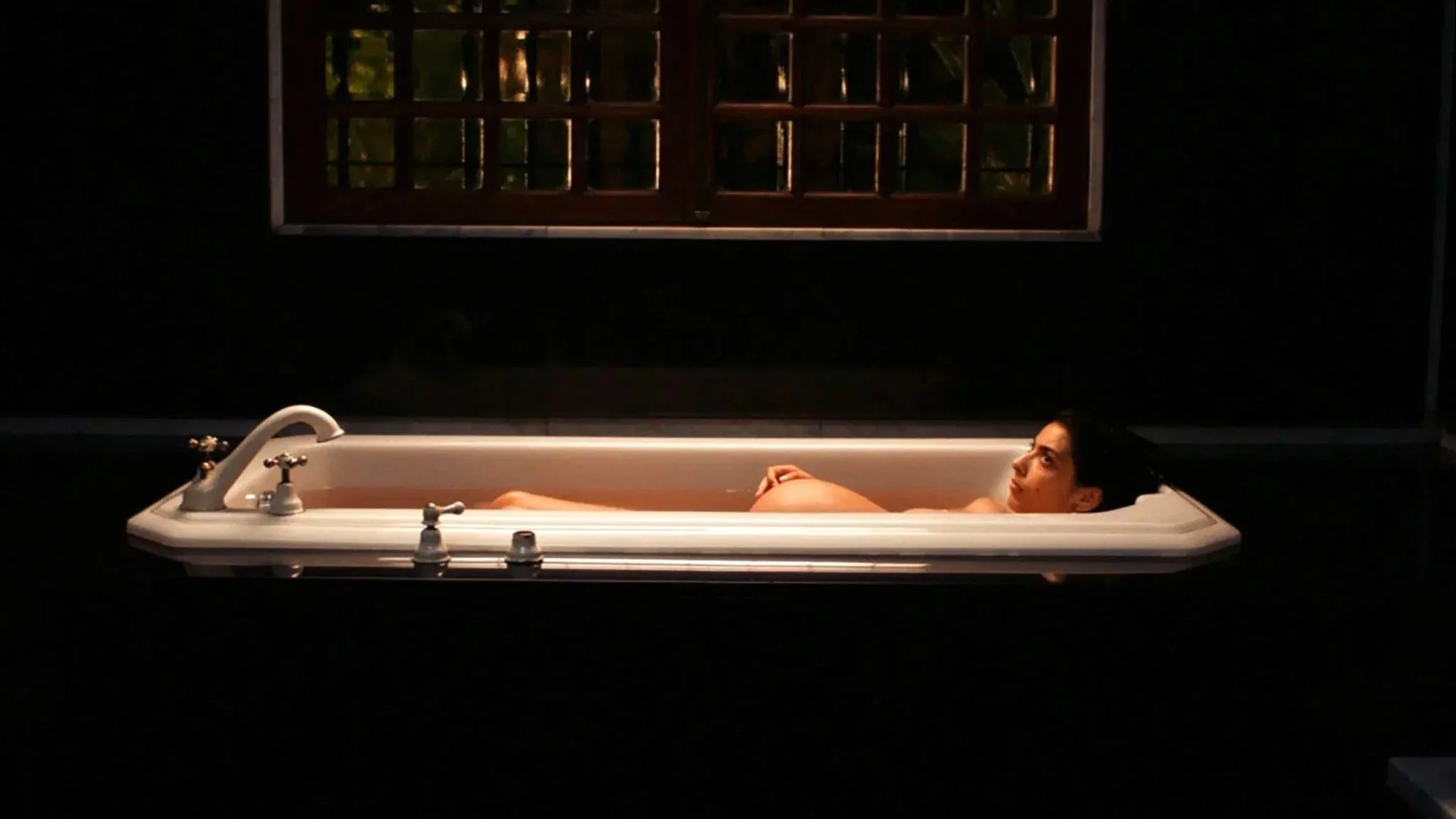
Image courtesy of Tape Collective.
Animalia is the debut feature by the Moroccan filmmaker Sofia Alaoui and my response to it could hardly be more mixed. But let me first deal with the good news: the initial impression is of a work fluidly directed and with other notable assets as well. We do not see many films shot in Morocco and Animalia boasts first-class wide screen colour photography by Noé Bach. The story that is told is one firmly centred on a woman named Itto and this role is taken by Oumaima Barid who gives a splendidly confident performance. These virtues mean that Animalia is initially very impressive, but as it proceeded I found myself increasingly dissatisfied with the tale it was telling.
I understand that Animalia has certain similarities with a short film made by Alaoui in 2020. Entitled So What if the Goats Die? it was a work with a supernatural element and, since the narrative in her feature film invokes the idea of some kind of alien invasion by extraterrestrials, there is clearly a link. That’s so although the character of Animalia is such that its main concerns seem to lie outside its plot line as such. It is, of course, not unknown for a sci-fi film or one that can be described as a futuristic piece to use that genre to comment on our world as we know it and for at least half of its length Animalia works very well on those lines.
We meet the key figure, Itto, straight away and it is quickly established that she has married into a rich Moroccan family despite being of Berber stock and with parents (now deceased) who were decidedly poor. It is not really surprising that Itto's mother-in-law, Hajar (Souad Khouyi), should regard her as not being the person that her son, Amine (Mehdi Dehbi), should have married. It may be that marrying upward had been a quest on Itto’s part but the couple appear genuinely fond of one another and Itto is in an advanced state of pregnancy. That fact becomes an excuse for her not to go to a reception in the city of Khourigba which the rest of the family are attending and, while they had expected to be back without delay, a roadblock prevents their return. As quickly becomes apparent, some kind of crisis has taken hold and the military are involved. By the next day things appear to be getting worse and Amine arranges for a neighbour to bring Itto to Khourigba where he and the other family members are staying put. However, the neighbour puts his own interests first and drives in a different direction. Itto is astute enough to realise what is happening and to offer him a bribe to take her to the correct destination but the neighbour takes the money and abandons her. It is only when she encounters a villager, Fouad (Fouad Oughaou), a Berber like herself, that she finds somebody prepared to take her to Khourigba. Their journey together takes up the central section of the film and what happens when Itto is reunited with Amine and his family provides the final segment.
Whether it be the wealthy desert home of the family or the landscapes through which Itto passes, Animalia is visually arresting and the story being told is one that draws attention to the contrast in the lives of those whom we see. Most obviously it is the difference between the haves and the have-nots but, since both Itto and Fouad are Berbers, this could also be considered a comment on the ethnic divide. There is also a pointed comparison between views on religion. Itto’s beliefs are in line with the crowds who in this crisis go to pray in their local mosques but others seriously question whether God can really exist given the state of society. Fouad and a teenager (Mohamed Lahbib) picked up en route share this latter view.
Until Khourigba is reached Animalia works well as a film that raises these issues without it being too important to clarify what the alien invasion represents. The fact that something disturbing is going on is conveyed not by introducing any overt alien creatures but by playing up the fact that dogs, birds and other animals are behaving strangely. The music score, never overused, plays up the unease and, despite the absence of anything here that is directly horrific, viewers may be reminded of such classic films as The Birds and Invasion of the Body Snatchers.
The more that people are affected by what is happening yet declare that everything is going to be alright, the more subtly telling the film is. But at about the halfway point Alaoui suddenly inserts stylised and distorted shots and repeats this again late on. These images are presumably meant to represent the aliens affecting the mindset of the humans but lack any clear meaning. Ultimately the film turns to words to express what this alien presence means. We are told that forces are taking control and that what's above is like what's here. If indeed change has come about, it replaces a world that was selfish, one that always found someone to blame. Seemingly we are all part of the one and indeed “God is Nothing as he is Everything”! In addition, we learn that "If you know yourself you know the truth of everything" and that "All was there but we didn't want to see it and couldn't". Animalia may even be echoing E.M. Forster’s Howard’s End ("Only connect") but I found that Alaoui’s screenplay failed to deliver a comprehensible message. There is quality work here and using the narrative to comment on class and religion means that the first half functions well but, once the relevance of what the aliens stand for becomes paramount, the film’s failure to make it clear is a fatal weakness. Those who can decipher it may of course dismiss my reservations as displaying my own shortcomings rather than those of the film. It should indeed be noted that the film has won awards. One was at the 2023 Sundance Film Festival where the film won Sofia Alaoui a prize for its ‘Creative Vision’ and at Palm Springs in 2024 she received Special Jury Mention in a section for ‘New Voices, New Visions’.
Original title: Parmi nous.
MANSEL STIMPSON
Cast: Oumaima Barid, Mehdi Dehbi, Fouad Oughaou, Souad Khouyi, Mohamed Lahbib, Rajaa Essaidi, Mohamed Az-El-Arab Kaghat, Mohamed Oughaou, Hsain Bellahcen, Said Lazraq.
Dir Sofia Alaoui, Pro Margaux Lorier, Toufik Ayadi and Christophe Barral, Screenplay Sofia Alaoui, Ph Noé Bach, Art Dir Hafid Amly, Ed Héloïse Pelliquet, Music Amine Bouhafa, Costumes Lydie Collin.
Wrong Films/Srab Films/Dounia Productions/Jiango Films/Arte France Cinéma/Canal+/Ciné+-Tape Collective.
91 mins. France/Morocco/Qatar. 2022. UK Rel: 12 December 2025. Cert. 12A.
