
Ivy Meeropol’s vivid, memorable documentary on the woman who brought two civil law suits against Donald Trump should encourage other rape victims to speak out.
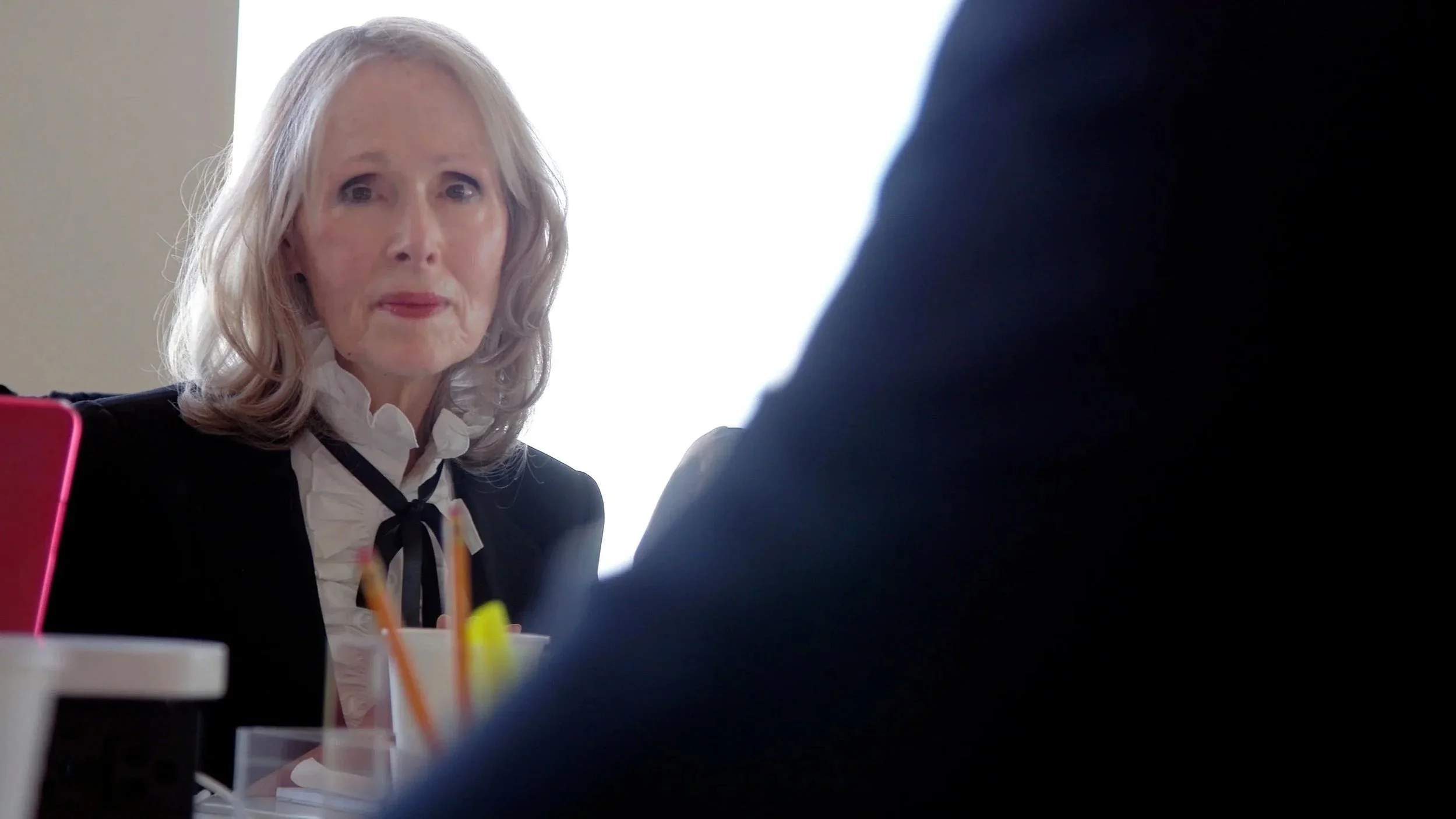
Image courtesy of Dogwoof Releasing.
by MANSEL STIMPSON
The title of Ivy Meeropol’s latest documentary will inevitably strike a chord with American viewers. That is because it duplicates the name which was used for a much-loved advice column in the magazine Elle for twenty-seven years from 1993 to 2019. So successful was it that it sprouted a TV version in 1996 for which the name was kept and until recently it was for her role as an agony aunt that E. Jean Carroll was best known although she wrote books and articles too. Today, of course, she is most famous as being the woman who took on Donald Trump in two law suits and won and it is indeed that aspect of her life that provides the most powerful scenes in this documentary.
Understandably Ask E. Jean begins with footage about Trump but it soon goes back twenty-five years and shows us extracts from that TV show. For those like myself who never saw it this illustrates the kind of celebrity that E. Jean became in the course of her professional career. Her feisty tone is very American and two aspects were central to her style as an agony aunt: one was a determination to encourage women to stand up for themselves and the other was to adopt a tone which, far from being downbeat, allowed her to be lively and humorous Indeed she has some characteristics that are closely akin to those of the late Joan Rivers. But, if this key phase of her career is emphasised, it is also the case that Ask E. Jean emerges as what could be described as a mini-biopic. As in a standard work of that kind, her earlier days are recalled including her time at Indiana University and her emergence as Miss Cheerleader USA in 1964. On turning to writing, she spent years failing to sell her stories but then made a success in the sphere of magazines with Outside publishing an interview article on Fran Lebowitz in 1983 and Esquire featuring profiles by her. E. Jean’s liberal outlook would lead to her becoming the first female contributing editor at Playboy and when she came across Hunter S. Thompson he influenced her writing with his gonzo journalism. In point of fact, she wrote a book about Thompson in 1993 but the film does not mention that and, while she refers to two unsatisfactory marriages which led in each case to a divorce, we get relatively few details.
What we do learn of E. Jean Carroll is interesting but quite rightly the film declines to become a more fully filled out biopic for the simple reason that the most important element here is the portrait that we are given of her fight in court against Donald Trump. This is covered partly through footage taken at the time but also by way of fresh material in which E. Jean now in her eighties (she was born in 1943) is seen talking to her close friend Lisa Birnbach as they both look back. This approach extends to similar discussions with her lawyer Roberta Kaplan and with another friend, Carol Martin, who had been a TV news anchor. As is now very well-known, the lawsuits brought by E. Jean Carroll arose due to an incident back in 1996 when she encountered Donald Trump in the New York Department store Bergdorf Goodman and, having been asked to accompany him as he shopped, suddenly found herself being abused by him in a dressing room. The first suit was a belated response to the rape that had ensued and the charge was for sexual assault and defamation. The winning verdict came in 2023. The second trial was for defamatory comments and this quickly followed due to Trump continuing to deny the charges that the court had found to be proved in the first suit.
It is, of course, somewhat ironic that, despite E. Jean’s out-and-out endorsement of the #MeToo movement and her belief that women do indeed need to speak out, she herself chose to take no action in 1996 and only told her intimate friends what had happened. Looking back now she is quite frank about her volte face and knows that in 1996 she held back for two reasons: first the fact that being believed over an accusation against somebody as famous as Donald Trump would be a challenge and secondly that it was all too obvious that bringing such a charge could result in an end to her career. Indeed, when she started to speak out in 2019 (a stance which occurred because the Weinstein scandal had brought home to her the importance of taking action), it was followed by Elle ending her contract albeit asserting that her comments about Trump had nothing to do with it.
In the event and entirely appropriately the main impact of Ask E. Jean comes from its intimate presentation of what she went through by going to law. This footage is memorable on two levels simultaneously. In so far as it is personal, it enables the viewer to get a clear impression of E. Jean Carroll herself. The film is patently on her side as is underlined by the written statement at the close that it was inspired by her writing and fabulous life. What really counts, however, is that Carroll herself comes across to us as an honest person whose very presence is such that it further validates the sense that the court hearings both led to the right verdict. When she claims that she acted for all women, you believe her. But it is sad to hear her admit that quite unreasonably – but like many other women in her situation – she is unable to eliminate her own sense of guilt: guilt that is for not having seen the warning signs that should have been obvious in the build-up to her being raped.
The second level on which the film works lies in the fact that this specific case illustrates just how much of a burden it is for rape victims to go to court given that the defence will seek to question them ruthlessly. Not only will the details of what happened become something that they have to live through again, but any possible impropriety in their past will be raised as a means of discrediting their testimony. Ask E. Jean includes detailed examples of such questioning that she had to face, first in 2022 and then in 2023. These scenes bring home with extraordinary vividness what a harrowing and humiliating experience this is while yet making it clear just how important it is for victims to summon up the courage to become accusers. It is here in particular that Ask E. Jean while depicting her own courage justifies her declaration that she did what she did on behalf of all women.
Featuring E. Jean Carroll, Lisa Birnbach, Roberta Kaplan, Carol Morton, Joshua Matz, Lisa Corvelli, Marilyn Minter.
Dir Ivy Meeropol,Pro Ivy Meeropol, Laura Bickford and Annabel Dunne, Screenplay Ivy Meeropol, Leah Goudsmit and Ferne Pearlstein, Ph Martina Radwan, Ed Ferne Pearlstein and Leah Goudsmit, Music Laura Karpman, Amelia Allen and Elena Pinderhughes.
Flora Films and Impact Partners/Red 50-Dogwoof Releasing.
91 mins. USA. 2025. US Rel: 22 May 2026. UK Rel: 24 July 2026. No Cert.