
Becoming Victoria Wood

Catherine Abbott’s documentary tribute to the much-loved Victoria Wood shows clearly what made her unique.
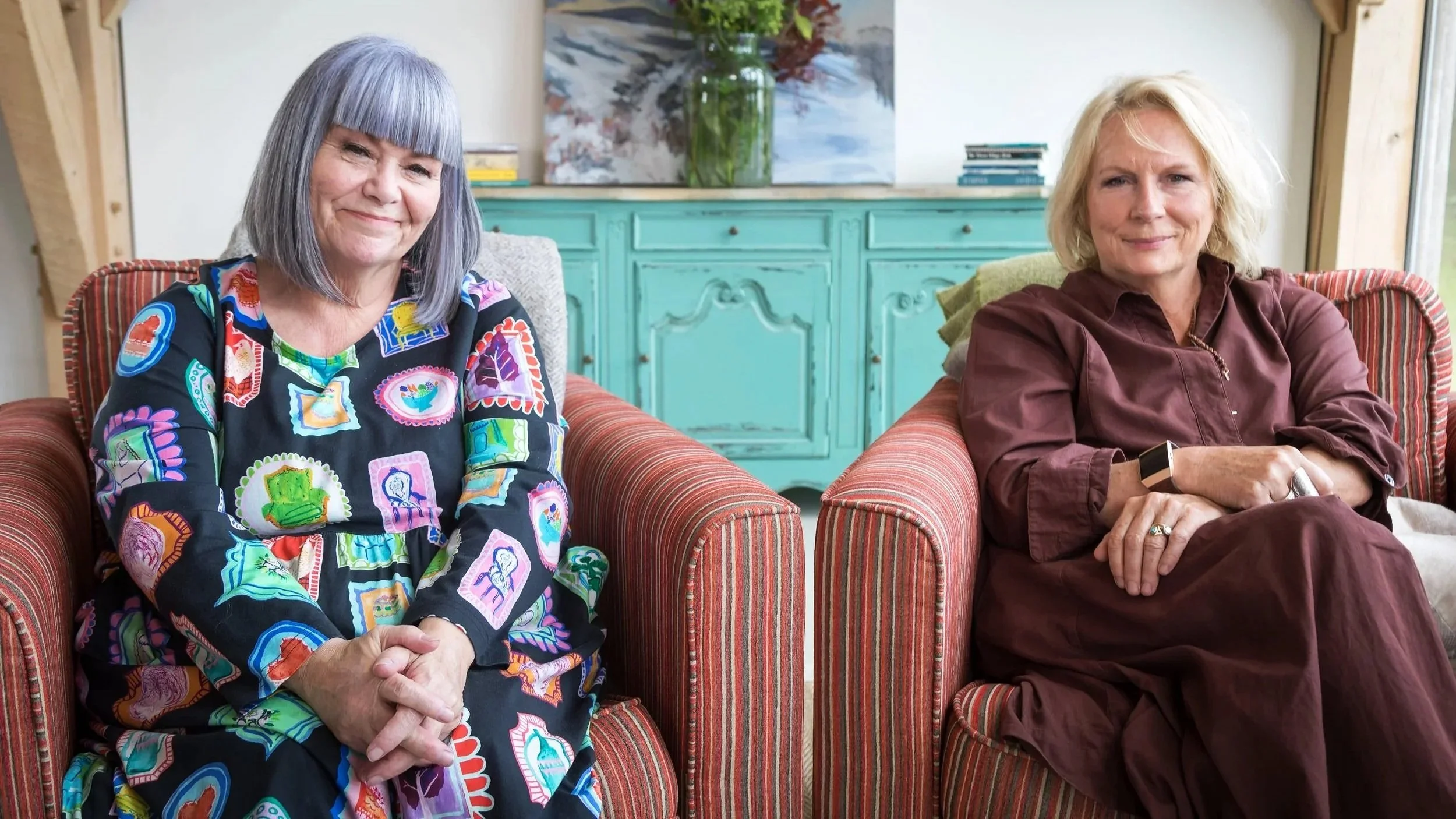
Old friends Dawn French and Jennifer Saunders
Image courtesy of Dartmouth Films.
by MANSEL STIMPSON
This film about Victoria Wood, who had become one of Britain's national treasures before dying at the early age of sixty-two in 2016, is ably made and uses a standard but popular format frequently adopted in documentary biopics. It tells her life story in chronological order and makes good use of archive material while adding fresh footage featuring friends and colleagues. Nevertheless, it is fair to say that Catherine Abbott, who is both director and photographer, has brought us a film which is at heart unlike others of its kind for the simple reason that Victoria Wood was a comic performer whose art mirrored her life to a degree that made her unique. The film’s own novelty is to include footage in which Jessica Barden, listed in the credits as a reader, stands in from time to time for the young Victoria Wood but whether or not including such semi-re-enactments is a good idea may be a matter of individual taste.
Even if the material that made up Wood’s art and which was expressed through her skills as a comedian, pianist, writer and composer of songs had been less individual, her success would have been a significant one. Although she was not the very first of her kind – she speaks of how when young she was inspired by the example of Joyce Grenfell who had her own one woman's stage show – Wood started her career at a time when almost all comic performers were men. Yet even in her school days she was playing the piano and dreaming of becoming an actress despite regarding herself as not being good-looking. Already a pointer to eventually finding material in the world around her, it was at an early age that she wrote a song which referenced one of her friends at Birmingham University and for a while it looked as though she might quickly succeed against the odds. However, although she appeared on the talent show New Faces she did not win and appearances on Esther Rantzen's TV show That's Life failed to lead to bigger things. A period of despondency followed although she did win an Evening Standard award in 1979 for her play Talent and she was developing her own style.
That style found humour and more too in drawing on female experience including her own. Songs that she performed around this time were not afraid to tackle her own situation. One was all about her wanting to be a comedienne and another was upfront about the fact that she was plump and considered not the best shape to become a popular entertainer (Abbott’s film scores here by linking a performance of this song with decidedly cruel press quotes about her body size). Despite earlier rewarding work in various venues with Jasper Carrott and Geoffrey Durham, whom she would marry in 1980, it was a one woman show, Funny Turns, staged at London’s Duchess theatre in 1982 followed by the huge success on BBC television of Victoria Wood As Seen on TV that brought her to a new level of fame. It gave her the confidence to do her own thing, frequently in company with Julie Walters and such artists as Celia Imre and Maxine Peake. From Acorn Antiques to Dinner Ladies this film reminds us of what they achieved.
Extracts from Wood’s TV work are incorporated throughout Catherine Abbott's film, but rather than being inserted interludes they show very clearly how Victoria Wood was expressing more and more of herself in what she gave us. Both her work on stage and what she wrote to act out on television reflected her ability to use women's experiences to comic ends but also to handle more serious material without losing her very individual signature. One song about a widow’s difficulty in adjusting to her husband's death retains that familiar tone yet also proves genuinely poignant. Although drawing on real-life and its clumsiness, her humour was never cruel and two of the friends interviewed for this film, Joan Armatrading and Maxine Peake, both stress the fact that what Victoria Wood gave in performance was always relatable, a fact which they see as crucial to her appeal.
Becoming Victoria Wood includes details about her parents when dealing with her childhood but otherwise very much concentrates on her career including footage of Wood herself in television chat shows. We do learn that she was the youngest of four children but none of her siblings appear and, although her marriage would eventually end in divorce, that is sidestepped and we are merely told that she died with her family at her side (we do briefly hear from her former husband in comments made earlier but he is not interviewed for the film). These are not omissions that matter however. Victoria Wood brings her own honesty to the piece in the archive footage in which she talks openly about her struggles and drawbacks and that honesty is carried over into what she does when performing. With most comedians one senses that their act involves the creation of a stage persona and there is nothing wrong with that. But with Victoria Wood her own life and outlook fed into her act and, while she was clearly a gifted artist, it is that direct expression which lies at the centre of her appeal. It is what leads one to think of her as a unique figure albeit one who has influenced so many women who have chosen to follow in her footsteps.
Featuring Dawn French, Jennifer Saunders, Maxine Peake, Michael Ball, Joan Armatrading, Jasper Carrott, Geoff Posner, Jane Wymark, Alison Lloyd, Bill Lloyd, Robert Howie, John Dowie, Anne Sweeney, Lesley Schatzberger, Sahlan Diver, Philip Jackson, Jessica Barden.
Dir Catherine Abbott, Pro Heather McCorriston, Ph Catherine Abbott, Ed Jane Tubb, Music Francis Macdonald, Costumes Sidonie Roberts.
Rogan Scotland/Phil McIntyre TV/Dartmouth Films-Dartmouth Films.
90 mins. UK. 2025. UK Rel: 9 January 2026. Cert. 15.
