Belén

Argentina’s official Oscar submission is a true-life courtroom thriller but told less compellingly than one might have hoped for.
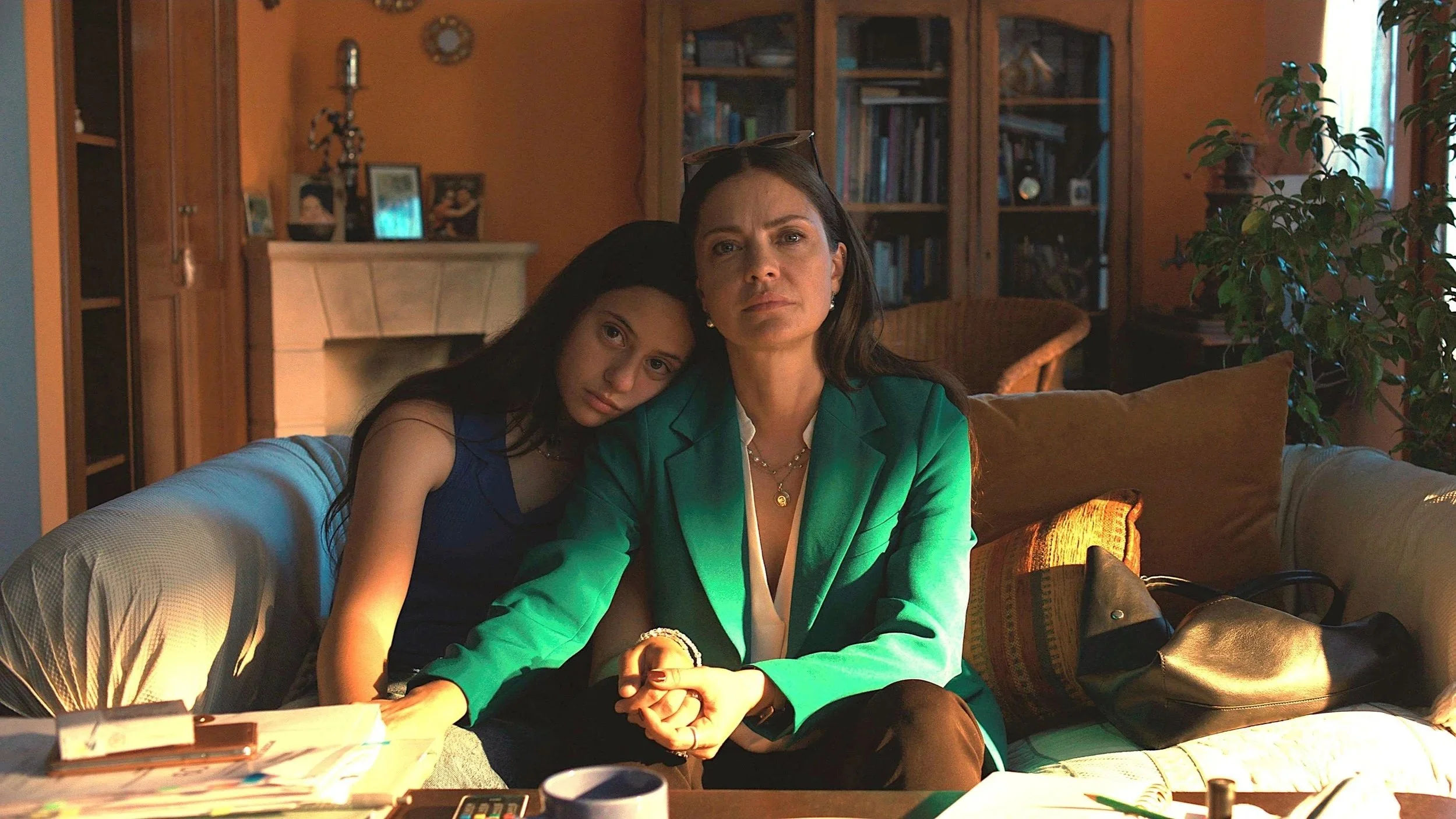
Image courtesy of Modern Films.
For us, Belén is not a title that speaks for itself, but in Argentina it does. There the name of Belén is immediately recognised as the one adopted for anonymity by the person involved in what became known as a major example of gross injustice. In 2014 a woman whose actual first name was Julieta and who was then 24-years old went into hospital with abdominal pains but was then charged with inducing an abortion in a toilet there. This led to her being detained in prison for two years, this apparently being the length of time that somebody could be held in this way pending a proper trial. It was not until March 2017 that Belén gained a full acquittal in the Supreme Court of Tucumán and this might well not have been achieved but for the devoted interest in her case taken by a lawyer named Soledad Deza who was fervent in her concern over women's rights. She believed that Belén had been falsely accused and with support which she obtained from Amnesty International she would turn Belén’s case into a rallying cry for feminists in Argentina. It would play a significant role in bringing about the decriminalisation of abortion in that country in 2020.
In 2019 Ana Correa took up the story in her book Somos Belén and, inspired by that, the actress Dolores Fonzi now brings us the tale on film. She is both director and star and with assistance from two others she also wrote the screenplay with another actress colleague Laura Paredes (she too has a role in the film). The part played by Fonzi is that of Soledad Deza and the titular figure is played by Camila Pláate. In effect this dramatisation gives equal weight to the unjust suffering of Belén herself and to the determined fight on her behalf by Soledad Deza: this seems a fair balance in the storytelling and indeed these two aspects are so closely connected that it feels entirely natural to move the focus back-and-forth in this way. Similarly, although based on this true personal story, Belén can also be seen as a positive illustration of what female activism generally can achieve and no less validly it can be described as a portrayal relevant to Argentinian social history with regard to women's rights.
It is worth noting that the film is meeting with success. First it carried off two awards at the 2025 San Sebastián Film Festival, one for Camila Pláate’s performance and the other a special mention for Dolores Fonzi. Furthermore, it has now been submitted as Argentina's nomination for an Oscar. Even so, my own feeling is that it is the power of the material and the sympathy that it creates which makes the film worthwhile since I have doubts about the way in which the story is told. My immediate reaction on viewing Belén was that, while there was no question at all about the deep sincerity inherent in its making, I would not have been at all surprised to learn that this was the first time that Fonzi had been involved in the writing and direction of a feature film. But, on checking up afterwards, I learnt that this was a second attempt, the first being Blondi (2023) which was also written with Paredes but which was not released in the UK.
The main reason why I had this reaction on viewing Fonzi’s film was that I felt that she lacked the gift needed to tell a story in a way which flows clearly and carries the audience with it. Instead of smooth storytelling there are scenes, sometimes brief and set in different locations, which impair the requisite sense of strong, dramatic progression and leave one with the sense of a work that often feels rough and ready. Nor is it well judged when it comes to the vast numbers of subsidiary figures introduced but not always adequately identified. Some of them, of course, are quite clear. They include the family of Soledad Deza – her husband (Sergio Prina), her children Flora (Gaia Garibaldi) and Manuél (Patricio Pérez Piñero) and her father (Marcelo Subiotto). Then there is the judge (Luis Machín), Belén's mother, Mabel (Lili Juárez), and the lawyer from whom Soledad Deza takes over (Julieta Cardinali). But many other subsidiary characters appear too extending to the many people assisting Soledad and to other members of Belén’s family. They appear for long enough for us to want to know exactly who they are but we are often left baffled in this respect (some characters remain unnamed while other names are heard without it being apparent exactly who they are).
Another issue is the way in which certain scenes feel less than authentic. As with most films based on a true story, it is acknowledged that some dramatisation is included. One sequence suggests as much since the way in which a relevant file which the authorities don't want to hand over is obtained has a fictional air about it (as does that cliché scene in which Soledad’s work prevents her attending on time a school concert in which her daughter is participating). Questions of a different kind arise when Soledad’s actions lead to threats against her and her family. There is a scene in which her husband rejects her suggestion that for safety’s sake he should move away for a time but nothing is said about the danger to their young son despite the fact that he has already been accosted and asked to deliver what proves to be a threatening letter.
Add these elements together and one finds that a narrative that should be straightforward and compelling is coming across without the appropriate sureness of touch that would capture the full impact of the material. The players including Fonzi herself are able enough even if they fall a little short of being especially memorable. Ultimately Belén emerges as a film with a story well worth the telling and yet as a work which leaves the impression that a more experienced writer/director would have created something far more capable of lodging itself in one's memory.
MANSEL STIMPSON
Cast: Dolores Fonzi, Camila Pláate, Gaia Garibldi, Luis Machín, Laura Paredes, Julieta Cardinali, Sergio Prina, Patricio Pérez Piñero, Marcelo Subiotto, Fabio Di Tomaso, Lili Juárez, Ruth Pláate, César Troncoso.
Dir Dolores Fonzi, Pro Leticia Cristi, Hugo Sigman and Matias Mosteirín, Screenplay Laura Paredes, Dolores Fonzi, Agustina San Martin and Nicolás Britos from the book Somos Belén by Ana Correa, Ph Javier Julia, Pro Des Micaela Saiegh, Ed Andres Pepe Estrada, Music Marilina Bertoldi, Costumes Lucia Gasconi and Greta Ure.
K&S Films/Amazon MGM Studios-Modern Films.
107 mins. Argentina. 2025. UK Rel: 7 November 2025. US Rel: 14 November 2025. Cert. 15.