
Blue Film

Many will find Elliot Tuttle’s deeply serious film about sex and paedophilia disturbing, or even unacceptable, but it is a superbly acted, thought-provoking drama.
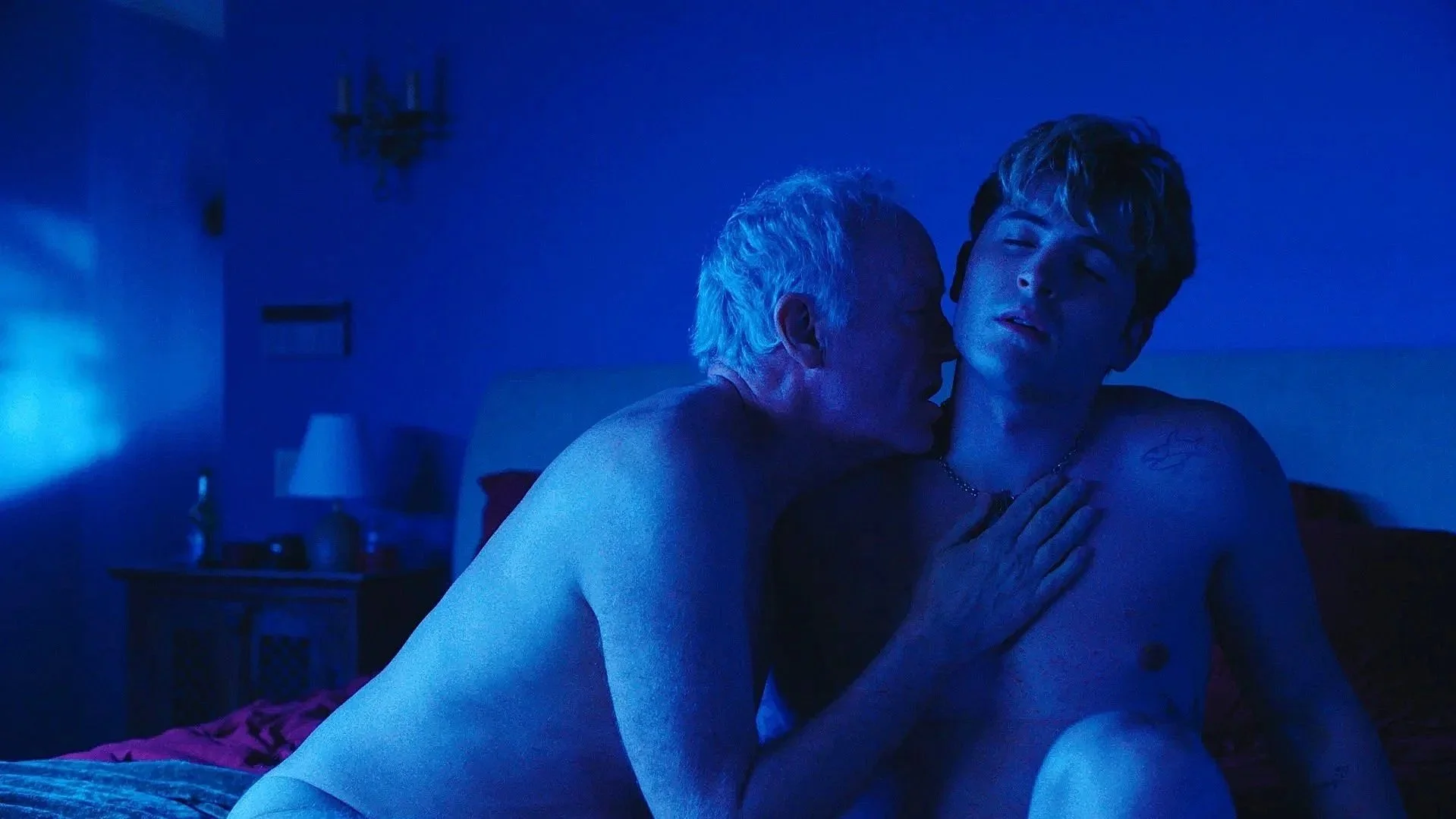
Image courtesy of Peccadillo Pictures.
by MANSEL STIMPSON
The title of this extraordinary film might suggest that it is an adult movie in the sense that it is a highly sexual work that is essentially pornographic. However, the phrase ‘adult movie’ can also be a phrase used to describe a film that will be best appreciated by serious-minded mature viewers and, perhaps unexpectedly, Blue Film, the first full-length feature directed by Elliot Tuttle, proves to be an adult movie in that second sense of the term. There will doubtless be some who would disagree with that view of it and the pre-credit sequence alone might suggest that they are right. That's because the opening segment takes the form of a video put out by a young man calling himself Aaron Eagle which is aimed at men and takes the form of a provocative invitation for viewers to invite him round for sex, something for which they will have to pay. This camboy is good-looking but, having a particular clientele in mind, he uses abusive language – he addresses his viewers as faggots – and this is to be understood as being a promise that when it comes to the sex on offer he will take a dominant role.
In terms of what we see in Blue Film this opening section is probably the most explicitly erotic in the film, but everything that follows will be disturbing viewing albeit that I would argue that it is uncomfortable in a deliberately thought-provoking way. The relevance of the video we have seen is that it sets the plot in motion. This is a tale with a cast of two, one being Aaron and the other an older man, Hank Grant, who has responded to that video and is now seen opening the door of his L.A. apartment to Aaron. The latter is not put out on finding that his host’s face is masked by the balaclava that he is wearing, but he is surprised to discover that, initially at least, Hank wants to talk to him and to take photographs of him as he responds to questions about his own life.
We are some way into the film before a revelation occurs which makes us view what we are watching in a fresh light. Such an event always gives a critic pause over the issue of what it is appropriate to reveal in a review and one decides more often than not that it is better not to describe it. In this case, however, what emerges operates less as a twist then as a lead into what the film is really about so (you are hereby warned) I will not hold back. We learn that Hank had contacted Aaron because he knew that Aaron's real name was Alex McConnell whom he had known as a pupil when he had been a middle school English teacher. Hank is not living in L.A. but has come there having hired overnight accommodation specifically to be able to contact Alex and to see him again. Whether or not now seeking sex with Alex, Hank wants to tell him that, although he had held back then, young Alex had been the love of his life and he had wanted to see him again to find out if he still felt the same way.
This means, of course, that Blue Film follows in the steps of other serious films such as L.I.E. (2001) and Mysterious Skin (2004) which had a paedophile as a central character. In all these instances the viewer is being asked to think more deeply about the situation in which a pederast finds himself. There is no denial of the harm that such people can do but nevertheless we are encouraged to go beyond simply branding them as monsters and leaving it at that. Thus, in Blue Film we are asked to regard Hank as somebody with emotions as well as desires who can truly describe Alex as the love of his life. However, at the same time, it also emerges that Hank has spent a term in prison for seeking to go further with another boy in the school. Indeed, Hank acknowledges that it was his awareness that it was wrong that had in the event caused him to let the child go. Nevertheless, the incident had been discovered leading to Hank being fired and to his receiving a prison term of seven years for attempted assault.
If considered in these terms Blue Film is very much a companion piece to those other titles I have mentioned which also sought to encourage more detailed and complex reactions regarding paedophiles and how we should view them. But Blue Film differs from those earlier works due to the fact that what is said by Hank and Alex also prompts questions around sex and sexuality more widely. The very fact that Alex has chosen to be sexually dominant brings up the issue of what view one takes of those who disturbingly seek an element of pain in sex and in particular to what extent one should decry it if both individuals involved find satisfaction that way. It may be easier to deplore paedophiles outright because of the damage that they can cause, but if they are indeed born that way they surely deserve pity for having a condition that they did not choose and one which may make them feel utterly worthless given how they are viewed by society. If such a person is religious then it becomes valid for him to ask why God allowed him to be born like that. Then again paedophiles able to limit their actions may ask where a borderline is crossed, especially when it is known that an older society, that of ancient Greece and Rome, had a very different attitude to such feelings. Furthermore, it is not uncommon for a paedophile to be somebody who was himself abused in childhood and, if that too might be a factor affecting them, can it be right to simply adopt a stance of outright condemnation by simply defining paedophiles as evil? In any case it is no wonder that Blue Film contains the observation that sex rather than empowering you can in some instances make you weak.
Tuttle’s film encourages us to speculate along these lines without ever telling us what to think. His direction is adroit enough to prevent the piece seeming uncinematic despite the limited setting and it being a work with only two actors (the only additional shots are brief intercut images of innocent childhood which again can be read in more ways than one). As for the players, they are first class. Reed Birney who impressed me in Mass (2021) plays Hank and in the showier role of Alex a relative newcomer, Kieron Moore, handles a challenging role with astonishing assurance. The film’s storyline can seem contrived and set up to incorporate all the thought-provoking issues that are triggered but with acting of this quality you readily suspend disbelief. Some might assume that the film does indeed want to shape and finalise responses but to its credit it leaves things open. That is nowhere more evident than in what emerges in what could be described as a late twist in the tale. Here and in a way which encourages you to think further we suddenly discover that one key statement that we have heard was a lie. Indeed, at times both men lie, but that only adds to our need to reach our own conclusions.
Cast: Reed Birney, Kieron Moore.
Dir Elliot Tuttle, Pro Bijan Kazerooni, Will Youmans, Adam Kersh and Waylon Sall, Screenplay Elliot Tuttle, Ph Ryan Jackson-Healy, Art Dir Marley Sall, Ed Zack Clark, Music Isaac Eiger, Costumes Anna McGrath.
Fusion Entertainment-Peccadillo Pictures.
85 mins. USA. 2025. US Rel: 8 May 2026. UK Rel: 11 September 2026. Cert. 18.
