Blue Has No Borders

Jessi Gutch takes the coastal town of Folkestone as a microcosm of a divided Britain today in her well-intentioned but incohesive documentary.
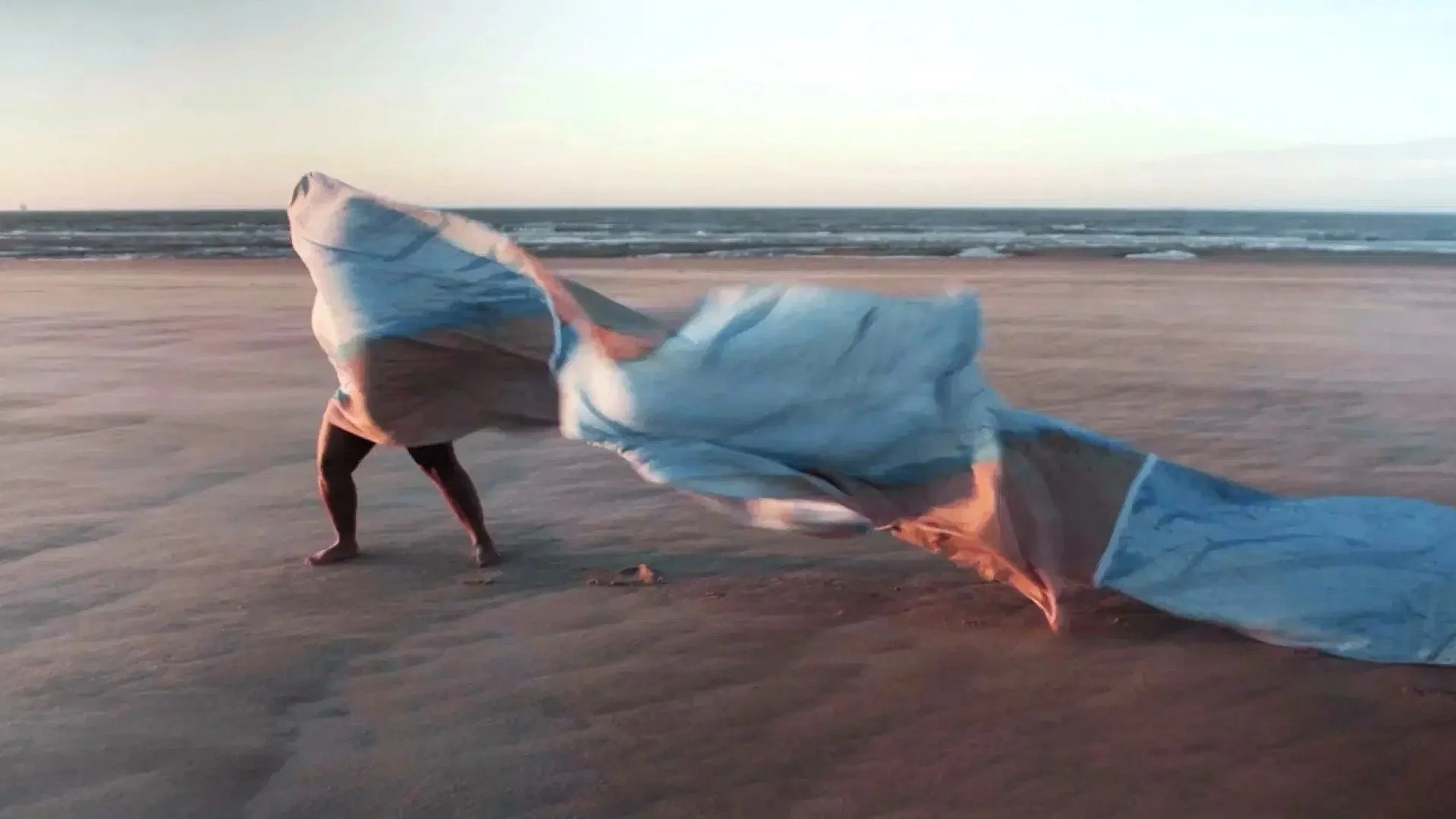
Image courtesy of I Am Charlie Ltd.
by MANSEL STIMPSON
This is the first full-length feature from Jessi Gutch who both directed and photographed it while also taking the prime credit as its writer. Blue Has No Borders is a documentary centred on the coastal town of Folkestone in Kent, south-east England. Its geographical position is such that it regularly sees the arrival of refugees seeking asylum in the UK having crossed the Channel in small boats. It follows inevitably that this issue is one which is a special concern to the town’s inhabitants and it is certainly one that recurs in this film. However, it soon emerges that Jessi Gutch, who also acts as narrator and puts in an appearance, has a wider goal. Her concern is born of the extent to which in recent times contrasted experiences, backgrounds and viewpoints seem to be driving people apart more than ever before. That is certainly happening in Britain as Brexit has demonstrated, while in America the current political climate has reached extremes. So Jessi's question is whether or not the world is losing the wider sense of community which allows those with different opinions to find enough common ground to be able to accept each other and which enables diversity to flourish.
Jessi explains how, having once settled on Folkestone as a suitable place in which to investigate this theme, she sought out a number of its inhabitants whose perspectives would provide variety and be suited to her purpose. Thus, with the immigration question in mind, she selected a Syrian named Heba now living in the town with her two younger siblings. Heba can speak of her own feelings over being cut off from her original culture and can also compare that with how, being younger, those siblings of hers have found it far more straightforward to take to English life which is all that they have really known. In contrast to that, we have Josie who speaks as somebody of mixed-race and who has grown up in England. As for Nathan, he is working class and white, a barber who may speak positively of Martin Luther King’s idea of having a dream to follow but who, in the face of ever more refugees continuing to arrive, points out that we have enough problems of our own to handle.
Away from that particular issue, Jessi Gutch acknowledges that in picking Neil she did so fully aware that he, being a council member and a former military man who had been a Brexiteer, would most likely provide a necessary contrast and have ideas which were very different from her own. We hear too from local fishermen facing the fact that with the depletion of fish their trade is becoming a thing of the past and from other voices speaking for the older members of the community as they recall times past. One further prominent figure here is the son of a fisherman, but Dan is present as a representative of the modern world, somebody who as Dita performs in drag and claims to be non-binary. In passing we learn that in a local election the labour candidate is the winner and, while no priest features prominently, we do witness a traditional religious feature of the town when the fishing boats in the harbour are blessed.
Gutch’s own opening remarks make her own stance very clear: "How many times does a lie have to be told before it becomes the truth? The England of my childhood is one that finds these refugees and welcomes them in and one that doesn't let them drown at the end of a long journey to survive. Isn't that what the greatest country in the world would do?" The dedication at the close of the film reflects this viewpoint and Blue Has No Borders is manifestly a sincere piece with which many people will be in sympathy. Gutch might well have quoted E.M. Forster (“Only connect”) but in the event the quotations we do get and which are used as headings for the five chapters into which the film is divided come from Dostoevsky, Dickens, Orwell, George Eliot and Lewis Carroll respectively. The final one, that from Carroll, is particularly apt since it refers to the fact that if we see each other we are able to believe in each other and this film leads to a concluding section in which the various contributors eat together in harmony: for all their differences they seem to have come together and it is even the case that the filmmaker despite her own initial antagonistic view of Neil now acknowledges, as he does, that they have become friends.
Despite the inclusion of Dostoevsky, these quotations being mainly from British writers may be considered part and parcel of passing reflections in the film about what it means to be British. But, for all the film’s good intentions, the various elements in it don't have enough cohesion for it to add up to a meaningful dissertation which carries real weight and impact. Like another new documentary, Breaking Social, it keeps jumping around its contributors in scenes that come across as bits and pieces rather than creating telling personal portraits which combine to shape effective social comment. For example, although the thread about Dan is sympathetic, it portrays the life of a gay man who has found his own way without encountering obvious hostility (his father, initially somewhat dismayed over his son’s sexuality is seen to have adjusted to it). Consequently, this aspect emerges as hardly relevant to the film’s study of conflicting opinions. Furthermore, that friendly get-together at the end sadly feels cosy rather than realistic and that is simply because it is all too apparent that Britain in actuality contains far too many people as staunchly one-sided and fierce in their views as, say, Tommy Robinson. Jessi Gutch’s widescreen photography is not without a poetic quality at times and her desire to challenge divides that separate people is admirable. Nevertheless, her film needed far better structuring for it to emerge as a strong, powerful and memorably insightful document. One certainly sides with its views but there is a sense of the film looking at life through somewhat rose-tinted glasses while also being a work which, despite telling moments, fails to marshall its material in a way that leaves a deep and lasting impression.
Featuring Heba Arab, Neil Jones, Nathan Scotford, Josie Carter, Dan Laws, John Gale, Alan Taylor, Freddy Mardle, Harry Mardle, Jessi Gutch.
Dir Jessi Gutch, Pro Nikki Parrott and Charlie Phillips, Screenplay Jessi Gutch with Gladys Joujou, Ph Jessi Gutch, Ed Gladys Joujou, Music Ela Orleans.
Tigerlily Two/Tigerlily Productions/Screen Scotland/I Am Charlie-I Am Charlie Ltd.
87 Mins. UK. 2025. UK Rel: 4 March 2026. Cert. 15.