
Blue Heron

Sophy Romvari's debut feature explores the trauma of her own childhood having moved from Hungary to Vancouver Island in the 1990s.
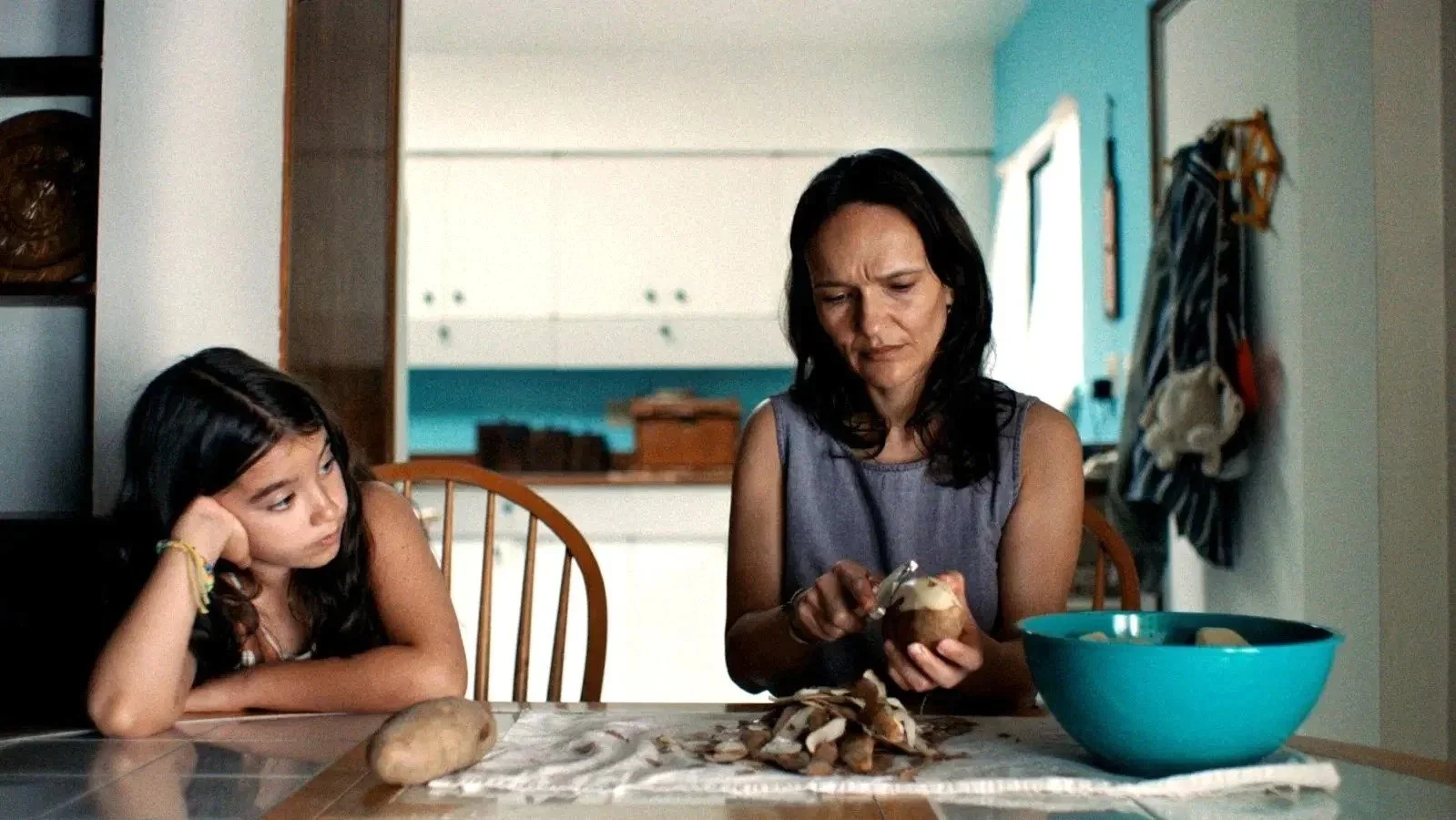
Photo courtesy of Conic.
by MANSEL STIMPSON
Sophy Romvari’s first feature has been highly acclaimed but I am perplexed as to why that should be so. Blue Heron has been described as a semi-autobiographical piece and Romvari is both the writer and the director so her deep commitment to the material is beyond doubt. Furthermore, she has assembled a cast who, although unknown to me, prove to be highly talented. One is left with the impression that had Romvari chosen to adopt a more straightforward and traditional approach her film might well have been memorable in a good way. Consequently, I am left wondering if those who admire it greatly are those who favour innovatory, offbeat films for their own sake. Whether or not that has played a part, it must be acknowledged that Blue Heron has won no less than eleven awards so my view of it probably puts me in the minority.
Romvari's film is designed as a work in two parts, a format that I find entirely acceptable. Its first half is devoted to events on Vancouver Island in the 1990s. A family of five have come from Hungary to Canada as immigrants and life in their new country is shown as representing the memories of the one daughter, Sasha (Eylul Guven) who was just eight years old when they arrived. In a style that is impressionistic and tends to be very fragmentary, we meet Sasha's parents (Ádám Tompa and Iringó Réti) and her siblings. Two of the latter – Henry (Liam Serg) and Felix (Preston Drabble) – although regularly present are in effect background figures, but the eldest son, the teenage Jeremy (Edik Beddoes) is key. Life for all of them is deeply affected by the fact that Jeremy is behaving in such a difficult way and doing so to the extent that it is indicative of something more deeply rooted and more disturbing than adolescent rebellion. It is a product of personality disorder.
The first half of Blue Heron is devoted to that setting and to that period but is nevertheless accompanied initially by a voice-over introduction. The voice in question is that of the adult Sasha who will appear in person in the film’s second half when she is played by Amy Zimmer. But to start with her function is simply to suggest that the images of the past represent her view of things as she looks back so that it is possible that some of her memories are unreliable. That is a setup which invites us to feel that we will be looking at this time in the family history through the eyes of an eight-year-old and that consequently the view given of Jeremy will be coloured by that. It is therefore in keeping that the worries of her parents who are seeking medical advice about him will often be conveyed by snatches of conversation which young Sasha overhears but is not adult enough to understand.
The problem for me in the film's first half is that what we see always suggests a stylised work created by a filmmaker instead of being convincingly viewed through a child’s eyes or as a reflection of her memories. One notices the quick cuts which can often possess a somewhat arbitrary nature and, instead of encouraging ready identification with these people, it causes this family portrait to come over in a chaotic way. The other brothers instead of emerging as individuals leave only a blurred impression. For that matter, although one scene takes the trouble to show Sasha deliberately eavesdropping on her parents, other episodes show them talking together without any indication that their daughter would be nearby. Thus, we are left with the impression that on occasion we are witnessing what Sasha never saw or heard.
If in this part of the film one positively longs for a more direct style to encourage closer identification with the characters, what follows has problems of a different kind. It is now years later and Sasha has grown up to become a filmmaker who is planning to tell the story of her family. Once again we can see the potential in following this route since the purpose of Blue Heron is not to make some definitive statement about Jeremy's condition and its causes but to record its impact on his siblings and on his parents (the latter understandably but inappropriately keep asking themselves what they did wrong). That the adult Sasha has still not fully come to terms with what she feels about Jeremy is indeed part and parcel of what Romvari is seeking to convey. We recognise that Sasha finds it difficult to balance compassion for him with her awareness of the unhappiness that he has caused.
However, the key fact about the construction of Blue Heron is that when it moves forward in time it also changes the style of the piece yet without announcing it clearly. We may initially see Sasha presented straightforwardly as an adult, but we also find that the film is incorporating further scenes from the childhood years while in addition playing tricks with time as the adult Sasha is herself seen transported back to her childhood. Thus, she suddenly takes on the role of a social worker who had been present at that time and there are also examples of the images taking on a strange stylisation of their own extending briefly even to a doubling of what we see. The film certainly recognises Jeremy’s tragedy – that he won't get any better is never hidden – but it seeks nevertheless to find a closing note that is to some extent consolatory (Jeremy is described at the close as a special soul who had a kind heart).
This should mean that Blue Heron would emerge as a touching film yet for me Romvari's direction made it impossible to believe at any stage that what I was seeing felt genuine regardless of her manifold good intentions. The child actors do quite well, but even better are the first-class performances by Tompa, Réti and Zimmer. With such fine players involved, I regretted all the more that Romvari chose to handle the material in ways which constantly came across as being so self-conscious that not even this cast could make the piece seem real and engaging. But, if that was my experience, the awards that the film has won suggest that many have found that its style and content do somehow fit together. It's not being able to feel that myself which explains why the film left me perplexed over its acclaim.
Cast: Elul Guven, Iringó Réti, Ádám Tompa, Edik Beddoes, Amy Zimmer, Liam Serg, Preston Drabble, Lucy Turnbull, Jecca Beauchamp, Georgia Blake, Matthew Rankin, Kalvin Olafson.
Dir Sophy Romvari, Pro Ryan Bobkin, Sara Wylie, Sophy Romvari and Gabit Osváth, Screenplay Sophy Romvari, Ph Maya Bankovic, Pro Des Victoria Furuya, Ed Kurt Walker, Costumes Maria Katarina.
Nine Behind/Boddah/Memory/TinyGiant/Ursa Major/Sembelle Productions-Conic.
91 mins. Canada/Hungary/USA. 2025. US Rel: 17 April 2026. UK Rel: 26 June 2026. Cert. 12A.
