
Boorman and the Devil

John Boorman’s battle to direct Exorcist II: The Heretic is revealed in telling detail in David Kittredge’s engaging, well-made documentary.
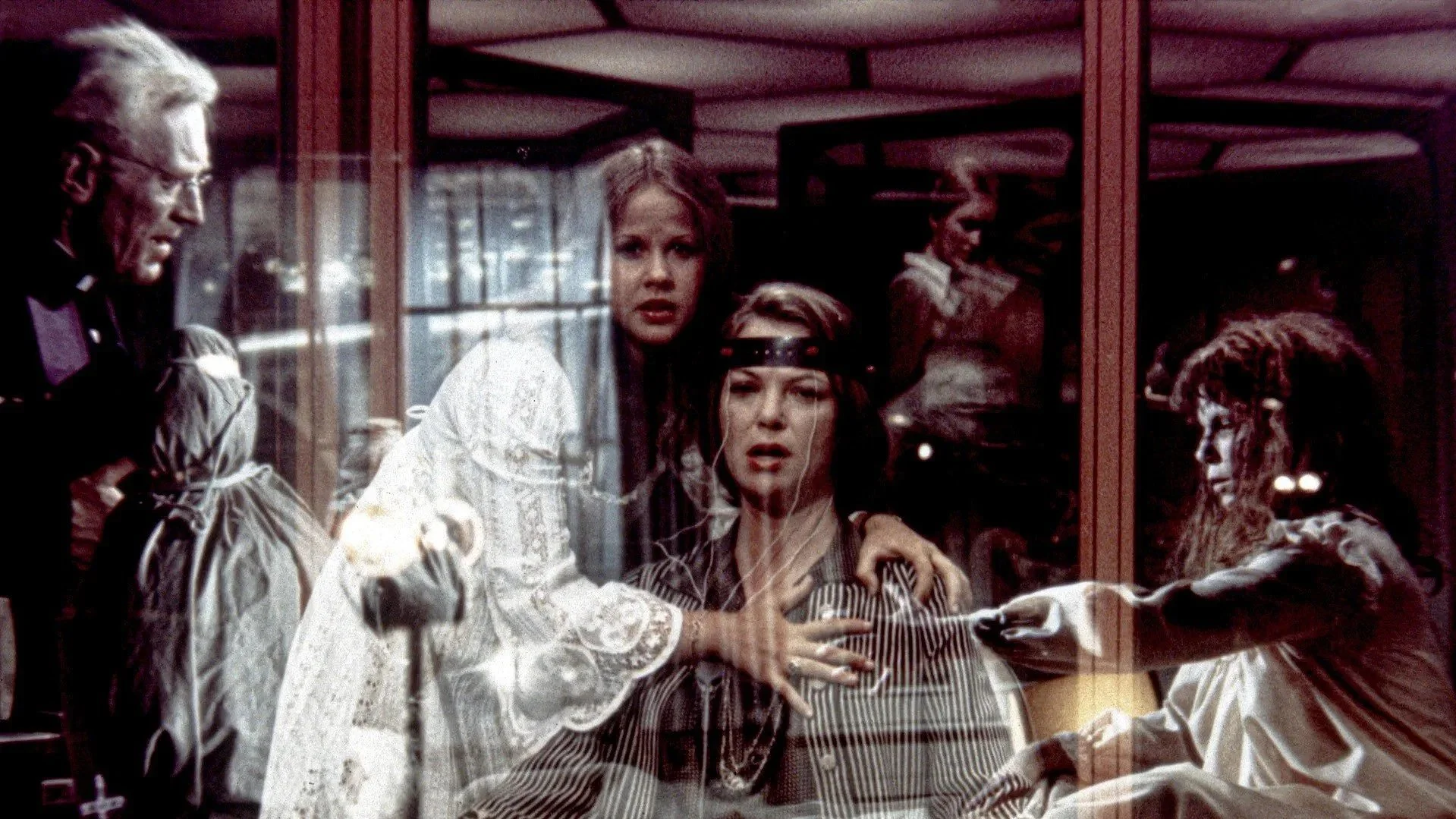
Max Von Sydow, Linda Blair and Louise Fletcher
Image courtesy of Blue Finch Film Releasing.
by MANSEL STIMPSON
This documentary is all about a film which was made in 1977. There is nothing unusual about looking back in this way in a work which examines in detail some movie from an earlier age but that usually arises when the old film in question is a classic of its kind. What is so unexpected about this piece by David Kittredge is that the film he has opted to study is one of the great flops in cinema history, Exorcist II: The Heretic. Even more surprising in view of his choice is the fact that what Kittredge gives us stands as one of the most insightful and rewarding examples of this particular genre. Although this is only his second feature and the first time that he has made a documentary, the film is for the most part an object lesson in how to present such material and Kittredge's work as his own editor is very much a part of that.
The film starts in Ireland where the director John Boorman lives on his County Wicklow estate and he was 85 years old when he commented in detail on the painful disaster of this project of his which was to have been called simply The Heretic. Contrary to his wishes Warner Brothers, who were understandably intent on marketing this film as a sequel, insisted that it be released as Exorcist II: The Heretic. Indeed, the special advance deals done with theatres for it to have a long set run were based on the stunning success of The Exorcist which, directed by William Friedkin, had turned out to be the company's highest grossing film to date. Boorman recognises that he failed to realise that, whatever the film’s actual title might be, the public would be expecting more of the same. His own aim was in fact quite different in that he did not intend the horror of demonic possession to be the core of the piece but instead saw it as "a poetic healing film bearing the hope of spiritual regeneration". He had personally found The Exorcist with its stress on Regan’s suffering an unpleasant work and in seeking to make the follow-up a tale with a metaphysical theme he regarded it less as a sequel then as a riposte.
Kittredge's film brings in a range of contributors including actors who were in the original film (Linda Blair and Louise Fletcher), the writer Rospo Pallenberg who in effect replaced William Goodhart as the main writer of the screenplay, various members of the crew, critics such as Bilge Ebiri, Stephanie Zacharek and Simon Abrams and other directors interested in the film (Joe Dante and Karyn Kusama). The opening section sets the context: it covers both Boorman's earlier career leading to his being seen as an A-lister after the success of Deliverance and the Hollywood trend from the 1960s onwards that increasingly favoured big, expensive movies. After that the main part of Boorman and the Devil follows the actual making of the film in chronological order.
That this proves to be such a rewarding watch results from the two strands present throughout the film, neither of which is dependent on viewers having any enthusiasm for Exorcist II: The Heretic or indeed any knowledge of it at all. The film begins with a quote from Hanif Kureichi: "The artist must live on the edge of failure". This belief that real art runs the risk of turning out badly is a crucial feature here in that what we see is Boorman attempting a genuine work of art but finding luck turning against him in so many ways. In this case that included the casting of Richard Burton (not the actor Boorman wanted), the death of Lee J. Cobb leading to his character from The Exorcist being removed from the new screenplay and Boorman himself being taken seriously ill during the shooting which led to a shutdown lasting for five weeks. It was even more significant that for commercial reasons the release date for the film had been set early on and had to be adhered to. Ultimately this would result in much script doctoring to get the shoot completed in time in addition to the pressure that arose from Burton having a date after which he would be unavailable due to his being committed to the film version of Equus in which he had had a stage success.
The details are specific to what happened during the filming of this particular piece but the documentary fascinates as a portrait of how making a movie is inherently subject to so much that is down to chance and as such it is an insight into filmmaking in general. Albeit that the artist at risk here was John Boorman, this piece is also a valid insight into the struggles that any artistic filmmaker can face. Even if the film is one that Boorman describes as a famous failure, he also declares that he believes that it includes some of his best work and it is apparent from what we see here that some of the photographic effects used were remarkably adventurous.
The last section of Boorman and the Devil records the disastrous previews, different versions being found for the ending as a result and cuts that were made to improve it. Up to here Kittredge paces his documentary beautifully and is adept in how much he gives us from each contributor (Louise Fletcher is one who stands out along with Melissa Skoff who was Boorman’s secretary). If the piece has had a natural flow until now the last ten minutes or so of the film are not quite so well shaped and brief references to Boorman's knighthood and to his later films do not totally earn their place since this is not a bio-pic. Consequently at 112 minutes the piece comes to feel a little overextended. One may feel that Boorman is sometimes trying to underplay his misjudgments on this project but the lasting pain of his film’s failure is apparent. This documentary may not leave one wishing to see Exorcist II: The Heretic but it is undoubtedly a revealing insight into the hazards of making movies and any film buff will find it immensely engaging.
Featuring John Boorman, Linda Blair, Louise Fletcher, Rospo Pallenberg, Mike Flanagan, Karyn Kusama, Joe Dante, Joseph McBride, Melissa Skoff, Jim Hemphill, Bilge Ebiri, Stephanie Zacharek, Simon Abrams, Victor Hsu, Jeff Kanew, Garrett Brown, Rose Portillo, Michael Blatty, Ron Vargas, Bonnie Prendergast, Doug Holmes, Chris Landers, Paul Clemens, Bennett Yellen.
Dir David Kittredge, Pro Travis Stevens, Jim Fall and David Kittredge, Screenplay David Kittredge, Ph Seamus Deasey, Alan Jacobsen, Elle Schneider and Tom Guiney, Ed David Kittredge, Music Eduardo Daniel Victoria.
Triple Fire Productions/Snowfort Pictures/Milton Ventures Media-Blue Finch Film Releasing.
112 mins. USA. 2025. UK Rel: 25 September 2026. Cert. 15.