
Bouchra

The true tale of a Moroccan mother and her daughter who has relocated to New York is an animated drama in which the characters are depicted as animals.
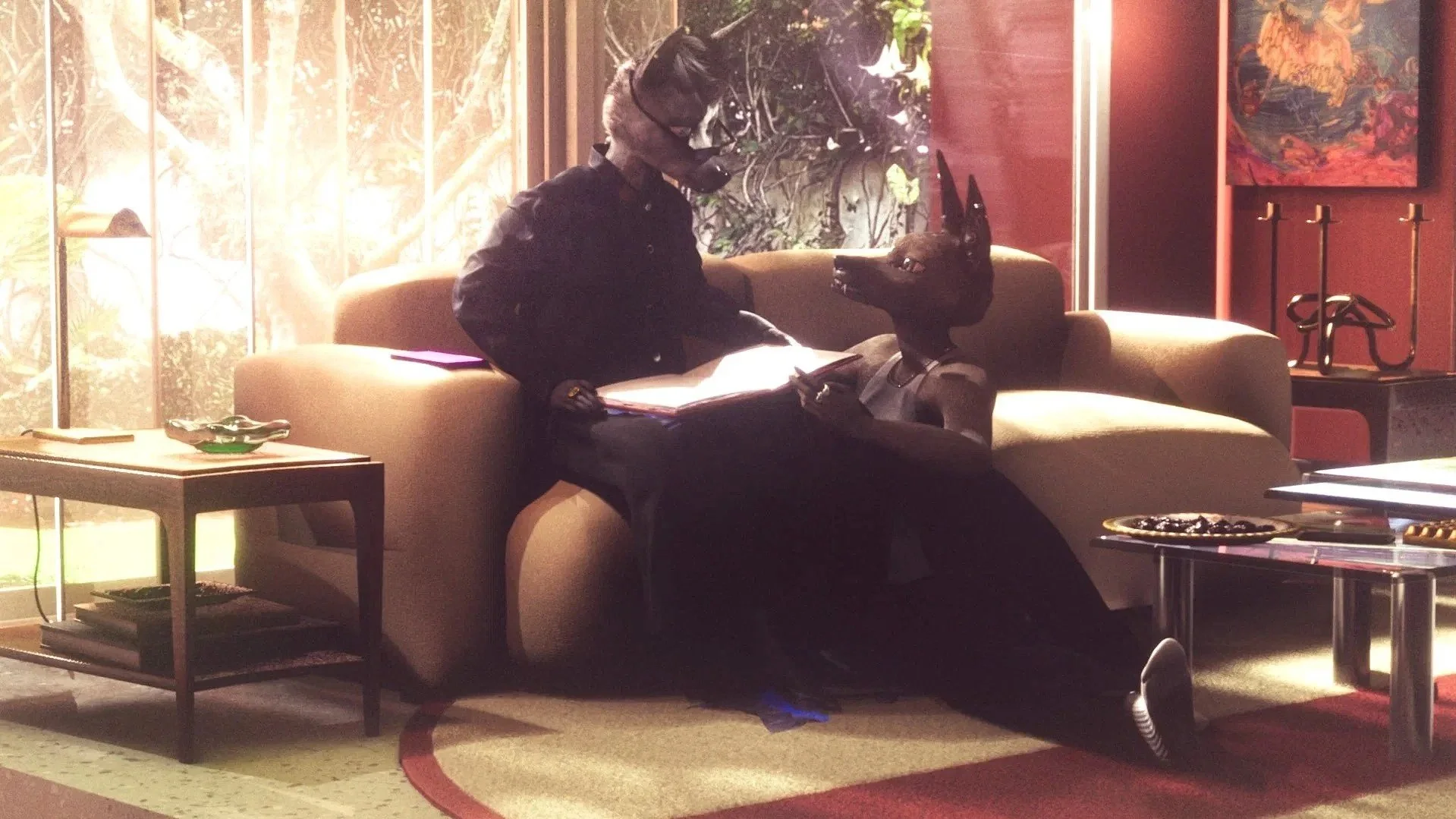
Image courtesy of Tape Collective.
by MANSEL STIMPSON
Back in 2021 the Danish filmmaker Jonas Poher Rasmussen made a surprising decision. Setting out to tell the story of an Afghan seeking refuge in the west, he opted to make it as a full-length animated feature. That work was Flee and it counted as an example of adult animation not only on account of its deeply serious central focus but because it also depicted the problems that this refugee faced due to the fact that his family were unaware that he was gay. It was one of the best pieces of animated cinema made in the present decade and, regardless of the stylisation inherent in animation, it proved conclusively that it is possible for that format to generate an emotional response from viewers that is as strong as any that can be achieved in a naturalistic treatment featuring fine actors.
I was reminded of Rasmussen's achievement when viewing this new work which is a first feature by Orian Barki and Meriem Bennani. Their work is also an animated feature of a serious nature and again sexuality is involved since Bouchra draws on the real-life experiences of Bennani herself and her situation as a lesbian born in Morocco but now living in New York City. The film’s titular figure stands in for her in that Bouchra is portrayed as a filmmaker working on a film about her relationship with her family who live in Casablanca and is particularly concerned with how things stand between Bouchra and her mother, Aicha. They talk regularly over phones but, despite that closeness, we learn that Aicha has always been very reluctant to talk in any detail about a letter which Bouchra had posted to her mother from America some nine years earlier and in which she had come out regarding her sexuality. Late on in the film, the issue does come up again in one of their talks and it provides a climactic scene since Aicha's reserve is discussed in a way that enables us to understand it from her viewpoint.
Although the mother/daughter relationship is the central thread here, the film also spends time depicting Bouchra's life in New York. Early on we meet her lover Nikki (a sequence which includes a sex scene as was also the case in the remarkable 2015 adult animation film Anomalisa made by Charlie Kaufman with Duke Johnson). Subsequently it is Nikki, now Bouchra’s ex, who offers her a job which involves working for Nabila in a film production company. There she encounters Lamia, a lawyer who acts for Nabila, and this leads to a new relationship for Bouchra. Other acquaintances who are part of this artistic scene appear and in addition there are sequences showing Bouchra with family members in Casablanca. Indeed, the film incorporates flashbacks to an earlier period when Bouchra had returned to Morocco to visit her parents.
Despite the stylisation used, this is at heart an intimate story and one wants to feel involved, not least because it patently means so much to Bennani in particular. But, whereas in the case of Flee that was fully successful regardless of it being animated, the stylisation here is far greater which makes it much harder to achieve. Rasmussen did at least portray the people in his films as human beings but Barki and Bennani choose to present their characters as creatures and furthermore as animals of various kinds. Thus Bouchra herself is a coyote while others are depicted as such varied species as frogs, cows and lizards. That risks being distancing enough in itself, but the figures that we see our mainly animalistic in terms of their facial features. Consequently, their images come quite close to giving one the impression that one is watching actors made to wear animal heads that cover their faces.
As though determined to make things even harder for the viewer to adjust, extra layers of artificiality are added to the mix. It is one thing to portray Bouchra as a filmmaker wanting to tell her own family story and asking Aisha to help by describing her experience of being a mother, but it is quite another to interrupt the narrative by suddenly showing Bouchra’s storyboards or even indicating in writing on the screen that we are starting a new scene. Furthermore, drawings appear at intervals, songs are sometimes heard in addition to the orchestral music score and early on a TV talk show is introduced as though it will be far more relevant than it turns out to be. Bizarrely a theatre scene finds a tomato, a lettuce and an onion as performers, but in this film it is not always easy to be sure which touches are meant to be comic (there is, however, some jokey dialogue suggesting that Netflix in imitation of Disney would do well to set up their own theme park!).
If much of this comes across as irritatingly muddling, one then finds about two-thirds of the way through that the film’s sense of stylisation is increasing even further with surreal touches appearing. They occasionally suggest the influence of David Lynch. However, in this complex context to learn late on that we are watching the film that Bouchra herself is making rather than creating additional confusion actually brings some clarity to what we are viewing. Nevertheless, I can only regard Bouchra as a film which, while utterly sincere in depicting the mother/daughter relationship at its centre, is far too multi-layered – and to such an extent indeed that one probably needs to be keen on experimental cinema to really appreciate it.
Odd as the piece is, two facts make it odder still. First, there is the fact that after viewing it I discovered that the piece was first made under the title For Aisha and appeared in that form in Milan following which it was re-edited to become Bouchra. Secondly, so far as I can recall, it is the first film which I have seen which includes in its final credits the cast for scenes which have been deleted. I would just add that Barki and Bennani are well established in the field of multimedia installations and those drawn to that kind of work may find it easier than I did to get on terms with what they offer here, the sincerity of which is of course never in doubt.
Voices of Meriem Bennani, Dounia Berrada, Yto Barrada, Salima Dhaibi, Orian Barki, Ariana Faye Allensworth, Hassan Hamdan, Lil Patty, Fayçal Azizi, May, Bouchra Benzekri
Dir Orian Barki and Meriem Bennani, Pro Filippo Fante, John Michael Boling and Jason Coombs, Screenplay Orian Barki, Meriem Bennani and Ayla Mrabet, Ph John Michael Boling, Pro Des Meriem Bennani and John Michael Boling, Ed Orion Barki and Meriem Bennani, Music Flavien Berger, Animation Jason Coombs.
Fondazione Prada/2 Lizards Production-Tape Collective.
82 mins. USA/Italy/Morocco. 2025. US Rel: 26 June 2026. UK Rel: 7 August 2026. Cert. 15.
