
Broken English

Iain Forsyth and Jane Pollard examine the six-decade career of Marianne Faithfull in their unique tribute.
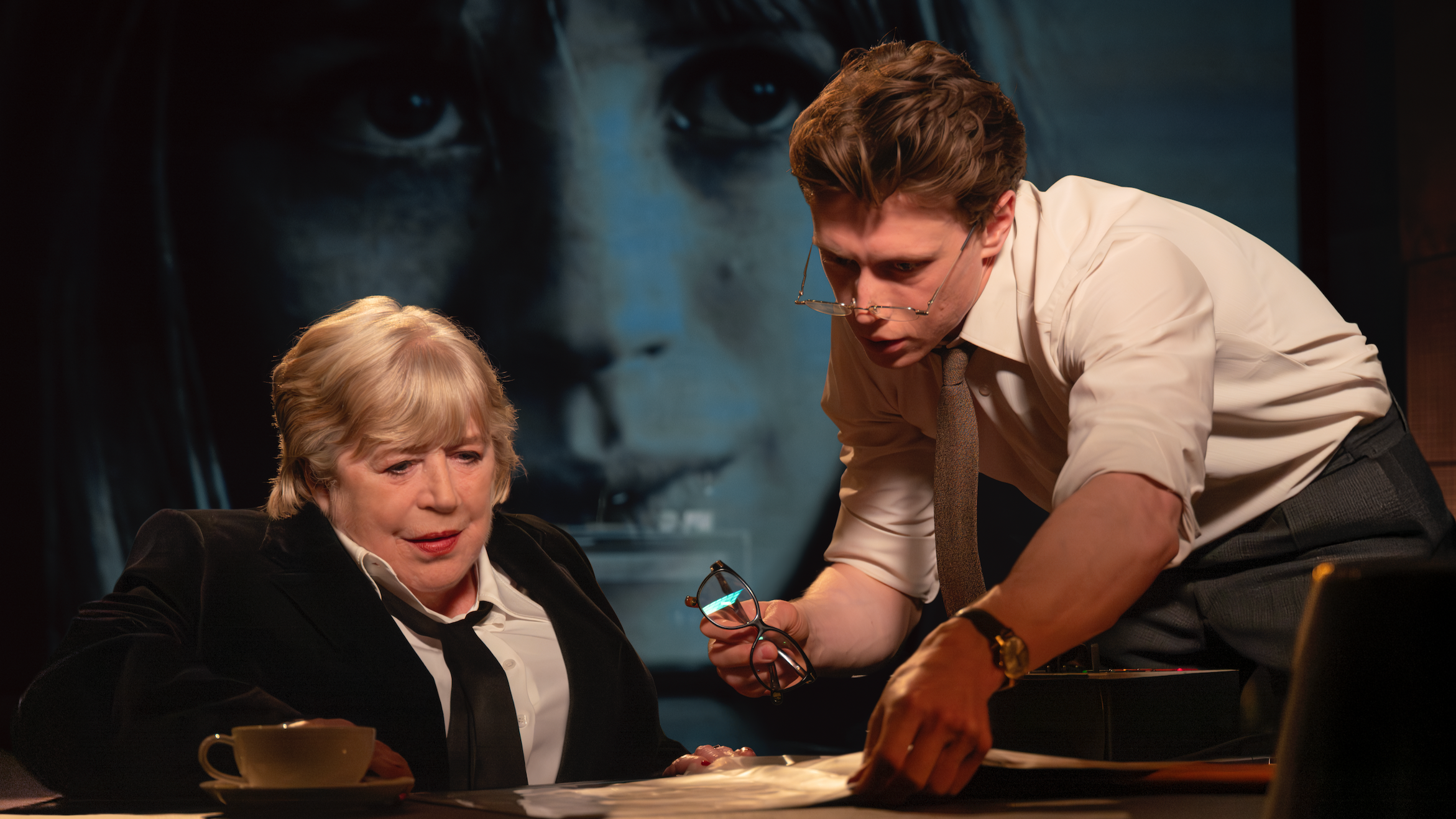
Marianne Faithfull with George MacKay
Photo by Joseph Lynn; Image courtesy of Mubi.
by MANSEL STIMPSON
Although obviously not planned to appear posthumously, the fact that Broken English arrives on our screens following the death of Marianne Faithfull in January 2025 at the age of seventy-eight means that it stands as a farewell tribute and, as such, it could hardly be more fitting. When first conceived by those unorthodox documentarians, Iain Forsyth and Jane Pollard, it was already a project to ponder her life and career with the respect due to a serious artist. Despite the longevity of that career and her contributions as singer, actress and song writer it remains the case that for many Faithfull is still best remembered for the press headlines in 1967 which built up the scandal when a drugs search in the home of pop musician Keith Richards revealed her presence naked but for a fur rug that she was clutching. Furthermore, the media would treat her as though her own significance in the second half of the sixties lay only in the fact that she was known to be the current girlfriend of Mick Jagger. This documentary was to be an opportunity for her to be on screen and very much the film’s key presence despite her health being such that she is seated in a wheelchair and has an oxygen supply to hand in case of emergency.
Regardless of this health issue, seeing Marianne Faithfull being interviewed at length is a totally positive experience. However, even though the film views things in chronological order most of the time, the set-up here is notably unconventional. For one thing the interview is presented as one undertaken by George MacKay in the role of a key member of an imaginary body known as the Ministry of Not Forgetting. This setting is realised in some detail in that the ministry is seen to have an overseer (Tilda Swinton) and a number of staff who appear. We are asked to believe that this group has selected Marianne Faithfull as its first subject whose life and true significance deserve to be explored. The interview with her is at the heart of the film leaving it an open question as to whether MacKay’s presence amounts to a performance of his role or should instead be considered a case of the actor actually turning interviewer. Either way he is splendid and the rapport between him and his interviewee feels warm and genuine.
Broken English is unusual in other ways too. For one thing it incorporates fresh performances of several songs associated with Marianne Faithfull by such artists as Courtney Love, Beth Orton and Jehnny Beth, the latter offering ‘Why'd You Do It?’ which, also involving dance movement, comes close to being a production number. Elsewhere the film brings together a group chaired by Edith Bowman and including Sophie Fiennes and Sophia Guillory. They offer their personal take on Faithfull and on how women artists often fail to get their due while also taking account of her wish not to rehash the scandals of the 1960s when being interviewed. But, despite choosing the ground that she is willing to cover herself, Faithfull comes over as somebody open to discussing her history with great frankness.
The elaborate concept for this piece may not always justify itself and it could be argued that the film somewhat downplays her work as an actress. It does touch on early-stage appearances in Three Sisters and Hamlet but is even briefer when considering her film career. It is possible that she linked 1968’s Girl on a Motorcycle with the image of her that she liked to forget. But much later work, such as 2007’s Irina Palm for which she received a best actress nomination in the European Film Awards, surely deserved to be stressed. Nevertheless, it is fair enough that Faithfull’s role in music is made central to this appreciation of her as an artist. If the key emphasis is on the songs that she composed herself, proper attention is also paid to her association with the music of Kurt Weill. One of the videos brought in for her to see includes part of a rehearsal tape when she was performing The Seven Deadly Sins and, if comparing her with the great Billie Holiday is pushing things, her individual delivery has its own art and the Weill connection invites a comparison with that of Lotte Lenya.
But, if a few details can be questioned (and for those not in the know it would be useful if the singers of the songs incorporated here were named), Broken English is an admirable opportunity to reconsider the achievements of Marianne Faithfull and to be made aware of how many musicians admire her. Even more important is the chance to see Faithfull herself so evidently at ease in the company of people who arguably have more faith in her than she had in herself. Best of all here is the way in which the film concludes. What we see is the one song performance photographed for the film which is by Marianne Faithfull herself. The song is ‘Misunderstanding’ and with her are her revered colleagues Nick Cave and David Courts. As it turned out, this would be her last recorded performance and there could not have been a more appropriate way to bring down the curtain on her career. It's not only that it evidences the fact that so late in her life she could still put across a song so well. More than that, it shows so clearly that when delivering this song with these colleagues she felt really happy.
Featuring Marianne Faithfull, George MacKay, Tilda Swinton, Zawe Ashton, Calvin Demba, Sophia Di Martino, Nick Cave, Beth Orton, Courtney Love, Jehnny Beth, Warren Ellis, Barry Reynolds, Ed Harcourt, Sophie Fiennes, Sophia Guillory, Edith Bowman, Natasha Khan, Harriet Vyner, Kate Coyne, David Courts.
Dir Iain Forsyth and Jane Pollard, Pro Beth Earl, Screenplay Iain Forsyth, Jane Pollard and Ian Martin with Will Maclean, Ph Daniel Landin, Pro Des Alison Dominitz, Ed Luke Clayton Thompson, Music Rob Ellis and Adrian Utley, Costumes Jerry Stafford.
Rustic Canyon Pictures/ Phantoscopic/Magna Studios/Globe Originals/Q & A Entertainment/Cold Iron Pictures-Vue Lumière.
99 mins. UK. 2025. UK Rel: 20 March 2026. Cert. 15.
