
The director’s two sons look back at the folk horror film that has become a cult classic – and how it affected their lives.
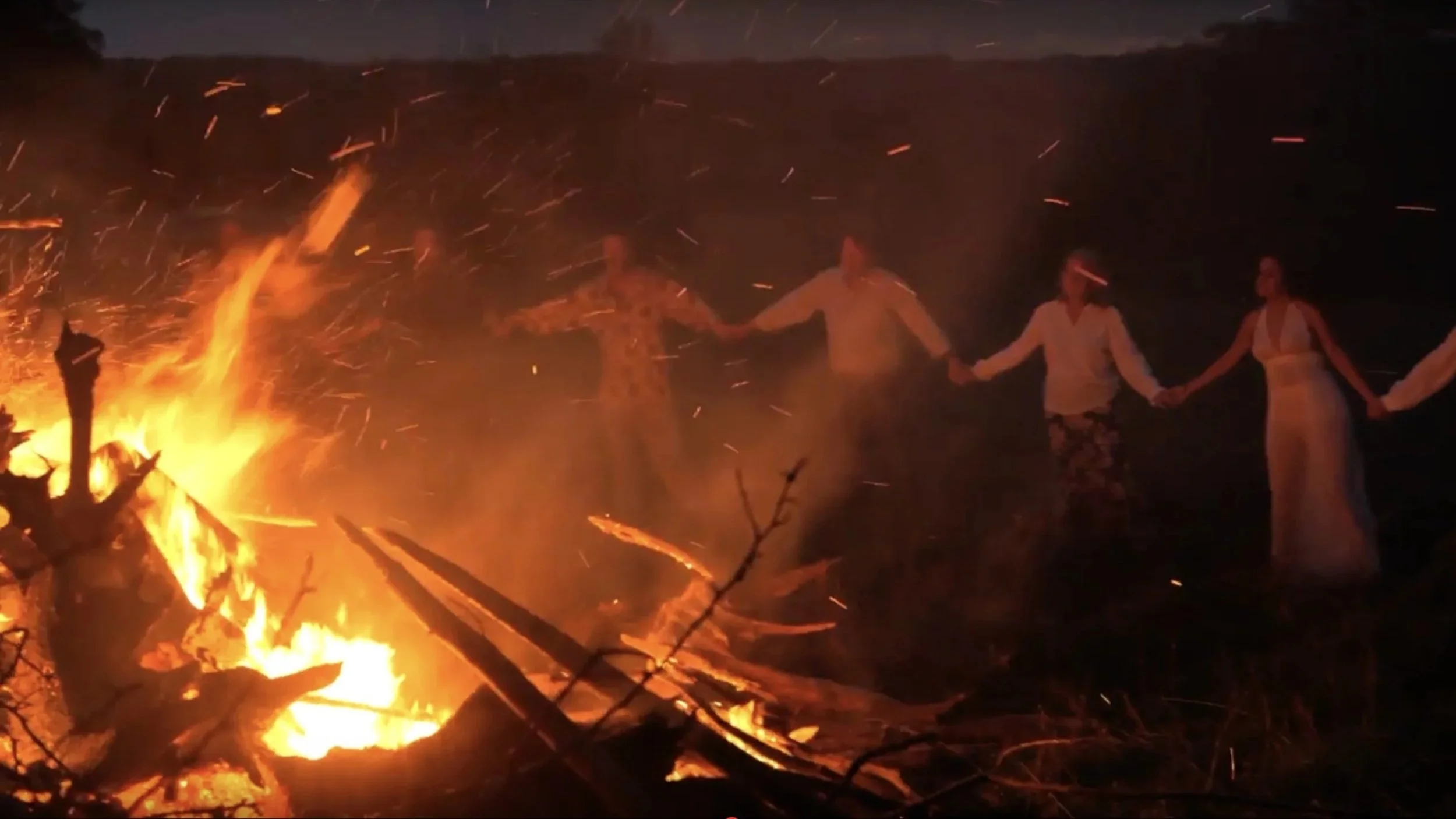
Image courtesy of Exposure/Unannounced Film Company.
by MANSEL STIMPSON
In many respects, but not in all, Children of The Wicker Man is directly comparable to the recent release Boorman and the Devil. Both are documentaries that offer a fascinating insight into the severe problems that can arise in the course of making a movie and are likely to fascinate cinema buffs whether or not they have seen the ill-fated pieces that are their subject. In Boorman and the Devil that work was Exorcist II: The Heretic, a film which by and large is still regarded as a failure. 1973’s The Wicker Man fared no better when it first appeared, but the widespread admiration for it that has grown up since makes it a very different proposition. Consequently, Children of the Wicker Man is able to take the longer view and record the film’s reassessment, but even so this is first and foremost a detailed account of the difficulties that abounded when Robin Hardy set about making his first feature, an endeavour which at the time looked to have turned out to be an outright disaster.
A special feature of Boorman and the Devil was the presence in it of John Boorman himself as he looked back and commented in detail on the film which, despite its failure, meant much to him. Since Robin Hardy died in 2016 no comparable viewpoint was possible here. But, for all that, this documentary is a highly personal work and not only because it was set up by Robin’s son Justin. What makes Children of The Wicker Man unique is that, in addition to covering the making of The Wicker Man, it also focuses on the character of Robin Hardy and the impact of that on two of his children. This film is an undertaking not only by Justin but also by his half-brother Dominic and the two of them are essential presences in the film. In the course of it we learn how after The Wicker Man had been completed Robin Hardy walked out on his wife, Caroline, who had put her own cash into its making and was then left without any further resources. When leaving Robin abandoned their two children, Justin and Arabella, disappearing totally from their lives for five years. In total he fathered seven children and married five times in addition to philandering, his behaviour being such that when this film was made in 2024 Justin and Dominic were both still coming to terms with the traumatic effect that their father had had on their lives.
For Justin it was around 1973 that the crisis at home became clear and his father's obsession with making The Wicker Man was a factor that had a central role in it. That's why at the start of this documentary rather than introducing it as a film honouring his father's troubled yet ultimately most successful movie he describes it instead as “the film that fucked up my family”. Working through his feelings about his father and discussing them with Dominic is a thread that runs right through this film and intertwines a little uneasily at times with the chief thrust of the film, the circumstances under which The Wicker Man was made and its subsequent history.
Interesting as the family aspect is, Children of The Wicker Man remains at heart a fascinating history of how Robin Hardy, a partner in Hardy Shaffer Associates with the writer Anthony Shaffer, committed himself to the idea of moving on from commercials to make a feature film. With some initial encouragement from Christopher Lee, Shaffer wrote The Wicker Man but, even though he had the advantage of being known for the play Sleuth and for the screenplay of Hitchcock's Frenzy, his name did not make it easy to persuade a film company to back the project. Eventually British Lion came on board, but that would lead to trouble because of the company’s own difficulties which meant that The Wicker Man was rushed into production ahead of changes which saw a new team taking over there.
When it comes to tracing the history of The Wicker Man the film gains from papers about it including the original annotated screenplay which belatedly came into Justin Hardy's possession, Furthermore, the detailed coverage seen here has the advantage not only of archive footage (which includes occasions when Christopher Lee spoke about it) but of a range of interviews. Among those featured in this way are the producer Peter Snell, the art director Seamus Flannery (92 when he was filmed), the actress Lesley Mackie, the music arranger Gary Carpenter, the critic David McGillivray who reviewed the film favourably for the BFI’s ‘Monthly Film Bulletin’ and Bill Paterson who might have appeared in the role taken by Lindsay Kemp. The casting of Edward Woodward, which seems so right, was last minute and on set Robin Hardy on one occasion reduced him to tears. We hear too of how Hardy took against the film’s talented photographer Harry Waxman resenting his endeavours to give guidance to a first-time feature director. Admittedly Hardy had had serious health issues and was close to bankruptcy at this time having had writs issued against him but he does not cut a sympathetic figure.
Following completion of the film, British Lion’s Michael Deeley saw it and hated it which led to cuts and then to a release without a press show and as a second feature to Don't Look Now. The film recouped less than half its budget and, in addition to Hardy deserting Caroline, Anthony Shaffer’s marriage broke up after his wife found him in bed with Diane Cilento who had played in the film. For that matter the long friendship between Hardy and Shaffer came to an end too. But then the fortunes of The Wicker Man changed starting in America where it won a campus audience and had a truly astonishing run in a cinema in San Francisco's Castro district.
It has taken until now for Children of the Wicker Man to get a UK Cinema release but that seems surprising. There are certainly varying views as to whether Robin Hardy’s direction was quality work or a drawback but the standing of The Wicker Man itself in the public eye is secure and this film is indeed a revealing account of its history. There are occasional oddities in it: an indulgent and bizarre blending of Justin and Dominic into a segment from the original film, an episode about Dominic going missing during Justin’s shoot which has no clear point and moments when as at the end the documentary tries self-consciously to create a half echo of The Wicker Man itself. But these are minor points and this documentary should satisfy those who seek it out. Arguably it is overkind when touching on Robin Hardy’s later work but it has an upbeat moment late on when it recalls him receiving an ecstatic welcome only weeks before his death at a screening of The Wicker Man in Malta. These late scenes also feature letters written to Justin and Dominic by their father now discovered but never posted. Here they are read out by their addressees for the first time and are found to express their father's pride in these two as well as a sense of his own regrets, but arguably it is too little too late.
Featuring Justin Hardy, Dominic Hardy, Peter Snell, Bill Paterson, Seamus Flannery, Gary Carpenter, David McGillivray, Lesley Mackie, Vic Pratt, Vicky Webster, Tim Plester, Gloria Lauri-Lucente, Fabrizio Foni.
Dir Justin Hardy, Dominic Hardy and Chris Nunn, Pro Alison Palmer, David Evans-Powell and the University of Birmingham, Written by Justin Hardy, Dominic Hardy and Chris Nunn, Ph Robin Keane, Ed Ella Victoria Wright with Guy Dagul, Music Guy Dagul.
Hardy Pictures/Carly Pictures-Exposure/Unannounced Film Company.
92 mins. UK. 2024. UK Rel: 23 October 2026. Cert. 12A.