
Collective Monologue

Jessica Sarah Rinland’s challenging documentary examines humankind’s relationship with animals in zoos and shelters.
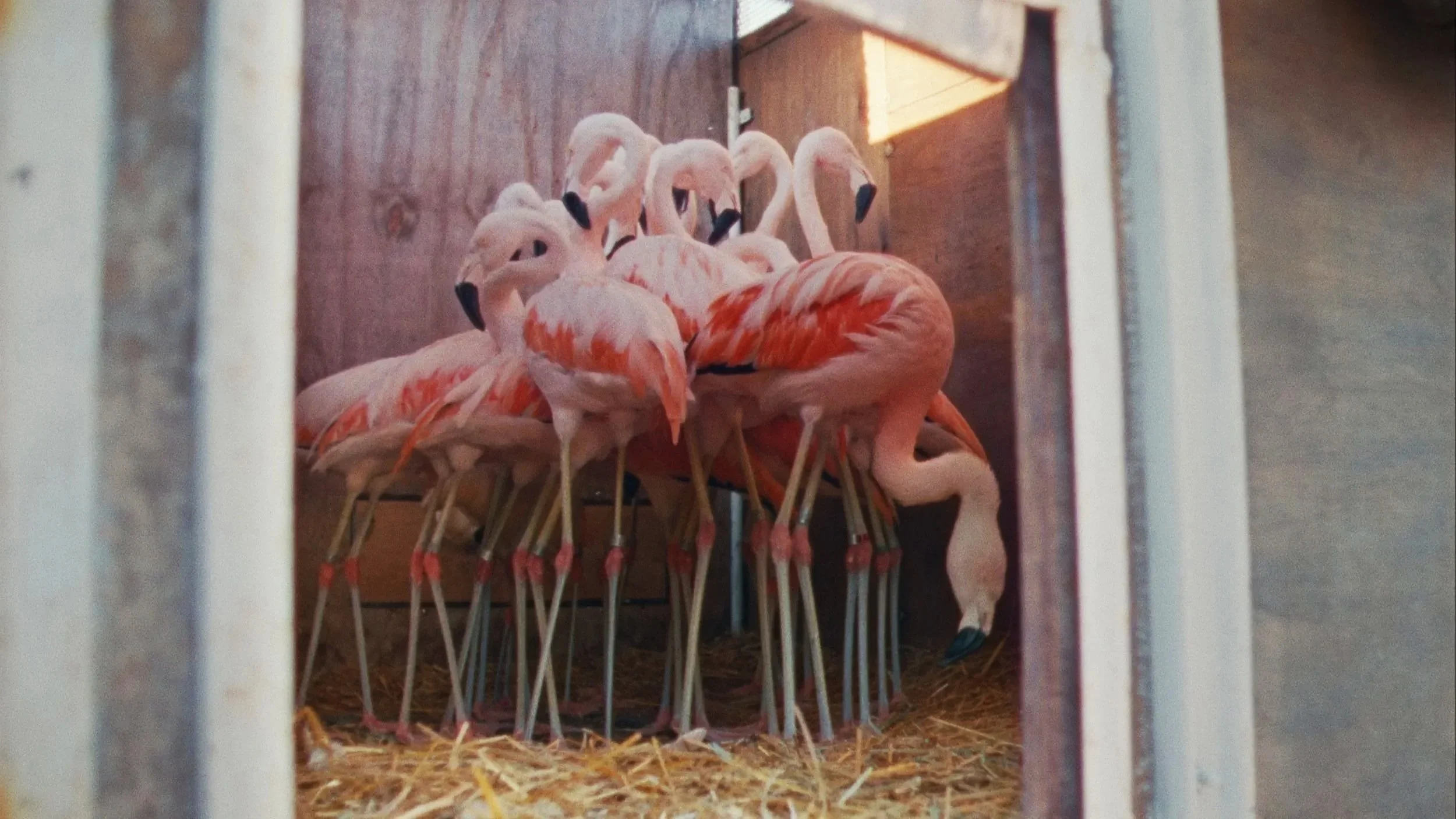
Image courtesy of Sovereign Film Distribution.
by MANSEL STIMPSON
Publicity for this documentary feature from Argentina indicates that it is concerned with animals found in zoos, eco parks and animal shelters. That description is entirely valid but may nevertheless give the impression that Collective Monologue is readily appreciable and will appeal to audiences who applaud such films as 2024’s Every Little Thing, that fine portrayal of hummingbirds being cared for in San Francisco. That's a reasonable assumption to make since most documentaries featuring animals are made in a straightforward traditional style.
What one needs to make clear is that the approach taken by this film’s director, who is also its photographer, editor and co-producer, is something that is far more challenging and likely to be of somewhat specialised appeal. The filmmaker, Jessica Sarah Rinland, is not the only one to take this route and on occasion it has met with great success. In 2010 Nicolas Philibert, whose earlier study of youngsters in school, Étre et avoir (2002), had met with huge popular acclaim, dared to make a film which concentrated exclusively on a feral orangutan kept in a Paris zoo in the Jardin des Plantes – it bore the name of the orangutan herself, Nénette. Equally daring was Victor Kossakovsky’s Gunda, his 2020 black-and-white study of a sow and her piglets viewed from their angle and shot in black and white and with no dialogue. Both films succeeded against the odds for viewers prepared to give themselves to the experience. In each case the viewer gained an intense understanding of how we treat animals. It would seem that Jessica Sarah Rinland’s film is intended to produce much the same response, but it is less intense and concentrated, less absorbing and less disciplined.
Another way to put Collective Monologue into focus is to compare it to the documentaries of Frederick Wiseman. That’s because Rinland follows his example by giving us an observational work which has no narrative to inform or guide the viewer. However, Wiseman is best known for his detailed studies of institutions of one kind or another and consequently his audience are always clearly aware of his focus. Collective Monologue does eventually emerge as a film that largely features a former zoo in Buenos Aires which has been undergoing conversion in order to modernise and to become more up-to-date in the way that its animals are handled. Nevertheless, the film has been running for some 37 of its 105 minutes before we get a shot of the city which even then is just a vague clue to where we are. Up to that point the film has mainly concentrated directly on the clearly devoted staff who are viewed carrying out their duties which range from feeding the animals to cleaning them down, weighing them and training them. The animals have names – a monkey named Juanita is one of the most prominent and even has a high place in the cast list – and throughout their carers, women like Macarena Santa María Loydi, make a point of talking to them.
While the portrait of the care bestowed is always apparent, Collective Monologue also emphasises from the outset the boxed in nature of the lives that these animals lead and arguably this juxtaposition exists to encourage each viewer to draw his or her own conclusions. However, the middle section of the film devotes considerable footage to old documents from the early 20th century containing records and photographs relating to the character of the old zoo and its employees with particular reference to an Italian named Clemente Onelli who was its director from 1904 to 1924. Such footage might have been used at the outset to introduce us to this particular establishment but bringing it in so belatedly when the specific location has been underplayed up to that point makes one ask what place this footage really has in Rinland’s film.
Later on the film will return to its emphasis on animals confined in a zoological garden and references are made to an unexpected question: having looked after them at what stage can they be liberated? But this aspect and its place within the set-up lacks clarification since, in addition to the absence of any narration in the film, it contains only limited remarks from the people involved. While Macarena herself becomes at least identifiable, the others are played down. Quite often Rinland’s style puts a special emphasis on close-ups, the relationship between animal and carer often being seen when a paw and a hand reach out to one another. Such close shots are used memorably elsewhere too, one example being the shots of tortoises slowly moving forward. A whole range of birds and animals appear including images of macaws, elephants and flamingos which speak for themselves. But when it comes to rarer breeds – tapirs, capybaras, and anteaters for example– the limited information given can leave one wanting to learn more about the creatures that one is seeing. Similarly, the lack of any narration can make the point of some sections of the film rather obscure as when the inclusion of many shots of construction work - again with close-ups dominant - lack any clear sense of purpose.
But, if the film’s seeming shapelessness and its demands on the patience of the audience can be off-putting, there are scenes here that will stay with one, especially those close-ups taken to extremes rarely seen before. That is enough to give the film some value, but potential viewers should be aware that Collective Monologue can be a demanding experience. At its close there is a written quote from the psychologist Jean Piaget which relates to the film’s title and suggests that Rinland does want the viewer to see the control of animals by humans, however caring they may be, as a failure to appreciate their true place and standing in the natural world. To leave this quote to the end credits does mean that Rinland far from being consciously dictatorial is keen to let her audience form their own conclusions. That could be considered laudable, but both Nénette and Gunda achieved far more through the intensity of their focus which ensured that viewers saw the world directly from the viewpoint of the creatures being exploited.
Original title: Monólogo Collectivo.
Featuring Macarena Santa María Loydi, María José Micale, Alicia Delgado, Juanita, María Soledad Rosso, Nicolás Gustavo Carro, Andrés Defeis, Lucio Cicchino, Franco Elio Itri, Elena Martín, Axel Jurado.
Dir Jessica Sarah Rinland, Pro Melanie Schapiro and Jessica Sarah Rinland, Screenplay Jessica Sarah Rinland, Ph Jessica Sarah Rinland, Ed Jessica Sarah Rinland.
Trapecio Cine/Bord Cadre Films-Sovereign Film Distribution.
105 mins. Argentina. 2024. US Rel: 17 July 2025. UK Rel: 20 February 2026. Cert. U.
