
Comédie Française

Theatrical chaos ensues in Martin Darondeau and Bertrand Usclat’s adept and affectionate French farce.
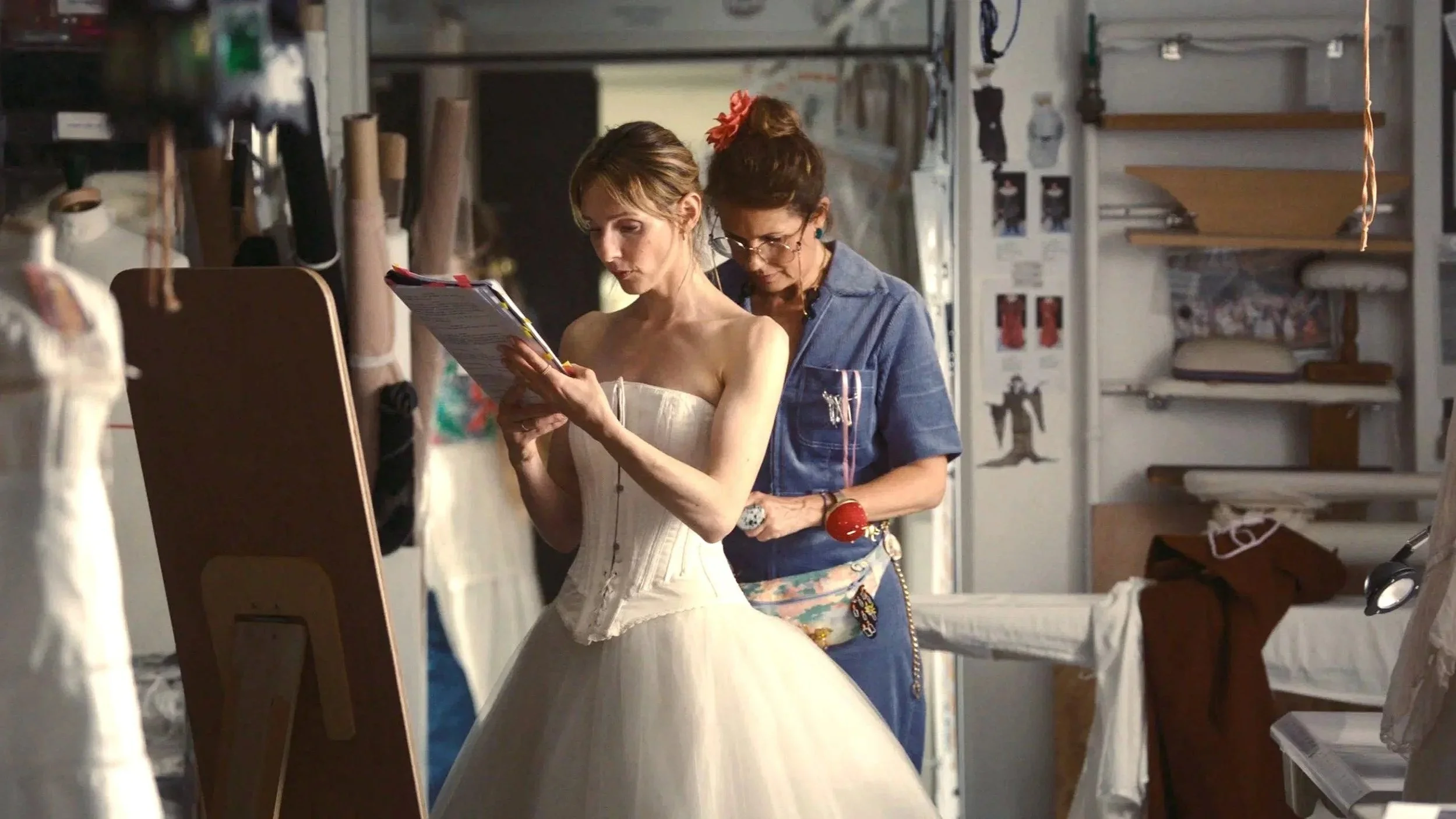
Pauline Clément and Florence Viala
Image courtesy of Tull Stories.
by MANSEL STIMPSON
The selling point for this comedy as it begins its UK release lies in the statistics around its success in France. The film opened in late July with numbers on the first day which were among the best of the year, went on to take second position for admissions in that week (beaten only by a film entitled The Odyssey!) and by the end of August had been seen by over one million people. All that is the more helpful in attracting audiences here since the players are for the most part best known in France and the two filmmakers, the duo Martin Darondeau and Bertrand Usclat, were making their first feature.
The box-office success of Comédie Française is down not to one but to two factors. The first lies in the fact that Darondeau and Usclat, who wrote the screenplay along with Clémence Dargent and the film’s lead actress Pauline Clément, have been very adept at creating a work that is knowingly strong in popular appeal. The other key to its success stems from the timing of its release which could not be better. With the world in its present state, there is a real longing in the public for a film that is predominantly comic and which comes across as entertaining, undemanding and escapist. Furthermore, at a time when so many commercial movies last for considerably more than two hours, it is a refreshing change to have one that clocks in at a modest but satisfying 75 minutes.
In applauding this film, I am recognising its attraction but am not suggesting that it is a comic masterpiece and it would certainly be wrong to praise it in terms that led to audiences to think it was on that level. The title is certainly apt in that it is a comedy about theatre life which takes place during the hours leading up to the first performance of a new production of Macbeth with the venue in question being indeed the celebrated Comédie-Française. That setting might lead some to expect a comedy of a kind that measures up to the high standard of classic and modern works staged there, but the piece we have here is not as ambitious as that. It is also a film of which it can be said that in the course of it the writing moves the goal posts, but it never loses sight of sustaining its broad popular appeal.
The first two-thirds of Comédie Française adopts an approach that is not far distant from Michael Frayn’s stage success Noises Off. It finds humour in the mishaps and panic that occur among the company in the two and a half hours before the curtain is due to go up. At the start we have a stage door keeper (Guillaume Gallienne) who pedantically won't let the play’s director, Nina (that’s Pauline Clément’s role), enter unless she can produce her pass. Then there's the news that the actress playing Lady Macbeth is stuck in Brest where she has been filming and has encountered rail problems which will mean that she cannot reach the theatre in time. The foibles and bad behaviour of the actors come into play too: Antoine (Julien Frison) refuses to appear if he is expected to wear green and old-timer Nadine (Danièle Lebrun) is unwilling to give up her old habit of smoking a joint before going on. Then there are the personal complications: Emilie (Marina Hands) who is the wife of this production’s Macbeth, Philippe (Laurent Stocker), is having an affair on the side with the said Antoine and by chance Philippe becomes aware of it. As for the director, Nina, she not only finds herself having to take over the role of Lady Macbeth but has her ex-husband, an actor, coming round with their baby son and dumping the child on her because he is going on tour.
These ingredients are neatly intertwined and built up and are much aided by the engaging personality of Pauline Clément who brings exactly the right touch and spirit to the key role of Nina. Two other cast members whom I have not mentioned are also notable for bringing a warmth to their roles: Sefa Yeboah who plays an usher with ambitions to act and Séphora Pondi as a make-up artist. There is an additional striking contribution and that comes from Benjamin Lavernhe. His entrance into the film changes its tone suddenly by introducing a supernatural element. He appears as the ghost of Molière who turns up to discourage Nina from cancelling the performance. The actor relishes his dialogue which finds Molière lamenting the fact that the theatre associated with him is spending time on the work of the overrated William Shakespeare.
In the event this scene with the ghost is really a bridge passage which leads into the final endeavour to present Macbeth as announced. For this last section of the film, the character of the piece changes somewhat. There is still comedy but we get also one or two moments closer to drama and sentimentality. But the main change at this point is that the emphasis now falls on that favourite notion featured in films about putting on a staging, namely the effort by the characters to live up to the tradition that the show must go on. That’s a viewpoint which the audience is now invited to endorse.
For all its jokes about theatre people and its cheeky observations on current theatrical trends, Comédie Française is an affectionate work designed to have a special appeal for those who enjoy the theatre and mostly it succeeds on its own terms. Even so and allowing for the fact that it is a piece that is more popular than sophisticated, it could be argued that the last couple of minutes when the curtain does indeed go up is over the top. However, one of the best jokes is yet to come. It would be a mistake to walk out as the credits start to roll because behind them we hear a radio broadcast. It is an effective companion piece to that earlier scene in which Molière’s ghost asserts that his own plays are superior to those of Shakespeare. When it comes to which of them is the winner, there is a neat twist in which the last word is expressed by way of an unexpected reference to music.
Original title: De la Comédie-Française.
Cast: Pauline Clément, Laurent Stocker, Marina Hands, Julien Frison, Adeline D’Hermy, Danièle Lebrun, Sefa Yeboah, Christian Hecq, Séphora Pondi, Benjamin Lavernhe, Guillaume Gallienne, Serge Bagdassarian, Nicolas Chupin, Florence Viala, Françoise Gillard, Gilles David.
Dir Martin Darondeau and Bertrand Usclat, Pro Thomas Vermaeghe and Mathieu Vermaeghe, Screenplay Martin Darondeau, Bertrand Usclat, Clémence Dargent and Pauline Clément, Ph Hugo Paturel, Pro Des Sébastien Danos, Ed Baptiste Ribault, Music Clément Ducol, Costumes Chloé de Nombel.
Atelier de Production/France 2 Cinéma/Comédie-Française/Canal+/Ciné+OCS/Cinécap 9-Tull Stories.
75 mins. France. 2026. UK Rel: 9 October 2026. Cert. 15.
