
Deadline

Kiwi Chow’s well-acted, thought-provoking drama from Taiwan tackles the minefield of school life.
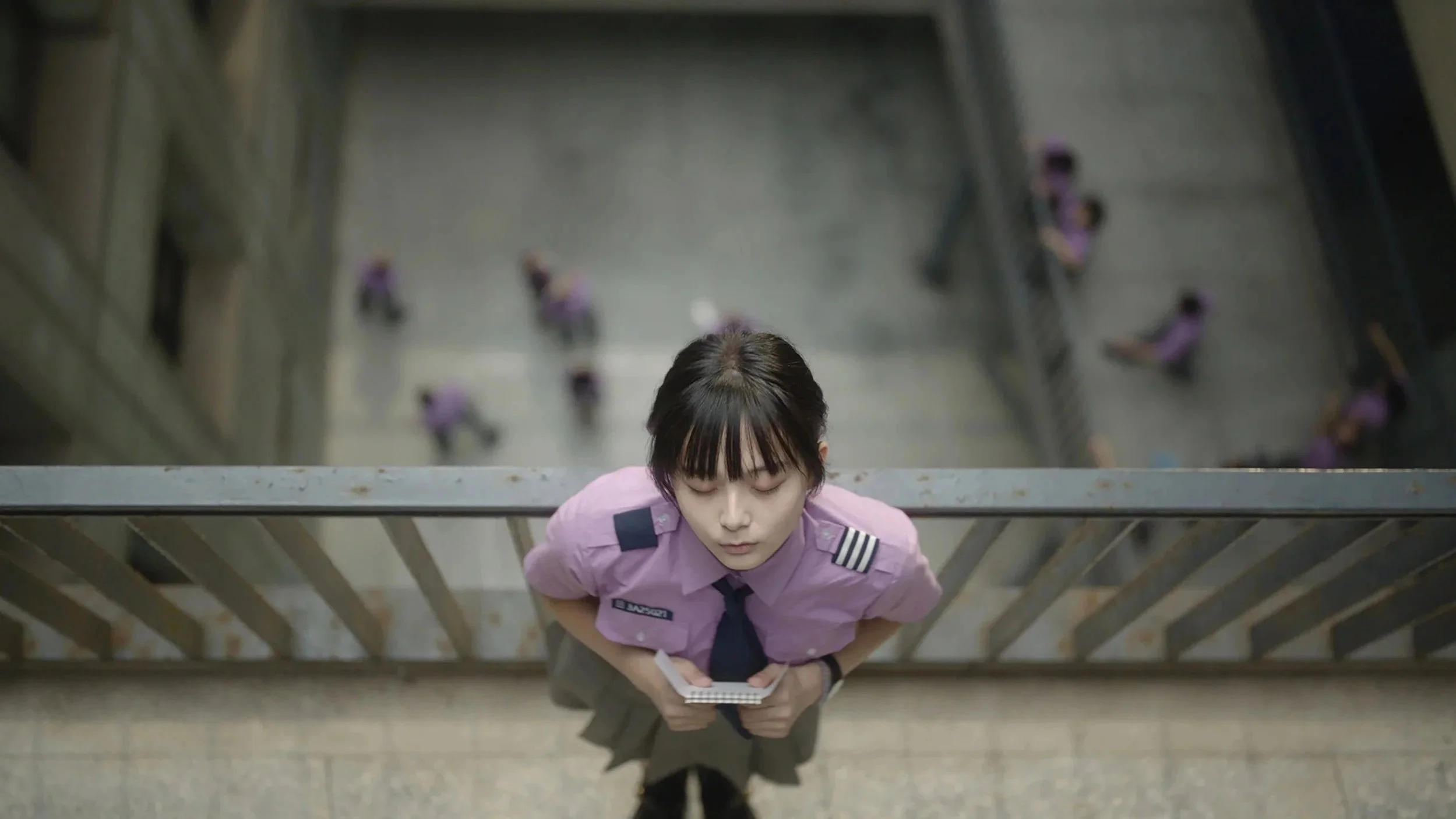
Image courtesy of DOVC.
by MANSEL STIMPSON
The Hong Kong filmmaker Kiwi Chow is not a newcomer but this is the first time that I have encountered his work. He was born in 1979 and turned director with his 2013 feature A Complicated Story. As has often been the case with him, it was a film on which he also took a share in the writing credit and his output to date includes a comedy and a full-length documentary. Nevertheless, dramas would seem to be his most favoured territory and Deadline is another instance of that. The setting for this piece is a secondary school in an unnamed town and the film compellingly captures the sense of an institution where the students are under constant pressure. Indeed, it becomes clear that the education system depicted is one in which outstanding examination results are a priority, discipline is strict and the regime is one in which it is accepted that a degree of suffering is entirely appropriate if pupils need that in order to become successful. The tone of the place is militaristic and some of the more sensitive students compare their situation to being in a prison.
The opening scenes of Deadline are exceptionally powerful. The widescreen ratio adds to the film’s ability to capture the character of this school housed in a modern impersonal building and equipped with today's technology which in itself adds to that impression. These images express all this so strongly that they also make it apparent at once that Kiwi Chow is capable of direction which, with assistance from his editor Allen Leung, marks him out as having the potential to be a major talent. Indeed, it is striking just how much is expressed through these images even before we start to become familiar with the central characters.
Deadline takes place during the seven days before the date set for the school’s final examinations and it is at the start of that period that at a school gathering papers flutter down. The wording on them is a demand that the school system be changed and contains a threat that, if this is ignored by the time of the exam, the writer, an anonymous student who claims to be suicidal, will end his or her life. This is a situation which does to some extent turn Deadline into a mystery tale, one in which uncovering the identity of the writer is a key element. The central characters here include the principal, Mr Kung (Anthony Wong Chau-Sang), and two teachers, namely Miss Tien (Allison Lin) who is well-established and Mr Gao (RD Huang) who is less experienced and see things from a different perspective. In addition, the film offers a range of students all of whom could be suspect. These extend from the head boy, Jay Mo (Michael Chang), to a young student, Heng (Run-yin Bai), who suffers from the neurodevelopmental condition ADHD and is mocked and bullied on account of it. Among the girls present are two rivals to be top achiever: Peiching (Ti Ya Zhi), and Ruoyan (Shao Yi Mei), the latter being somebody disturbed enough by the tensions to self-harm as we learn early on. But even more central a figure among the students is Chun (Jimmy Liu). While the others accept the competitive world in which they find themselves, Chun is a rebel who questions the path which would take him to university and dreams of breaking away (he loves plants and could imagine enjoying life as a farmer).
Despite the mystery element included here, Deadline plays first and foremost as a work which takes a critical view of the school system and of the attitudes behind it. Consequently, one can understand why some critics have found Deadline somewhat akin to the 2024 Japanese film Happyend. That work also had students as central characters but took a wider approach when considering authoritarian systems of control albeit that surveillance technology in the school was a feature that it emphasised. Unlike some I was not impressed by that film and regard Deadline has having at its best the dramatic power which was largely missing in Happyend. On the other hand, July Jung’s Next Sohee (2022) was a film from South Korea which, despite its length, sustained its force to the very end (I saw it twice and liked it even more the second time). That work despite featuring a high school student had less to do with school life, but its broad questioning of social hierarchies and institutions chimes with much of what is being implied in Deadline. That aspect, even if it is not followed through here so implicitly, seems a valid part of Kiwi Chow’s film. Indeed, while it is apparently less clearly political than some of his work (not least the 2021 documentary Revolution of Our Times), the authorities in Hong Kong have felt justified in banning Deadline from being shown there despite it having been shot in Taiwan. They claimed that the ban was due to national security concerns.
One feature not found in those other films is concern over drugs taken by students in the hope that that will help stimulate them and thus enable them to do better in exams. Deadline shows the complexity of that issue over which the school authorities as well as some parents whose children are students are understandably hostile due to its dangers. From a different angle entirely, any extra stimulation obtained by it becomes an advantage that could be said to render the exam results unfair. Even so, there are parents who would support this use of drugs and, indeed, teachers who want to help anxious pupils might feel that drugs are justified given how the system works. Late on Deadline stresses the conflicting views on this issue felt by the students themselves.
Ironically it is the brilliance of the first third of Deadline that makes one aware of its limitations. So much has been put over at the outset that there are times when later scenes seem to be repeating points already conveyed and with its running length of close on two hours the film can at times seem stretched out. That is not to say that there is a lack of drama (deaths do occur, but at times events veer towards somewhat contrived melodrama). Nevertheless, this well-acted film makes some strong points that are suitably thought-provoking and at its best Deadline unquestionably confirms that Kiwi Chow is a director of immense promise.
Cast: Anthony Wong Chau Sang, Allison Lin, Jimmy Liu, RD Huang, Shao Yi Mei, Run-yin Bai, Tai Ya Zhi, Michael Chang, Meng-Syun, Wang Tzu Chang, Evan Chen, Cheng Zhengjun, Kate Pang, Wan Ting Chen.
Dir Kiwi Chow, Pro Kiwi Chow and Frankie Chung, Screenplay Kiwi Chow, Frankie Chung and Chun Wing Tsang, Ph Yat Lui Danny Szeto, Pro Des Yoshihito Akatsuka and Tien-Chueh Lee, Ed Allen Leung, Music Lu-Ming Lu, Costumes Emma lin and Zoey Su.
Benchmark Films/Haven Productions/Photon Films/Reno Studios/Outland Film Production-DOVC.
117 mins. Taiwan. 2025. UK Rel: 16 October 2026. Cert. 15.