

Ferzan Özpetek’s engaging and handsome drama of life in an Italian costume shop celebrates the power of femininity.
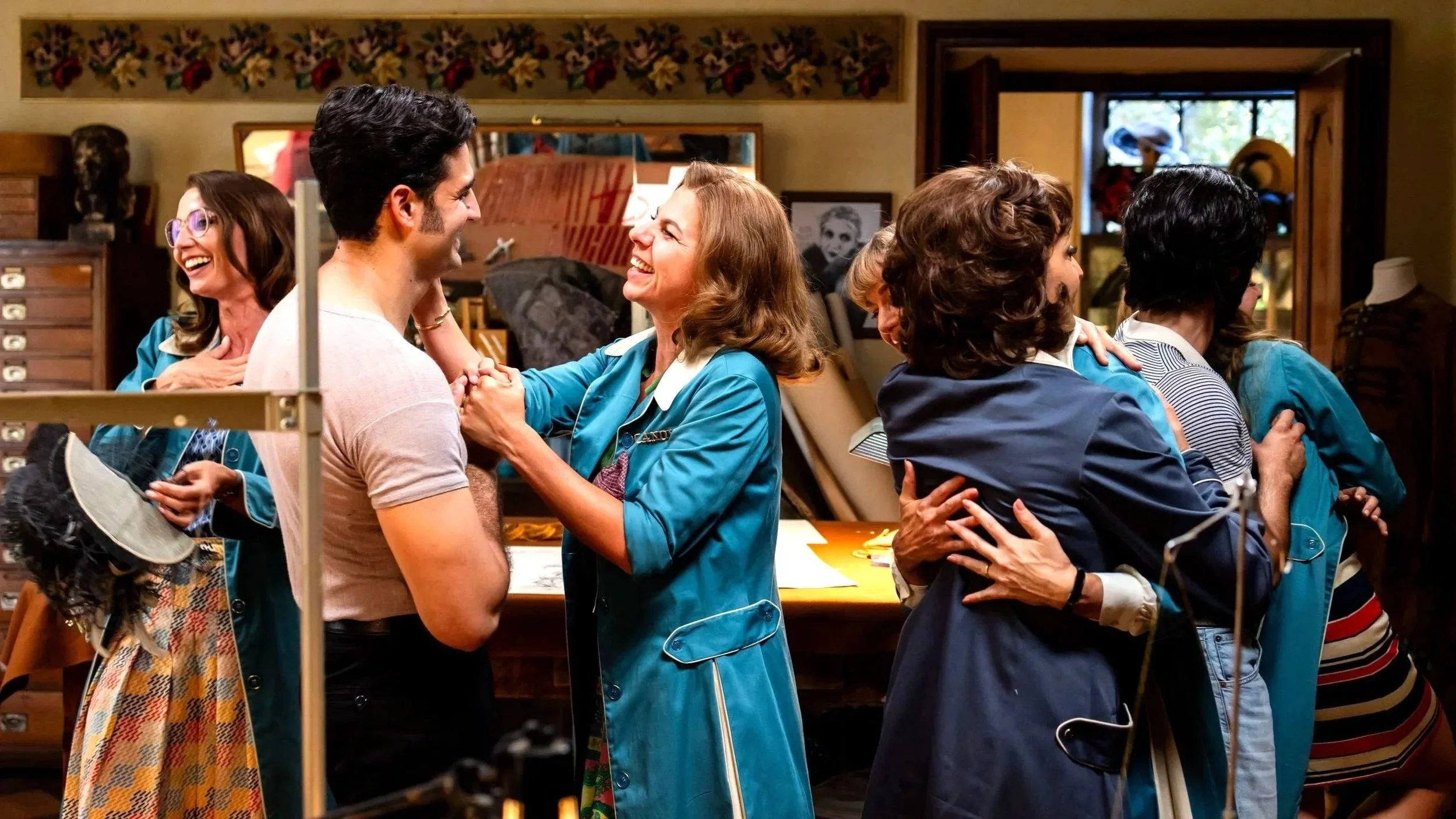
Image courtesy of Vue Lumière.
by MANSEL STIMPSON
Although born in Istanbul in 1959, Ferzan Özpetek has been resident in Italy since 1976 and has become one of that country’s most prolific directors. His very first feature, 1997’s Hamam: The Turkish Bath, rightly won awards but, save for a handful of titles, his films have not been distributed in the UK so the course of his career is not one with which I am really familiar. If his first works fitted neatly into one's idea of arthouse cinema, by the time that Özpetek came to make Loose Cannons in 2010 he was showing signs of changing tone and becoming more obviously commercial. By that I mean that the film contained elements of comedy and melodrama not seen before in his work, albeit that it ended on an offbeat note that seemed rather pretentious. Whatever route he may have taken in the films that then followed, Diamanti, which brings his work back into distribution here, is certainly in line with the popular elements that emerged in Loose Cannons. It's a film which has won awards in Italy but, if considered in a wider context, I would expect this to be a film far more readily embraced by the public than by film critics.
Diamanti, which translates as Diamonds, is a handsome widescreen production which quickly reminds us of Özpatek’s directorial skills since it immediately exhibits an engaging flow which readily carries us forward. Its opening scene establishes its one novel feature in that it is set at a gathering where Özpetek himself is the host and his guests are actresses invited to read a new script for a film in which they could appear. This scene is rather like an overture since we hear on the soundtrack some of the lines that they are reading and this introduction then leads into that very film, one set in a costume shop in Rome in 1974 where work is in hand to provide all the costumes for a period movie set in the 18th century. That film’s director (Stefano Accorsi) makes an appearance but the focus here is first and foremost on women: the sisters Alberta (Luisa Ranieri) and Gabriella (Jasmine Trinca) who run the business, an Oscar-winning costume designer named Bianca Vega (Vanessa Scalera), the cook who for years has fed the staff (Mara Venier) and the many seamstresses who work there.
The fact that Özpetek is a gay director choosing to make a film in which most of the central characters are women has encouraged some critics to compare this film unfavourably to Almodovar's classic Women on the Verge of a Nervous Breakdown. However, a more valid comparison is with the kind of material which becomes the basis of those long running TV series which feature a range of characters who over time each have their own dramatic thread. Alberta herself, the sister very much in command of the business, is taken aback when Leonardo Cavani (Carmine Recano) with whom she had been in love suddenly comes back into her life. Gabriella, who is married to Lucio (Luca Barbarossa), is haunted by a past tragedy which is only belatedly revealed. One of the seamstresses, Paolina (Anna Ferzetti), is a poverty-stricken single mother with a young son, Simone (Edoardo Stefanelli); another, Nicoletta (Milena Mancini), has the misfortune to be under the thumb of an abusive husband, Bruno (Vinicio Marchioni); a third, Eleonora (Lunetta Savino), who is having an affair, has a niece, Beatrice (Aurora Giovinazzo). This niece hides away from the police following involvement in an activist rally and secretes herself among the costumes in the shop (her own emerging skills as a designer mean that by chance she is in very much the right place). Yet others employed by the sisters are Nina (Paola Minaccioni) whose adolescent son, Vittorio (Dario Samac), has problems of his own and Giuseppina (Sara Bosi) a newcomer to the shop who has got a post there through nepotism.
These various plot threads are intermingled along with yet others (as when an antipathy between the designer Bianca Vega and an actress (Carla Signoris) who is a customer of the shop is built up and then resolved). A connecting link between them all lies in the fact that the film is firmly centred throughout on the need for women to assert themselves due to their being undervalued. Aided by a music score by Guiliano Taviani and Carmelo Travia which captures the popular tone of the enterprise, Diamanti is entertaining, albeit a work lacking in real depth.
Luisa Ranieri as Alberta, Jasmine Trinka as her sister and Mara Venier as Silvana the cook are the players who most fully engage us. The piece being well mounted is one that encourages us to accept it on its own rather superficial level as pleasant entertainment. But, while it sustains its running length of 135 minutes better than one might have expected, the storytelling as it goes on increasingly shows its weaknesses. Oddly enough the story of the battered wife, Nicoletta, takes on an exaggerated mode that is close to black comedy and out of place with the rest. Two short sections become virtual musical numbers and don't fit either, but the real drawback is that in time the individual tales set up come to seem more and more the stuff of popular fiction rather than anything that the viewer can really believe in. Nor does it help that eventually we get brief intercut shots again featuring Özpetek himself and it is he who takes over in the closing scene: to put himself centre in this way is to distract from the tribute to the ladies – many actresses who have appeared in previous films of his are seen here – which should be the chief focus. After all it is the women who are the diamonds of the title. At one point Gabriella, whose comment is then echoed and approved, declares “We’re nothing but we are everything". Audiences who find that a wonderful declaration may get on really well with Diamanti. Others may share my feeling that it sounds far too much like a scripted line.
Cast: Luisa Ranieri, Jasmine Trinca, Vanessa Scalera, Mara Venier, Geppi Cucciari, Milena Mancini, Anna Ferzetti, Paola Minaccioni, Lunetta Savino, Sara Bosi, Aurora Giovinazzo, Carla Signoris, Kasia Smutniak, Nicole Grimaudo, Elena Sofia Ricci, Stefano Accorsi, Carmine Recano, Luca Barbarossa, Vinicio Marchioni, Dario Samac, Edoardo Stefanelli, Edoardo Purgatori, Milena Vukotic, Ferzan Özpetek.
Dir Ferzan Özpetek, Pro Marco Belardi, Screenplay Ferzan Özpetek, Carlotta Corradi and Elissa Casseri, from a story by Ferzan Özpetek and Carlotta Corradi, Ph Gian Filippo Corticelli, Pro Des Deniz Göktürk Kobanbay, Ed Pietro Morana,Music Giuliano Taviani and Carmelo Travia, Costumes Stefano Ciammitti.
Green Boo Production/Faros Film/Vision Distribution/MiC-Vue Lumière.
135 mins. Italy. 2024. UK Rel: 17 April 2026. Cert. 15.