
E.1027: Eileen Gray and the House by the Sea

The third feature about the Irish architect and furniture designer Eileen Gray finds a wholly fresh approach.
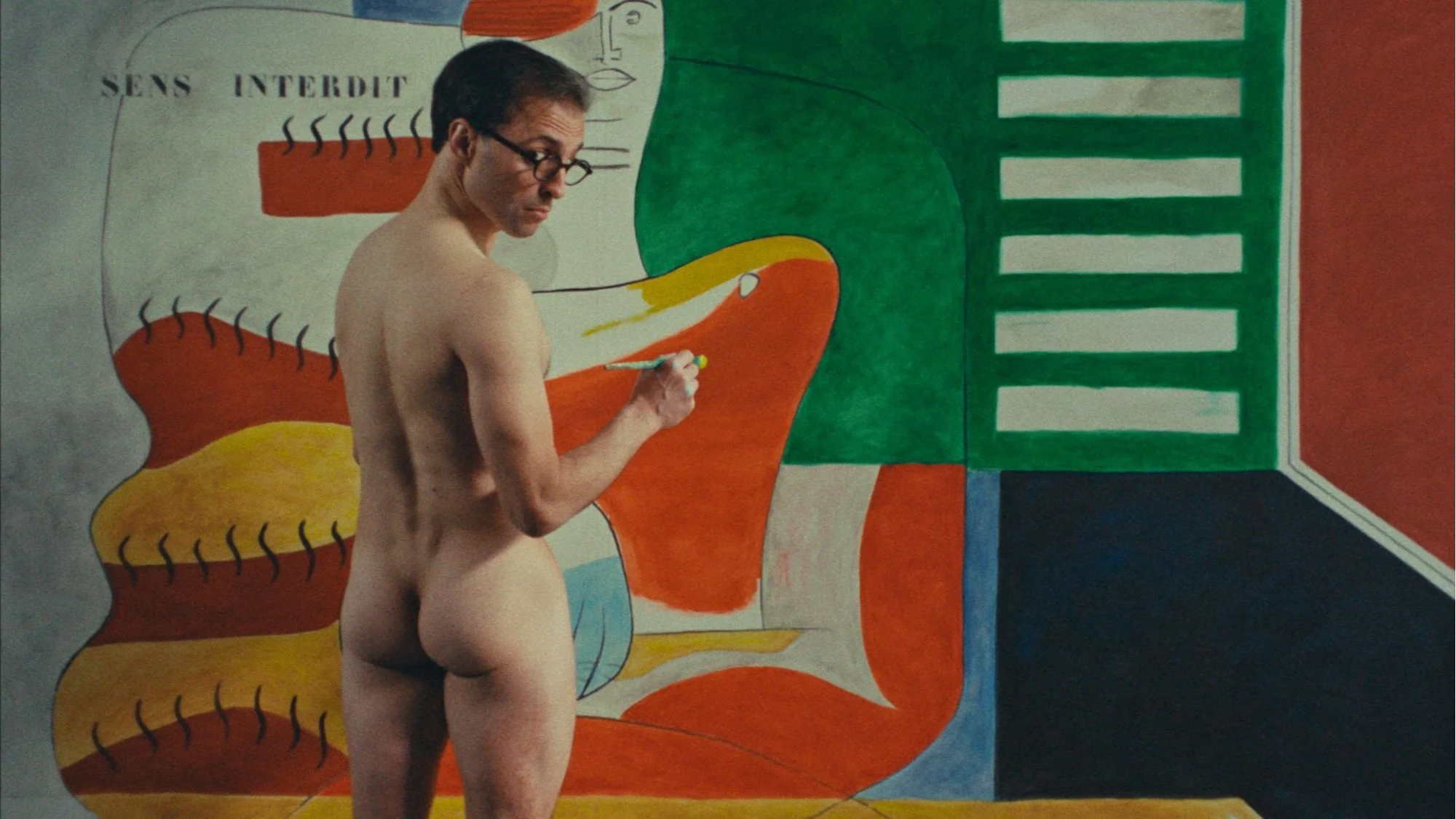
Image courtesy of Modern Films.
In May 2016 a very unusual occurrence arose in that month’s UK cinema releases when somebody decided to issue in the same week two films based on the life of the Irish furniture designer and architect Eileen Gray. One of them was a very able documentary about her by Marco Orsini entitled Gray Matters and the other was a French dramatised work, The Price of Desire, which was far less successful. At the time it seemed that two lessons could be learnt from this, one being that a standard documentary approach was the one best suited to treating the life of Eileen Gray and the other that with two films having been made there was no call for any further ones covering the same subject. Now, however, we have a new film about her which while covering no new ground in terms of the material somewhat unexpectedly proves that the format of the all-out docudrama can yield something more individual and effective than I had supposed.
This third take on Eileen Gray is the first feature by Beatrice Minger who, based in Zürich, has made it in collaboration with the veteran filmmaker Christoph Schaub. All three films feature the modernist villa designed by Eileen Gray in the 1920s and built on the Côte d’Azur at Cap Martin. Orsini’s Gray Matters appeared at a time when Gray was being rediscovered through exhibitions (she had died in 1976 at the ripe old age of 98) and his film accordingly took account not just of her architectural skills but also her lacquer work and significant furniture designs. Consequently, it is this film which has the widest range while the other two concentrate largely on the house which became known as E.1027. That's an understandable choice if one is looking to pinpoint the drama in Eileen Gray's life since the history of the house is absorbing on a personal level while also illustrating the extent to which her era was one in which male domination meant that as an artist Eileen Gray was disadvantaged by being a woman.
Even the odd name of the house is linked to Gray's personal story since she designed it as a refuge by the sea, a place in which to work, which in its decor and furnishings would be expressive of herself (Gray’s essential belief was that a house should be in harmony with its inhabitant). She chose to live there with her lover, the journalist and architect Jean Badovici, a French Romanian who edited the magazine L’Architecture Vivante. Indeed, as a gift to him, E. 1027 (the name a coded reference to their initials intertwined) was put in his name. Badovici was a friend of Le Corbusier the dominant architect of the day and, after Gray's relationship with Badovici deteriorated and led to her moving out, Le Corbusier persuaded Badovici to let him paint bright murals on the walls which totally conflicted with the tone and style of Gray's original conception. An article published about these frescoes gave the impression that it was Le Corbusier and not Gray who had designed the building and with E.1027 passing into other hands after Badovici's death Gray's creation was wholly lost to her.
For a long time now, documentary filmmakers over-worried about the predominance of talking heads in their work have more and more favoured the introduction of re-enactments. This can work well if adroitly handled but I have long found it a bête noire of mine when such instances involve illustrating talk of, say, a car journey in the past with an image of a vehicle which one knows full well is not the real thing even if the filmmaker wants us to think that it is. The great triumph of Beatrice Minger's film is that, while what we hear is firmly rooted in actual texts and quotations, visually the piece is consistently stylised throughout albeit that it contains footage shot inside E.1027 which has been restored having earlier fallen into dilapidation. This is an approach which, aided by an admirably sensitive music score by Peter Scherer, gives the film a character that is utterly individual.
Judging by reviews that I have seen, this is a film that divides opinion and some have found it a work lacking in any real sense of passion and momentum. But that verdict strikes me as a failure to grasp the nature of the piece. This is a dream-like film in which one senses that the Eileen Gray whom we see before us (as aptly played by Natalie Radmall-Quirke) is looking back on her life. What we see represents her memories and recollections which often play out against a set or a black screen and sometimes with archive images mounted behind her. Axel Moustache appears as Jean Badovici and Charles Morillon as Le Corbusier while the only other role is that of Gray’s maid, Louise, played by Vera Flück. It could be argued that this stylisation is less logical on those rare occasions when we see the two men together at a time when Gray was not a witness, but for the most part the factual tale takes on the feel of being Gray's personal reflections presented in a mode that is unique but consistent. Despite some references back to Eileen Gray’s earlier life, Minger’s offering is less comprehensive than Orsini’s conventional Gray Matters but it maintains a character that is refreshingly distinctive and which can comfortably include late on a glimpse of the real Eileen Gray in a 1975 interview. This may be the third feature about her but it undeniably has a voice all its own. I liked it.
MANSEL STIMPSON
Featuring Natalie Radmall-Quirke, Axel Moustache, Charles Morillon, Vera Flück.
Dir Beatrice Minger with Christoph Schaub, Pro Philip Delaquis, Written by Beatrice Minger with Christoph Schaub, Ph Ramon Giger, Pro Des Nina Mader, Ed Gion-Reto Killias, Music Peter Scherer, Cos Sophie Reble.
Soap Factory Productions/SRG - SSR/Arte G.E.I.E./Das Kollektiv für audiovisuelle Werke-Modern Films.
89 mins. Switzerland/France. 2024. UK Rel: 16 May 2025. Cert. 15.
