
Father Mother Sister Brother

Jim Jarmusch’s Golden Lion-winning three-part comedy-drama of family life contains some of his best work.
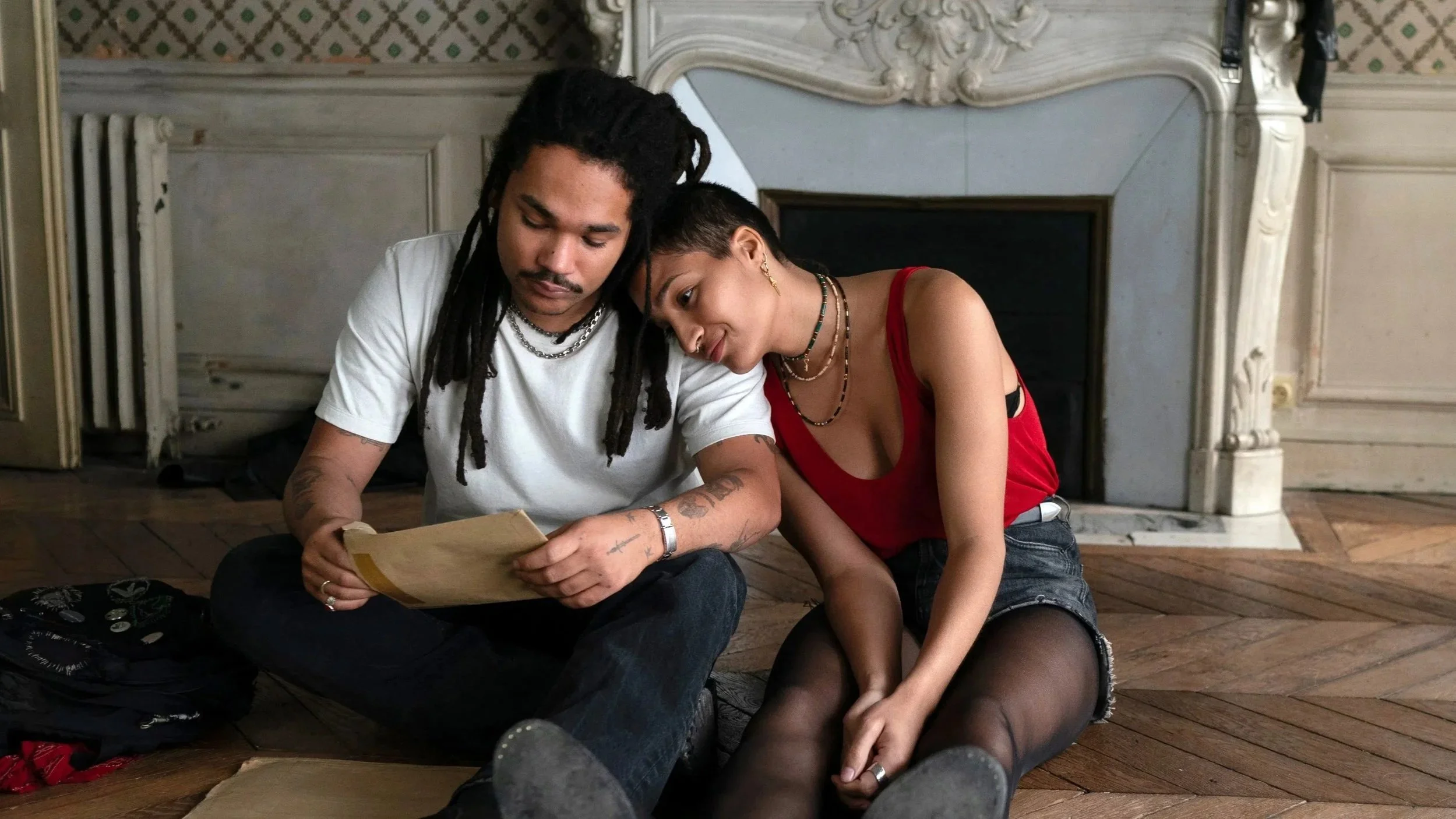
Luka Sabbat and Indya Moore
Image courtesy of Mubi.
by MANSEL STIMPSON
We have had to wait six years for a fresh feature film from Jim Jarmusch but he now offers us this characteristic piece which his admirers will undoubtedly want to see. It is a work which incorporates a triptych, each with a distinct cast but linked by their focus on family relationships. The first of these, ‘Father’, is set in America, the second ‘Mother’ in Dublin and the third ‘Sister Brother’ in Paris (the siblings were born in New York so that no subtitling is required regardless of the setting). This is not, of course, the first Jarmusch film to be made up of separate sections. 2003’s Coffee and Cigarettes contained no less than eleven vignettes and Night on Earth (1991) despite taking place during a single night portrayed five taxi rides in five different cities across the world. However, the pieces in this latest film are more significantly connected than those previously brought together: that’s because the viewer is being encouraged to reflect on the extent to which all three show family members who possess a limited knowledge of each other since most of us choose to have secrets by keeping things to ourselves.
Long famous as an independent filmmaker who writes his own screenplays, Jarmusch was born in 1953 and has been making his own idiosyncratic films since 1980. His work reflects a desire to bring together elements of American, European and Japanese cinema and in the process standard narratives and plots are often sidestepped. That is certainly the case with Father Mother Sister Brother since each segment contains little action and relies for its interest on the talk of the characters, what they reveal to each other and what they conceal. The language is less stylised than that of Harold Pinter but for all that it has its own individuality, its own voice and tone. His dialogue is written with precision and the same quality is to be found in his cinematic eye thus ensuring that the importance of what is said in his films is balanced by an acute visual sense.
The first offering in this new work, ‘Father’, illustrates perfectly what his signature style can provide. Here he shows us a son, Jeff (Adam Driver), and a daughter, Emily (Mayim Bialik), driving to the countryside to see their widowed father (Tom Waits). It is winter and it has been two years since they last visited. As the siblings talk, we learn that Emily is married and has two children but that Jeff is divorced. But if this tells us something about them the more puzzling figure is the father. Emily had been unaware that Jeff had sent money to support him and it may be that this rather eccentric man is indeed in need - or it could be that he is consciously making claims on the child whom he recognises as being the more susceptible to such demands. What is said during the time that these two spend with him is all made up of small talk and when they are invited to make a toast (one of them being to "family relations”) it is when drinking just tea or water. Although there are some viewers who may fail to engage with a piece in which so little actually happens, ‘Father’ can be regarded as Jarmusch at his very best. He is aided by his players. When Adam Driver first acted for him in 2016’s Paterson he showed how totally he understood the style of delivery required by Jarmusch's dialogue and Tom Waits has, of course, been associated with Jarmusch for a long time and is equally sure-footed. The surprise is that Mayim Bialik, an actress unknown to me, is equally in tune with the tone needed and as a bonus the episode is neatly rounded off by what we see of dad after his children have driven away.
For ‘Mother’ the film moves to Ireland where the mother in question (Charlotte Rampling), an authoress, is awaiting the annual visit of her two adult daughters. The older one is Timothea (Cate Blanchett) and the younger is Lilith (Vicky Krieps). In this instance the extra insight we are given comes not at the close of the piece but early on since we learn that Lilith is involved with Jeanette (Sarah Greene) and we wonder if this key development in her life will be acknowledged to her mother and sister. The casting ensures that these roles are well played but, while Blanchett has appeared in one earlier Jarmusch film (Coffee and Cigarettes), both Rampling and Krieps are working with him for the first time. One misses here that extraordinary sense of perfect instinctive synchronisation between artist and style present in ‘Father’. Similarly, the writing now feels slightly less assured and the piece rather than resonating tends at its close to just fade away.
‘Mother’ is certainly not unentertaining, but the triptych ends on firmer ground with the episode ‘Sister Brother.’ Here we see Skye (Indya Moore) arriving in Paris where her twin brother, Billy (Luka Sabbat), is busy emptying the apartment that had been owned by their parents and putting their belongings into storage. We gather that the parents who have been killed in an air crash had been unconventional in their behaviour and largely unknowable to their children. Nevertheless, their neglect of them has brought these two siblings closer together than those in the two earlier episodes. This is well caught by Moore and Sabbat and, although talk is still key, ‘Sister Brother’ with its emphasis on the empty rooms carries extra atmospheric resonance through its visuals.
Comparisons between the different families portrayed in Father Mother Sister Brother do indeed add to its fascination. In addition, Jarmusch playfully inserts touches that link the three sections. In each of them a Rolex watch features, skateboarders are seen in the background and in the dialogue the phrase “Bob’s Your Uncle” or a variation of it pops up three times. Visual parallels appear too as when each segment is found to contain overhead shots. The echoes provided in this way are a feature of the film but the extra weight that comes from bringing together what could have been three separate short films lies not in such incidentals but in the parallels and variations that we witness and which we recognise as part and parcel of human behaviour. A further sense of unity stems from the film’s use of music in which Jarmusch himself is involved and which includes two recordings of the song ‘Spooky’ – one by Annika Henderson and one by Dusty Springfield – which are expressive when it comes to setting the film’s tone. Given that the three sections are not equally impressive it could be argued that Father Mother Sister Brother was lucky to win the 2025 Golden Lion award as best film at the Venice Film Festival, but one doesn't begrudge that when for Jarmusch’s admirers ‘Father’ is pure gold.
Cast: Tom Waits, Adam Driver, Mayim Bialik, Charlotte Rampling, Cate Blanchett, Vicky Krieps, Sarah Greene, Indya Moore, Luka Sabbat, Françoise Lebrun, Philippe Azoury.
Dir Jim Jarmusch, Pro Charles Gillibert, Joshua Astrachan, Carter Logan and Atilla Silah Yücer Screenplay Jim Jarmusch, Ph Frederick Elmes and Yorick Le Saux, Pro Des Mark Friedberg and Marco Bittner Rosser, Ed Affonso Gonçalves, Music Jim Jarmusch and Annika, Costumes Catherine George.
Saint Laurent/Mubi/badjetlag/The Apartment/Screen Ireland/CG Cinéma/Cinema Inutile/Hail Mary Pictures/Les Films du Losange-Mubi.
110 mins. USA/France/Ireland/Turkey. 2024. US Rel: 24 December 2025. UK Rel: 10 April 2026. Cert. 15.
