Ghost Trail

Jonathan Millet’s feature debut is both a personal tale and a deeply felt comment on atrocities committed in Syria.
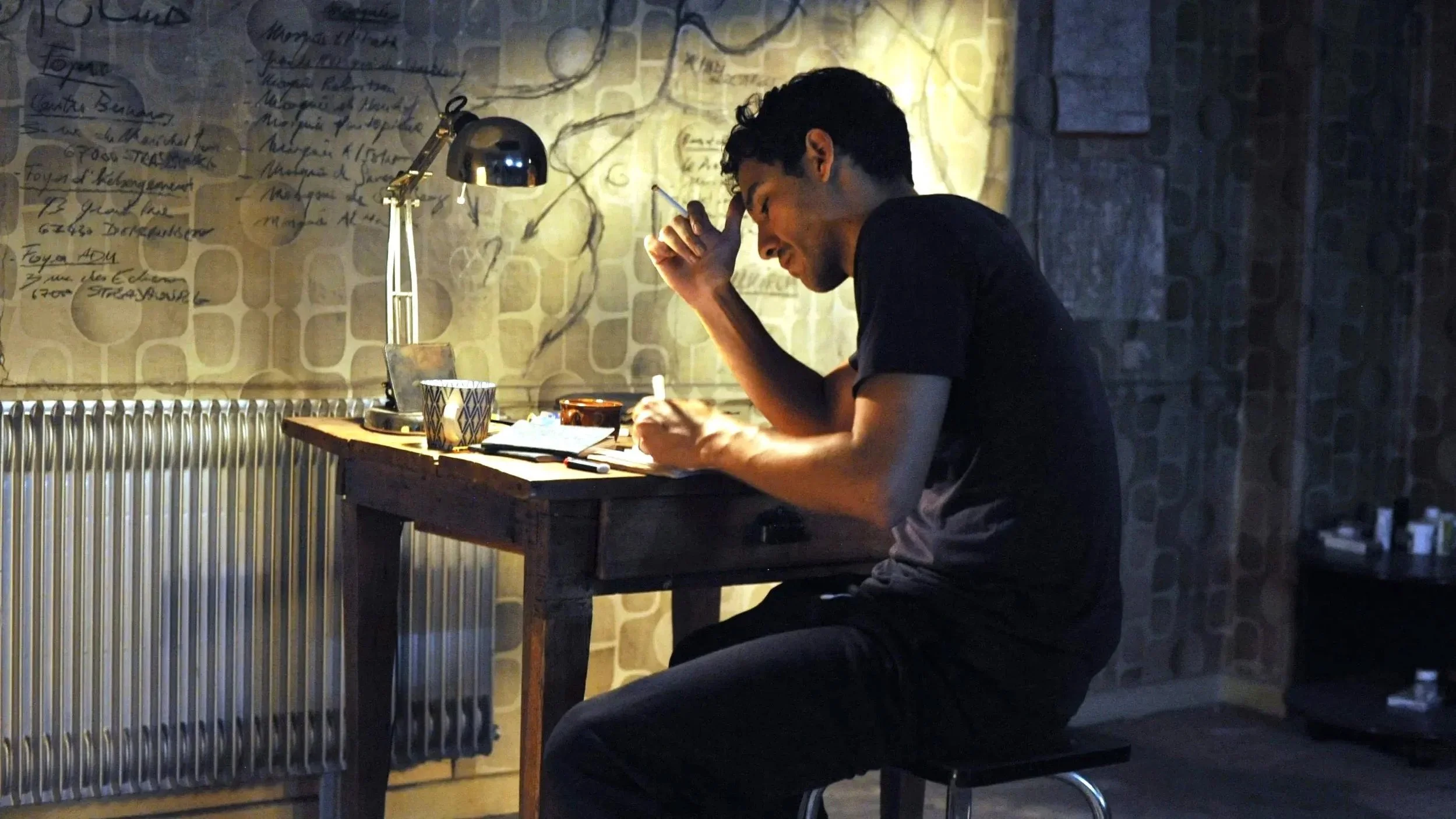
Adam Bessa
Image courtesy of New Wave Films.
Already an established documentarian, Jonathan Millet has with Ghost Trail created his first full length dramatic feature. He has said that it came about following research that he undertook back in 2015 regarding refugees from Syria. That was when he became aware of a group of vigilantes functioning in Germany whose aim was to track down former collaborators of Bashar al-Assad but realised that it was impractical to make a documentary film about them. Now, however, sharing the screenplay credit with Florence Rochat he has made just such a group the central figures in this award-winning drama. The origin of Ghost Trail helps one to understand the somewhat unusual nature of this film which is at one and the same time a kind of spy thriller and a work which is commenting indirectly but potently on torture inflicted by the Assad regime in such places as the Sednaya Prison which became known as a human slaughterhouse.
The opening of Ghost Trail is strikingly original as what initially appears to be a black screen gradually clarifies to reveal that we are inside a vehicle in which men have been herded together. We are told that this is Syria in 2014 and the men are left in the desert where they are likely to die. But then the film’s title appears on screen and we are now at the beginning of the main narrative set two years later and for the most part located in France in the city of Strasbourg. It is here that we find one of the men seen earlier, Hamid (Adam Bessa), who had been a professor of literature in Aleppo and whose mother (Shafiqa El Till) is living in a camp in Beirut. Hamid himself having survived has now become a refugee seeking asylum. But when phoning his mother Hamid claims to be in Berlin and thus, without the details immediately becoming clear, it is apparent that Hamid is involved in some secret activity which cannot be disclosed to her. In due course we realise that he is on the track of a man (Tawfeek Barhom) who has settled in Strasbourg and who, existing there under an assumed name, could well be a Syrian war criminal who had been employed in the military prison.
To disclose the plot to this extent may lessen the suspense of the early scenes which precede the film’s own disclosure of what Hamid is doing but it is necessary if one is to alert potential viewers who would be drawn to Ghost Trail if made aware of the way in which it comments on Assad’s time in power. There are no actual flashbacks to illustrate the horrors of Sednaya Prison and for some that may reduce the impact of the narrative. But, regardless of that, its stance, at once political and humane, is quite clear. It does, however, mean that on the surface at least the focus is on Hamid’s personal story and on the process whereby he attempts to check out the identity of the man he suspects of being a war criminal. Hamid has a handler, Nina (Julia Franz Richter), who will duly contact him from time to time but but he will also be helped by a Syrian woman, Yara (Hala Rajab) who befriends him. A key scene in the film occurs when, having already followed and observed his suspect at some length, Hamid at last comes face-to-face with him and they talk in a café. This is the film’s strongest scene although the issue of what should be done if the identity of the targeted man is confirmed (arrest him in expectation of legal proceedings or assassinate him to make a certain kill) will be discussed in another tense episode.
When one describes the story it suggests that Ghost Trail will be gripping throughout, but in the event it proves to be less exciting than many tales of this kind. One reason for that arises due to a deliberate decision: quite consciously the film is something of a character study, a portrait of how a man like Hamid intent on a form of justice which is nevertheless revenge as well may become obsessed by his quest. In doing so he lets it take over from everything else in his life (in other circumstances his rapport with the helpful Nina might well have led to a relationship). The cost of his obsession to Hamid himself is indeed very much a central aspect here.
However, another factor is also present which plays its part in making this a less involving and tense story than expected and it is related to the portrayal of the way in which the film shows the contact between Hamid and the other members of the vigilante group. The film carries that familiar tag "inspired by true events" and it seems entirely appropriate to tell the story in a wholly naturalistic way so that the viewer feels present at actual events. But Millet’s approach when dealing with the messages that pass between Hamid and the others in the vigilante group can jar. The first time that this happens it arises when, without explanation, the film cuts to a video war game being played out. Initially it doesn't seem to fit at all, but then we realise that the game which fills the screen is one being played by the vigilantes and that the game is being used as their means of contact. We can then accept it but it disrupts the flow of the film. Later on, a touch of stylisation is allowed in by letting us hear Nina’s voice as she addresses Hamid but without the visuals accompanying this providing a source for them (it might on occasion represent words received earlier repeated in Hamid’s mind but the stylisation and the uncertainty again disrupt our sense of being directly involved in what is happening). Many a film could incorporate such a touch with ease but Ghost Trail’s narrative is one in which the sense of authenticity needs to be scrupulously maintained if we are to feel fully caught up in it. However, this is a film which is aided by strong performances from Bessa, Barhom and Rajab all of whom are well cast. Furthermore, the drama usefully extends late on to sequences in fresh locations, including Berlin, Beirut and Lebanon. Even so, while never losing interest, I felt less emotionally involved with Hamid and his situation than I had expected to be. The film is certainly one with good points yet for me what should have been a memorable and haunting drama fell some way short of achieving that.
Original title: Les fantômes.
MANSEL STIMPSON
Cast: Adam Bessa, Tawfeek Barhom, Julia Franz Richter, Hala Rajab, Shafiqa El Till, Sylvain Samson, Mohammad Saboor Rasooli, Marie Rémond, Dorado Jadiba, Islam Awadi, Fakher Aldeen Fayad.
Dir Jonathan Millet, Pro Pauline Seigland, Screenplay Jonathan Millet and Florence Rochat, Ph Olivier Boonjing, Art Dir Esther Mysius, Ed Laurent Sénéchal, Music Yuksek, Costumes Anne-Sophie Gledhill.
Niko Films/Films Grand Huit/Hélicotronic/Arte France Cinéma/Canal+/Ciné+.-New Wave Films.
107 mins. France/Germany/Belgium. 2024. US Rel: 30 May 2025. UK Rel: 19 September 2025. Cert. 15.