
Goebbels and the Führer

Joseph Goebbels, the Third Reich’s Minister of Propaganda, gets his say in a docudrama that proves all too relevant today.
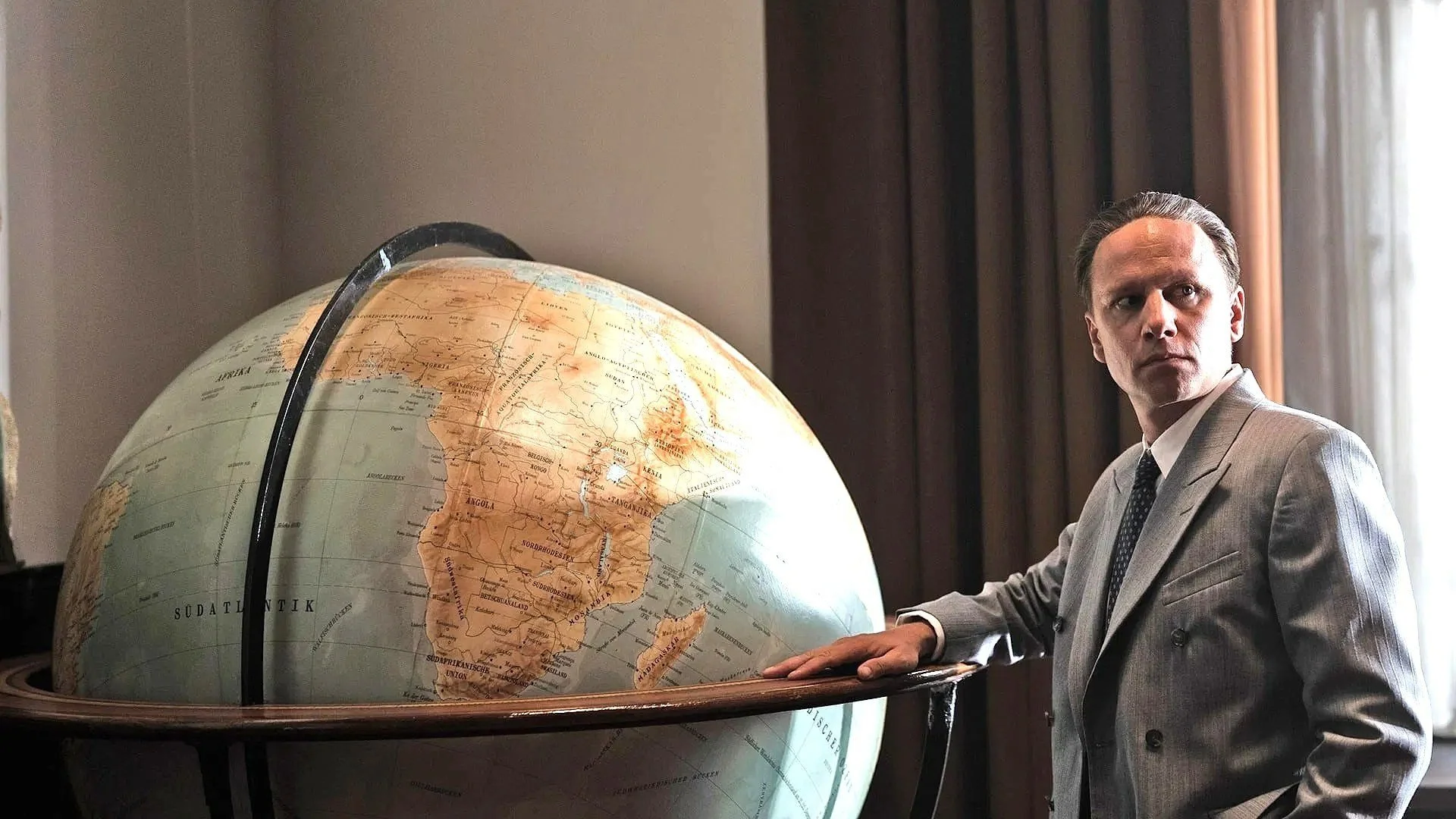
The world and Robert Stadlober
Image courtesy of Miracle Comms.
Over the years so many films have been made relating to the Second World War that it might well be thought that no new approach could now be found. That makes it all the more surprising that the German writer/director Joachim A. Lang should now be giving us this film which treads new ground and does so in two ways. The first of these is evidenced by the prominence that it gives to Joseph Goebbels, the Third Reich’s Minister of Propaganda. The original title of the film was Fuhrer und Verfuhrer which translates as "leader and seducer" and the word ‘fuhrer’ has become so closely associated with Hitler that one might well assume that the reference is entirely to him. However, the English title puts Goebbels first and in doing so it reflects the fact that for once it is indeed he rather than Hitler who is the central figure here.
What Lang tells us at the outset is that he is opting to look at how Goebbels shaped the image of Hitler and that of national socialism and, while he recognises that viewing events from the perpetrators’ perspective may be risky, he regards it as necessary. His justification for that view is that taking an up-close look at the biggest villains of history strips the masks from their faces and thus disarms the demagogues of the present. What we see on screen is a drama played out by actors and set exclusively in the period between March 1938 and April 1945 but, since Goebbels is made the crucial figure, it becomes an outline of the war in which the skill of Goebbels in creating propaganda based on false statements foreshadows revealingly the state of things in the world today. Whether by concealing the truth from the German people or by organising events in which what would appear spontaneous had in fact been carefully set up, Goebbels was giving lessons which have been all too well learnt by the chief autocrats of our times.
This aspect of what Goebbels did is a key one in this film, but it may also be said to have another function in that it clearly shows the strategy and the horror of what the Nazis were doing at this time. As such its general view of the war is one that has value in retelling what happened for a younger generation who may be ill- informed and who need to be given a clear picture of these events having regard to the rise of Neo-Nazism. But, if the aim here is admirable, what we have on the screen while certainly of interest is not always as dramatically compelling as one would wish.
Lang has stressed that the dialogue in his film is based on thorough research and indeed includes many direct quotes. It could be that this desire for veracity has encouraged him to give the piece a documentary tone and it is the case that, despite using the wide screen, he adopts decidedly subdued colouring which helps to play down the contrast when actual historical footage in black-and-white is incorporated. Nevertheless, this mode does lower the dramatic tension somewhat although Robert Stadlober is a strong presence as Goebbels and Franziska Weisz is well-cast as his wife, Magda. The film is less effective when it comes to Fritz Karl’s portrayal of Hitler. There is a lack of any sense of his famed charisma which extended beyond his magnetic appeal as a public speaker and was shown when he won over individuals who had been ready to doubt his wisdom. It is true that for much of the time we see Hitler in intimate settings – he was particularly close to Goebbels, Magda and their children – but even so one feels that with hardly any signs of this aspect of his character the portrait is incomplete.
In limiting itself to this period, the film ignores the earlier life of Goebbels. However, Hitler wanted to promote Goebbels, Magda and their children as a perfect German family and the film accordingly does include episodes concerning the affair which Goebbels had with the Czech actress Lída Baarová (Katia Fellin) and which he broke off at Hitler's insistence. However, the scenes portraying their romance contain dialogue which is not always readily persuasive despite the film’s concern with authenticity. More convincingly we witness the ambitious Goebbels putting down men such as Göring (Oliver Fleischer) and Himmler (Martin Bermoser) as he seeks to become second only to Hitler. His own anti-Semitism appears to have spurred on Hitler's own commitment to exterminate the Jews and there are extracts here from the notorious 1940 film Jud Süss which he promoted. One fact about it referenced here which will startle many a cinephile is that when that work was shown at the Venice Film Festival a critic named Michelangelo Antonioni praised it for its cinematic achievement.
For Lang's film to tell the general history of the war but to record it essentially from the perspective of Goebbels and Hitler is entirely acceptable since it is self-evident that the work is anything but an endorsement of these men. In light of that, it is encouraging to note that the film won the Audience Award at the 2024 Munich Film Festival. But, strong as its message is, this is not a film possessed of a high voltage. It hits home most in its last minutes. Here it quotes from Primo Levi who called the era of the Third Reich the greatest crime in history but even more significantly it gives the last word to a survivor of the concentration camps, Margot Friedländer, and she strikes exactly the right note.
Original title: Führer und Verführer.
MANSEL STIMPSON
Cast: Robert Stadlober, Fritz Karl, Franziska Weisz, Dominik Maringer, Moritz Führmann, Till Firit, Christoph Franken, Michael Glantschnig, Oliver Fleischer, Katia Fellin, Martin Bermoser, Johannes Rhomberg, Wolfram Rupperti, Emanuel Fellmer, Samuel Fischer, Raphaela Möst, Sebastian Thiers, and with the participation of Margot Friedländer.
Dir Joachim A. Lang, Pro Till Derenbach and Michael Souvignier, Screenplay Joachim A. Lang, Ph Klaus Fuxjäger, Pro Des Pierre Pfundt, Ed Rainer Nigrelli, Music Michael Klaukien, Costumes Katarina Bielikova.
Zietsprung Pictures/SWR/Maya-Miracle Comms.
123 mins. Germany/Slovakia. 2024. US Rel: 4 November 2024. UK Rel: 6 June 2025. Cert. 15.
