
Harvest

The Greek director Athina Rachel Tsangari sets her folk-drama in medieval Scotland, exploring themes of prejudice and exploitation.
Caleb Landry Jones
Image courtesy of Mubi.
For the Greek filmmaker Athina Rachel Tsangari, this fourth feature is a bold undertaking. It comes almost a decade after its predecessor Chevalier, it is her first film in English and, co-written by Joslyn Barnes and herself, it is based on a novel by Jim Crace which has long been considered a difficult work to adapt for another medium. In the event Harvest is a film which has divided opinion with Tsangari herself acknowledging that a comparison with Marmite is not out of place. Having myself felt that Chevalier did not really live up to Attenberg (the 2010 film which first brought this director to prominence), I was quite uncertain how I would respond to Harvest but for the most part I found it much more interesting than some reviews had led me to expect.
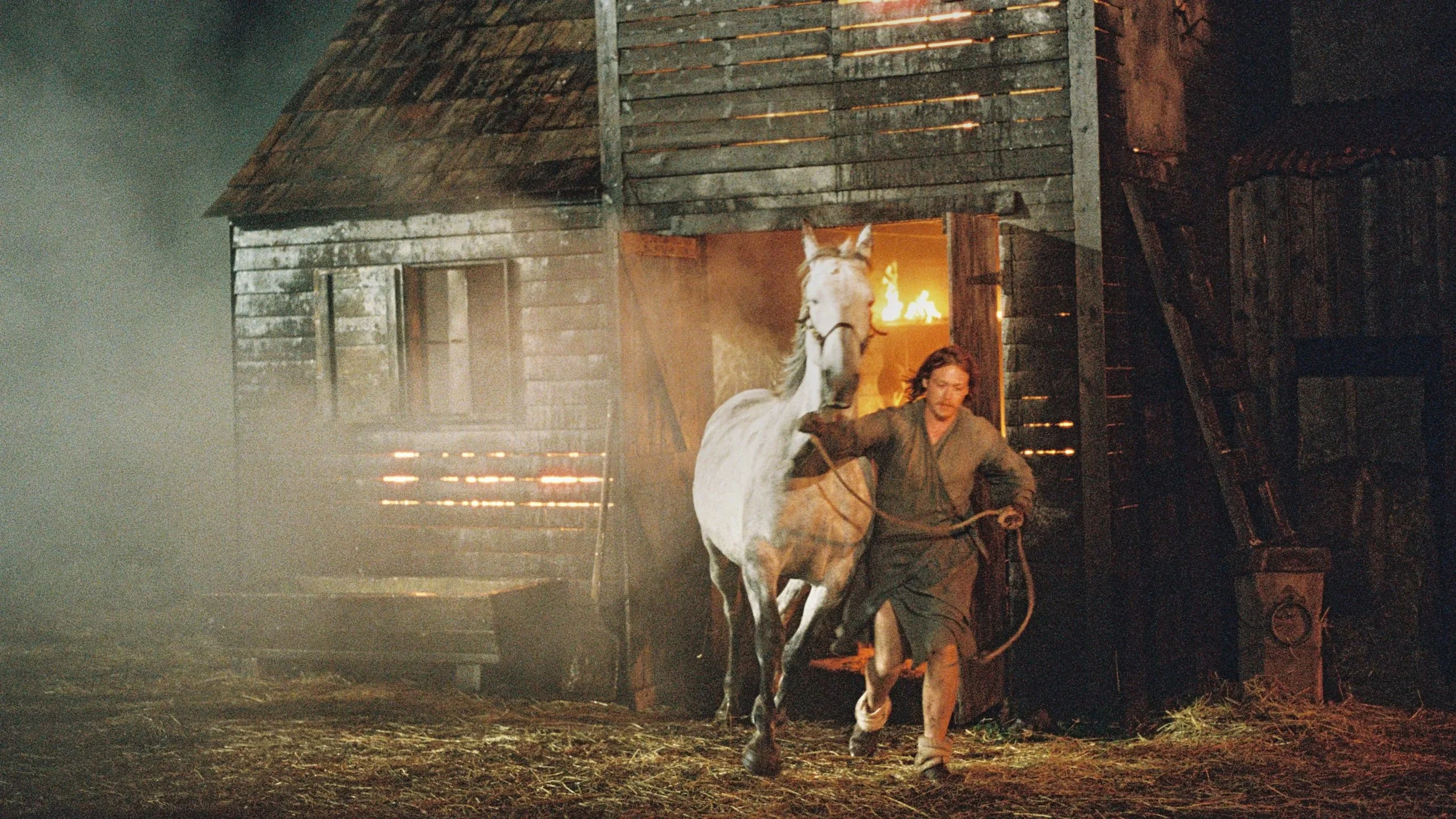
Harvest is a work which evokes the past yet does so with the intention that it should be seen as relevant to our own age. Although clearly a period piece, it avoids direct reference to events that would date it precisely. Instead, it plunges us into a rural setting in Scotland at some time before the industrial revolution when most of the villagers still had a firm belief in witchcraft. Theirs is a community closed in on itself and with little contact with the wider world. Its inhabitants discourage those who might consider going beyond its boundaries and, while their life is harsh and rooted in the land, they at least have the advantage that the lord of the manor, Master Kent (Harry Melling), is a considerate man. But their outlook is such that they are hostile to strangers: they view them suspiciously and treat them as scapegoats when some untoward event occurs for which someone needs to carry the blame. Just such an incident occurs early on in the film when a stable belonging to Master Kent is set on fire and individuals newly arrived from another village are treated as being responsible. Three of them are put in the pillory, one of them being a woman (Thalissa Teixeira).
Another stranger is viewed with suspicion too and that is the cartographer Earle (Arinzé Kene) who is introduced by Master Kent as somebody who will prepare a map of the area which will define and name its features. Even Walter Thirsk (Caleb Landry Jones) is only partially accepted. Now a widower farming in the area and known to Master Kent since childhood (Walter’s mother had been his milk nurse), he is not quite one of the people even if he has now established a relationship with a local widow, Kitty Gosse (Rosy McEwen). Essentially a man apart, Walter also plays a special role in the narrative since from time to time it is he who provides a voice-over commentary reflecting on the community and sharing his thoughts with us.
Quite enough is going on for this portrait of the village community to hold our interest: its pagan beliefs and ancient ceremonies (the celebration of the harvest, the selection of a Gleaning Queen) add to the period atmosphere while its hostility to strangers carries wider relevance (indeed the skin colour of Earle and of the woman placed in the pillory underline racism as part of the issue). However, it is in the film’s last third that a further element becomes central to the tale. It turns out that the manor had belonged to Master Kent’s late wife and its true owner is his cousin, Master Jordan (Frank Dillane). This man now arrives in person and we soon learn that it was he who had employed Earle and that the map being prepared is linked to his plans to transform what had been common land into a site that he will fully control as a sheep farm run for profit. This development brings to the tale distinct echoes of the Highland Clearances and of the Enclosure Acts emphasising the way in which such changes can readily lead to the locals becoming victims. Some might nevertheless see this as progress but, without glamorising what had gone before, Harvest clearly invites us to question this and to ponder the extent to which the injustices present in this tale remain relevant to society today.
To some extent those hostile to Tsangari’s film may have been influenced by expecting it to be what it is not. Publicity seems to have compared it in part to a western, a genre which carries the expectation of having action at its centre. Similarly, the rural period setting in which residents readily resort to violence against those thought to practice witchcraft may suggest a work that will lead into the territory of folk horror. But, while Harvest is not without bloodshed, it is much more about social issues and that may disappoint some. In her direction Tsangari seeks to make the film an immersive experience with much use of close-ups and adroit editing. At the same time the film is unhurried. That can feel apt, but it does provide the opportunity to question details in the writing including the rather literary character of Walter's voice-over comments. The leading players all do well but some subsidiary roles are less persuasive. Furthermore, although the running length of 134 minutes is sustained, there is a sense that the later scenes needed an extra intensity for their power to be fully expressed and some tightening might have achieved that.
By the close one feels that Harvest is a considered piece that often works well but which even so doesn't have quite the dramatic heft required. The tale is such that it takes the unusual course of showing Walter having an instinct for what is right but failing to follow through even though he might have been expected to emerge as the hero here. Furthermore, his weakness echoes that of Master Kent who, faced with his cousin’s ruthlessness, offers no challenge or criticism. Their inability to take a stand can be read as a warning to others who fail to act, but the tragedy of their failure should have been more deeply felt. Even so, Harvest has a character of its own and, if anyone is surprised by Tsangari choosing to make this particular film, the work’s dedication at its close can be seen an explanation for it and one that is of a highly personal nature: it reads "For my grandparents whose farmland is now a highway".
MANSEL STIMPSON
Cast: Caleb Landry Jones, Harry Melling, Rosy McEwen, Arinzé Kene, Frank Dillane, Thalissa Teixeira, Neil Leiper, Maya Bonniwell, Noor Dillan-Night, Gary Maitland, Gordon Brown, Emma Hindle, Antonia Quirke, Stephen McMillan, Nicola Moll, Paul Fegan.
Dir Athina Rachel Tsangari, Pro Rebeca O’Brien, Joslyn Barnes, Michael Weber, Viola Fugen, Athina Rachel Tsangari and Marie-Elena Dyche, Screenplay Joslyn Barnes and Athina Rachel Tsangari, from the novel by Jim Crace, Ph Sean Price Williams, Pro Des Nathan Parker, Ed Matt Johnson and Nico Leunen, Music Nicolas Becker, Ian Hassett, Caleb Landry Jones, Lexx and The Harvest Family Band, Costumes Kirsty Halliday.
Sixteen Films/Louverture Films/The Match Factory/Haos Film/WhyNot Productions/Arte France Cinéma/BBC Film/Screen Scotland/Carte Blanche/Faliro House Productions/In Bloom/Roag Films-Mubi.
134 mins. UK/USA/Greece/Germany/France/Italy. 2024. UK Rel: 18 July 2025. Cert. 18.
