
Hen

A chicken takes centre stage in a most unusual political comedy-drama from Greece.
Home to roost
Image courtesy of Conic.
by MANSEL STIMPSON
I have not seen a film which in any way resembles this one since watching Hukkle over twenty years ago. That is not really surprising since Hukkle was the first feature of the Hungarian director György Pálfi and Hen is his latest - and there is no doubt at all about his being a highly individual and idiosyncratic filmmaker. In the period between these two works he has made a number of feature films which have passed me by and which for the most part have remained unseen in the UK. That Hen should now be distributed here is perhaps down to the fact that the titular figure is indeed the film’s central character and that may help to attract an audience even if they then discover that Hen is far from being the kind of endearing animal tale that they may suppose.
Hukkle was made in 2002 yet only appeared in UK cinemas two years later, but it was so unusual that it might well have failed to find a distributor here. The film was a portrayal of life in a Hungarian village which time seemed to have passed by. It was shot virtually without dialogue although various villagers were seen. However, they appeared alongside an amazing variety of animals including cats, dogs, snakes, pigs, fish, sheep and, yes, hens. If at times these creatures seemed to be observing the human beings, Pálfi’s film viewed the latter with as much detached curiosity as when it focused on the animals. Meanwhile the comic details, which abounded but which the audience were often left to pick out for themselves, carried echoes of Jacques Tati. Nevertheless, the second half of Hukkle became much darker incorporating a murder and more than one funeral.
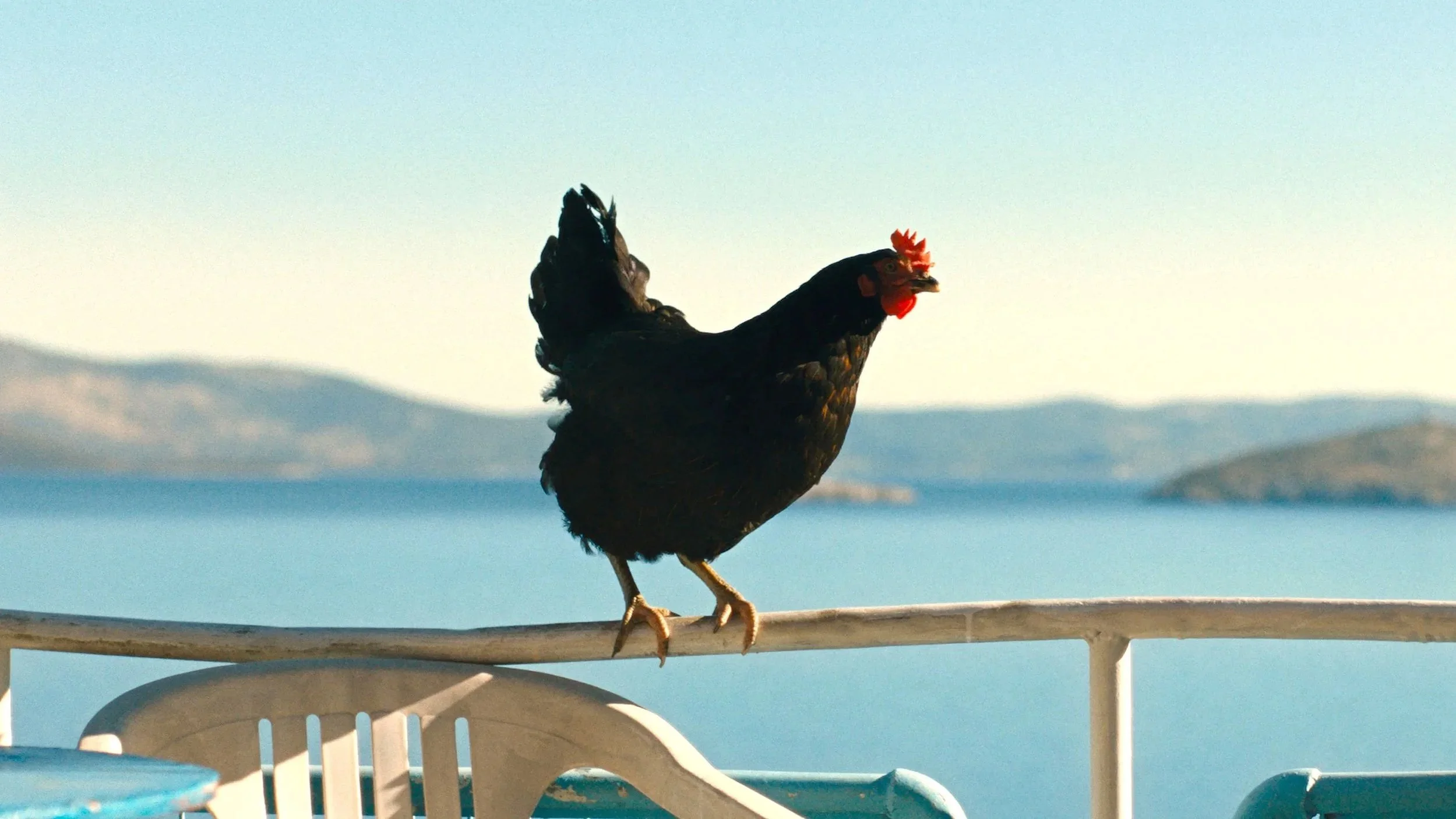
It is worth looking back on Hukkle now, partly to note how the two films differ but even more to underline just how much they have in common. There is slightly more dialogue this time, yet even so Hen contains only a limited amount of it and again a range of animals appear. One particular hen is the central figure but, in addition to other hens and roosters, a dog features and we see too a fox as well as birds, cats and goats. What unfolds is the story of a black bantam with the egg from which it will hatch being seen in the opening moments of the film. The setting for that is a commercial hatchery and these early shots (Hen is a widescreen movie splendidly photographed by Giorgos Karvelas) immediately attest to Pálfi’s inventive eye for striking compositions. The fact that our hen is black and looking out of place among all the yellow chicks leads to it becoming a reject, but that also gives it an opportunity to run away. In doing so it encounters various early hazards but is then picked up by a dog which brings it to his master who runs a seafood taverna (the film was shot near the Mediterranean coast). This man played by Yannis Kokiasmenos is in effect the main human character in the story since he keeps the hen, puts it in a coop and when it is endangered looks after it. While supplying egg after egg is the most notable feature of this hen’s life, a fondness for getting free is equally central and eggs drop in all kinds of places both indoors and out.
Several critics have rightly praised the skill with which the tale is told, this being a work which rejects any use whatever of CGI or AI (indeed the film’s cast list gives pride of place to the eight hens who appear as the black chicken). However, there has also been a tendency to compare Hen with films in which the central focus is the fate of an animal, works such as the 2021 documentaries Gunda and Cow as well as dramas such as EO(2023). However, Hen vitally differs from those films in that the suffering of animals is not its absolute focus and what we get is a view of life in which we are invited to follow two dramas at once: one of these is indeed what happens to the hen (that being what plays out in the foreground) and the other concerns the restaurant owner and his family and their fate. The emphasis on the hen results in this human tale emerging almost indirectly and in the background but it involves quite as much suffering, if not indeed more, than is found among the animals.
In contrast to Hukkle, Hen has a stronger plot line and one which with only a touch or two of repetition enables it to run longer (98 minutes). But it does resemble the earlier film in growing decidedly more grim. As a sideline to his business, the man has allowed himself to become involved with smugglers. When that involves dealing with cigarettes, this may be excusable, but we find that it has transformed into people trafficking and, when things go wrong and he seeks to back out, the smugglers’ boss man (Andoni Kafetzopoulos) becomes an even graver threat than the police. Some of these scenes and especially one in which a van filled with corpses is set on fire are decidedly uncomfortable viewing. This same episode involves the hen and is likely to be very disturbing for animal lovers and certainly squashes any notion that this hen's tale might have Disneyesque appeal to the young, as indeed does the ‘15' certificate. Arguably the statement in the end credits that all animals were treated with full care comes too late to compensate for the shock.
The difficult task of making a film like this is carried off with remarkable skill. When one has seen it and can assess it whole, the work, one which also earns a bonus mark for its unusual and atmospheric music score, is probably closest to Robert Bresson’s 1966 classic Au hasard Balthazar. While not in quite the same way, both works are presenting the story of an animal as one to invite reflection on the extent to which kindness and cruelty play a comparable role whether one is considering the lives of human beings or of animals. With Bresson there is always a religious element that is obviously not present in Hen and to some extent I feel that Pálfi’s film rather than making any clear-cut statement is instead telling two stories which in tandem are extremely thought-provoking. That may not have yielded a masterpiece, but this is a fascinatingly individual film and for such offbeat material to come across with that impact is an achievement in itself.
Original title: Kota.
Cast: The hens (Feri, Anett, Nóra, Eti, Szandi, Enci, Eszter and Enikö), the roosters (Árpi and Rozsdás) and the dog (Bruti) and Yannis Kokiasmenos, Maria Diakopanagiotou, Argyris Pandazaras, Machmod Bamerny, Chronis Barbarian, Andoni Kafetzopoulos, Nikos Kattis, Dimitris Pelekis, Antonis Tsiotiopoulos, Eleni Apostopoulou.
Dir György Pálfi,Pro Thanassis Karathanos, Giorgos Kiriakos, Martin Hampel and Costas Lambropoulos, Screenplay György Pálfi and Zsofia Ruttkay, Ph Giorgos Karvelas, Pro Des Constantinos Zamanis, Ed Réka Lemhényi, Music Szabolcs Szöke, Costumes Vassilis Barbarigos.
View Master Films/Pallas Film/Twenty Twenty Vision Filmproduktion/Hellenic Broadcasting Corporation (ERT)/ZDF/Arte-Conic.
96 mins. Germany/Greece/Hungary/UK/France. 2025. UK Rel: 22 May 2026. Cert. 15.
