
How Deep Is Your Love

Eleanor Mortimer’s valuable documentary explores new and undiscovered life on the ocean floor as it faces extinction at the hands of deep-sea mining.
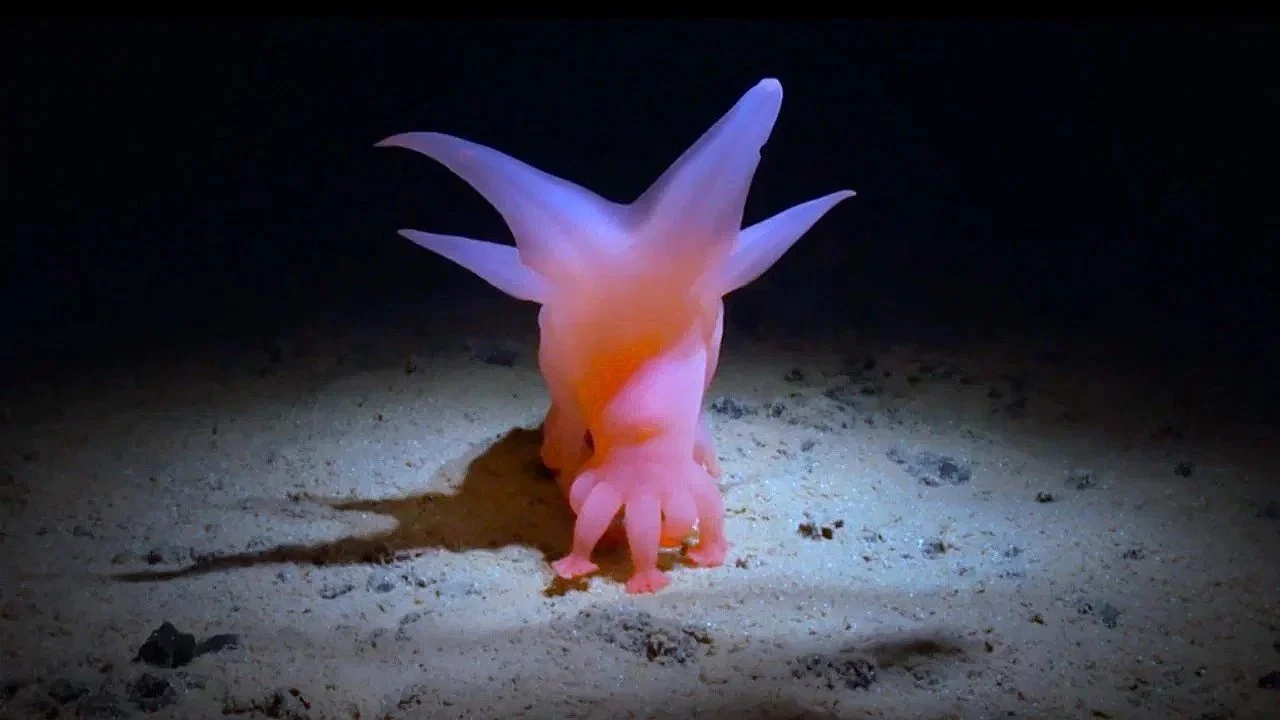
Image courtesy of Tull Stories.
by MANSEL STIMPSON
With its UK release following close on from that of North Sea, Nature Untamed, it is only natural to compare these two works yet in some key respects they are very different. Both are documentaries concerned with underwater worlds but How Deep Is Your Love is set far away from the North Sea. Its sea bed is in the Pacific Ocean and is found in that part of it known as the Clarion-Clipperton fracture zone. Nevertheless, both works while revealing living things found deep down below are also concerned with threats that face them. In his film Mark Verkerk is warning of damage caused by trawlers and by the offshore wind farms in the North Sea while Eleanor Mortimer’s concern here is with deep-sea mining. She is aware of the risk that the International Seabed Authority, which has negotiated rules for some forty years in this respect, might grant licenses which would recognise the value of the metals in the rocks but would lead to disruption of the work of marine biologists whose studies are far from complete.
The North Sea documentary touched on a number of locations, covered various elements and was notable for the exceptional underwater photography of its central figure and narrator, Peter van Rodijinen. In How Deep Is Your Love Eleanor Mortimer is director, photographer and narrator while in addition she is seen travelling as an observer on board the research vessel, the James Cook, as it sets off on this expedition to Clarion-Clipperton. This voyage will last for around fifty days and on board will be deep-sea specialists who are biologists, scientists or ecologists. The greater part of the film takes place on the ship, explains how robots are lowered to obtain pictures from the depths and shows how specimens are brought up to be examined and in many cases to be named. One of the great differences between these two films is that the range of life in the North Sea consists of species known to us while those seen here are in many cases part of the vast number of unknown inhabitants. Those who make an appearance include cucumbers, sponges, amphipods, and brachiopods as well as such oddly named creatures as the headless chicken monster, the gummy squirrel and the ghost octopus. Many are less colourful than what we see in North Sea, Nature Untamed which gives that film the upper hand in beautiful images but here the significance lies in the novelty value.
In the case of Mark Verkerk’s film, I found myself rejecting the matey tone of the commentary and in that respect Eleanor Mortimer’s style seems a more appropriate one. Nevertheless, her tone of delivery is so uniform that it does add to the sense of this film proceeding on too even a keel for its own good. The threats that could cut short the time available to examine this little-known underworld are made clear and there is plenty of material showing the work being done by the experts on board the ship. But, despite that, How Deep Is Your Love, however passionate about its concerns, does lack any real sense of excitement. The fact that at intervals the film cuts away from the Pacific to report on events at a key conference in Kingston, Jamaica held by the ISA does suggest an attempt to liven things up (the 28th session touching on Clarion-Clipperton is, we are told, one which finds us at the crossroads if no agreement about mining is reached since without it unregulated activity causing damage to the seabed is likely to occur.) But, by returning to this particular conference more than once in bits and pieces, it comes to seem a bit stretched out and repetitive rather than adding power to the film. For a spot of drama, one has to turn instead to Greenpeace protestors appearing, an event which leads to a lament that their appropriate concerns should lead them to approach not a mining company craft but an oceanographic research vessel.
The sincerity behind the movie is not to be doubted, but I do find myself regretting some moves in the later stages which are again presumably intended to enliven the film. That includes some pop songs suddenly featured on the soundtrack, some speeded-up shots and the superimposition of images of underwater creatures over shots of people on dry land which just seem too clever-clever. Ultimately, despite the good things in this documentary, I came to the conclusion that North Sea, Nature Untamed is the film more likely to impress a wide audience. But, even so, the fact remains that this film’s focus on forms of life which are even now being discovered is the main point of it and on that score it is valuable and stands alone.
Featuring Lupita Bribiesca Contreras, Bethany Fleming, Eva Stewart, Maria Belen Arias, Adrian Glover, Lucas King, Daniel Jones, Emre Mutlu, Lotty Astbury, Solomon Pili Kaho‘ohalahala and Eleanor Mortimer as narrator.
Dir Eleanor Mortimer, Pro Jacob Thomas, Screenplay Eleanor Mortimer, Ph Eleanor Mortimer, Ed Nicole Hálová and Maya Daisy Hawke, Music Fraya Thomsen.
Sandbox Films/Luna Film/Ngauruhoe Films/BFI Doc Society Fund-Tull Stories.
100 mins. UK. 2025. UK Rel: 2 October 2026. Cert. 12A.
