
Just an Illusion

Éric Toledano and Olivier Nakache’s coming-of-age comedy-drama set in 1980s’ Paris is not up to their previous standard.
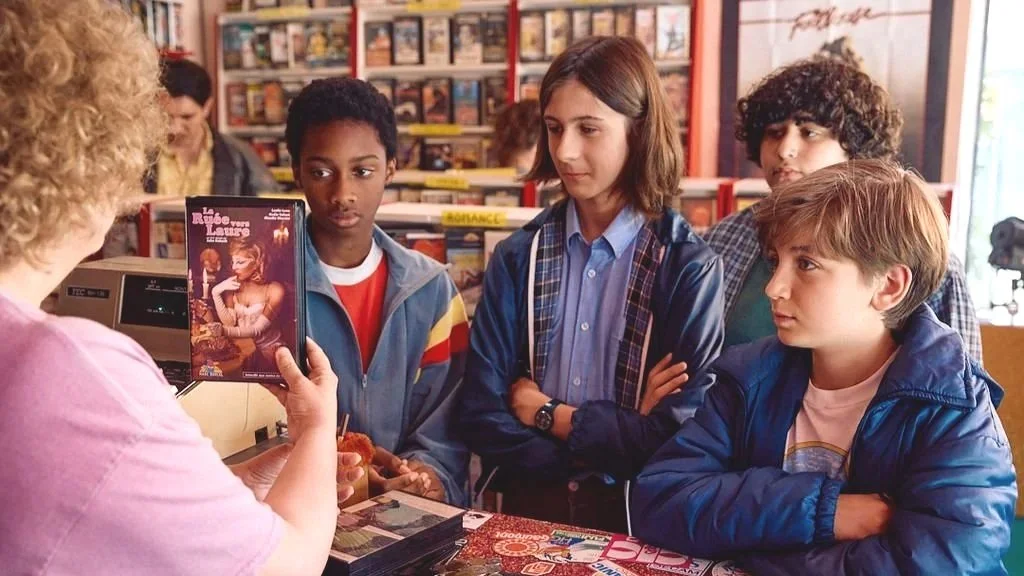
Image courtesy of Metfilm Distribution.
by MANSEL STIMPSON
The real star of this film, a piece set in the suburbs of Paris in the 1980s, is the child actor Simon Boublil in the key role of 12-year-old Vincent Dayan. Although young Boublil, now fourteen, had made one earlier screen appearance in a supporting role, this is the film that gives him the opportunity to shine. To be able to recognise his talent is a pleasure but what is also apparent is that he deserved to make his mark in a much better film than this one.
Just an Illusion is the work of the established French duo, Éric Toledano and Olivier Nakache, who as writers and directors have now created nine feature films together among which 2011's Untouchable stands out. Like most of their work, popular appeal was its aim and it succeeded so well that it broke records for global admissions to a French language film. While its popularity was greatly aided by the performances of its two leading actors, François Cluzet and Omar Sy, the movie also proved that Toledano and Nakache could be very adept when creating a work that combined comedy and drama. That is a mixture that has been present in many of their films including this latest one, but, in contrast to Untouchable, it has sometimes yielded works that failed to make the blend work and that is particularly true in the case of Just an Illusion.
Vincent is the younger son of Yves (Louis Garrel) and Sandrine (Camille Cottin) and has an older brother, Arnaud (Alexis Rosenstiehl), the latter being not just in the same household but having to share the same room with Vincent which makes for contention. Vincent has a group of school friends with whom he hangs out, but much of the time he is obsessed with another pupil, Anne-Karine Duchesnay (Jeanne Lamartine). The girl clearly disdains him and is stand-offish when Vincent is selected to collaborate with her over their preparation of school work. However, for Vincent this is a case of first love and he is unwilling to give up. He does indeed start to win her over in time even if that is partly achieved by pretending that the posters in his room reflect his taste in music when, truth to tell, they belong to his brother.
Vincent’s other key concern at this time is that he is preparing for his bar mitzvah and the speech that he is preparing for this will provide the film’s emotional climax. However, Just an Illusion rather than being built around a strong plot opts to fuse together a series of story threads attached to each of its central characters. In the case of Vincent's father, we learn early on that, despite having obtained an executive post and prided himself on that achievement, he has just been fired but is trying to conceal that fact by pretending to go to work while actually seeking another post. Meanwhile and in contrast to that, mother is at long last faring better: having been a secretary in the same firm for fifteen years (a situation that she describes as having been stifling) she now has a chance of promotion. But, if that prospect makes her happy, it is also apparent that she and Yves are constantly arguing, a situation which might even lead to divorce. Indeed, the film plays up the possibility that the caretaker of the block where the family live, Etienne Berger played by Pierre Lottin, may well have his eye on Sandrine. When it comes to Vincent's brother, Arnaud, there are concerns about how this adolescent has come by money in his possession, but his main function in the story lies in the sibling relationship.
It is, of course, quite possible for an episodic, character piece to provide an endearing entertainment but, if it is to do so, its tone is of the essence. That is all the more so when, as here, there are both comic and dramatic elements combined. In Simon Boublil the film has a remarkably sure-footed young actor who can certainly handle comedy (an extra plot thread finds Vincent desperately trying to recover a porn video which he has hidden in a chess box which unexpectedly gets passed to the local rabbi). But, even more importantly, Boublil conveys a vulnerability which could make us feel for Vincent in his attachment to Anne Karine (once she responds more positively to him her parents intervene to disapprove). That the potential for that is not realised comes down to the fact that on this occasion Toledano and Nakache prove so inept when seeking to blend the comic and the dramatic.
So far as Vincent is concerned, the writing lets the actor down by failing to realise that to work well in this context the comedy needs to be lifelike and to avoid exaggeration. Instead of that the film adopts a broad comic tone all too well illustrated in an early scene in Anne-Karine’s house. Vincent’s arrival there for their schoolwork session finds him first spilling some ink and then inadvertently giving her father the impression that he wears lipstick. As for Louis Garrel, the actor seems all at sea since the writing in the scenes depicting the father's pretence that he is still employed quite fails to balance the comedy and the pathos in his situation. One might feel that the comic element is paramount, but that impression clashes with scenes in which this Jewish family with both Algerian and Moroccan ancestry consider their history and whether or not in these circumstances their lives in Paris enable them to identify as French.
As if finding a viable blend were not already difficult enough, the film also features a lot of songs that are heard on the soundtrack and, as though it wants to be a musical, it even extends to a dance number for Sandrine and Yves to the song ‘I’m So Excited’ by the Pointer Sisters. Later 10CC’s ‘I’m Not In Love’ takes over as a stylised representation of Vincent’s love for Anne-Karine. All of this adds to the challenge of our finding a way to believe in the characters sufficiently to respond to the situations both comic and serious in which they find themselves. Some audiences may be willing just to sit back and treat this as light, escapist entertainment ignoring the elements closer to drama rather than to comedy. Yet the fact is that those elements are undoubtedly present and intended but are ultimately ignored by the filmmakers themselves. At its close Just an Illusion opts for a feel-good conclusion but it is all too obvious that the sentimental ending is only achieved by a reversal in which all the earlier darker shadows are ignored and every character is viewed as an example of sweetness and light. So, yes, Simon Boublil did deserve better but even so his exceptional potential is fully apparent here.
Original title: Juste une illusion.
Cast: Louis Garrel, Camille Cottin, Pierre Lottin, Simon Boublil, Alexis Rosenstiehl, Jeanne Lamartine, Samuel Maïmoun, Lilian Wallet, Demba Diaw, Rory Kramer, François Raison, Adele Jayle, Augusto Fornari, Giorgia Sinicorni.
Dir Éric Toledano and Olivier Nakache, Pro Nicolas Duval Adassovsky, Screenplay Éric Toledano and Olivier Nakache, Ph Agustin Barbaroux, Pro Des Jean Rabasse, Ed Dorian Rigal-Ansous, Music Gogo Penguin, Costumes Isabelle Pannetier.
Quad et Ten Cinema/TFI Films Production/Quad + Ten/Gaumont/Canal+-Metfilm Distribution.
118 mins. France. 2026. UK Rel: 11 September 2026. Cert. 12A.
