Kim Novak’s Vertigo

Now in her nineties, screen legend Kim Novak talks about Hitchcock, James Stewart, Vertigo, painting and aging.
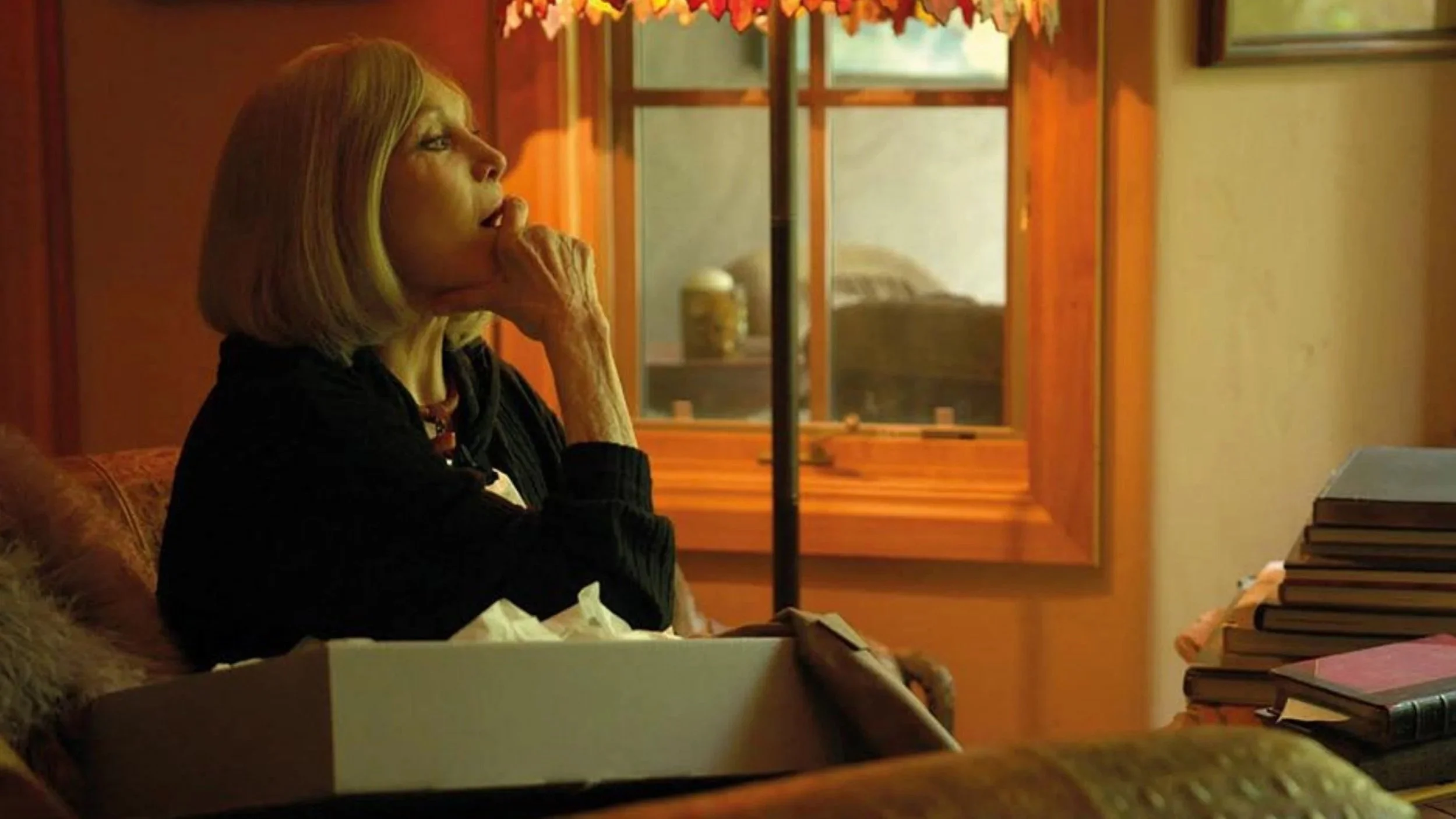
Image courtesy of Dogwoof Releasing.
by MANSEL STIMPSON
The Swiss-American Alexandre O. Philippe is surely quite as much a cinema buff as he is a filmmaker. For over twenty years he has been in the business making, in addition to short films, a considerable number of documentary features and the majority of these have been about the movies. Not all of his films have been released in the UK but he made his mark here with his detailed study of the shower scene in Hitchcock’s Psycho (that being 78/52 made in 2017) and with his exploration of the influence of The Wizard of Oz on the films of David Lynch (2022’s Lynch/Oz). However, his feature films relating to cinema also include some with a separate and distinct approach. Whether or not planned as a series, he has made films which focus directly on individuals interviewed in old age who look back on their careers: first came William Friedkin in his mid-eighties (2019’s Leap of Faith: William Friedkin on The Exorcist)) and he was followed by 90-year-old William Shatner (2023’s You Can Call Me Bill). These two films did not get a UK release but the latest work of this kind has and is with us now, Kim Novak’s Vertigo. The film does contain some footage of Philippe showing him as a highly engaged and admiring interviewer but, along with a variety of film clips, the focus is absolutely on Kim Novak and what she has to say. She is splendidly articulate and, despite her asserting that getting old is not easy and that she feels close to the end, it is difficult to believe that at the time of filming in 2024 and 2025 she was 91-years-old.
Philippe’s own comments in the course of the film include mention of the impact that Hitchcock’s Vertigo had on him and he declares that it was the movie that got him into films. His evident enthusiasm for both it and for Kim Novak herself was obviously pleasing to her and an encouragement to give herself wholeheartedly to the filming that followed. It is a timely reminder of just how big a name Novak was (indeed in the late 1950s she was the number one box office star) since the fact that she turned away from Hollywood in the late sixties took her out of the limelight. To be honest, I have never been a huge Novak fan, but that did not prevent me from finding this film well worthwhile. It emerges both as an engaging portrait of Novak herself and as a reminder of past movies through the many extracts that Philippe incorporates. Although not every film made by Novak is included in this way, the majority of them are represented and we get as well other works that are relevant to what is being said. One surprise inclusion here is a memorable clip from Sidney Lumet’s Before The Devil Knows You're Dead (2007) which appears when Novak laments the passing of great film actors and chooses to pick out Philip Seymour Hoffman to praise.
At the outset, Novak declares that she is not certain what is expected of her but her forthright comments regarding her parents and particularly about Hollywood are never less than interesting. She talks of her huge admiration for Garbo (that triggers a whole range of scenes from Garbo’s films) and she is probably aware too that Garbo could be seen as relevant to her own story since Garbo provides the most famous example of all when it comes to an actress who in her prime turned her back on Hollywood. The fact that Novak did the same can in part be attributed to the fact that Novak had never really been satisfied with her movie career. Despite her lack of acting experience, she received above the title billing in her very first proper role (that being in 1954 in Pushover opposite Fred MacMurray) but in being promoted by Columbia as a glamour star she felt that she was denied the opportunity to take on more challenging roles. Although she could be defiant (when asked to change her name she gave up Marilyn but insisted on retaining Novak since it evidenced her Czech ancestry), Columbia's chief, Harry Cohn, was famously despotic. Novak felt that the image of her that Hollywood consciously built up was an identity utterly distinct from her own self. When assigned a role she would often draw the character to make it become more real for her and she suggests that on screen she was less an actor than a reactor responding to the other players (she particularly praises James Stewart).
Like the late Brigitte Bardot, Novak is an animal lover but while they would feature in her later life even more important to her was the fact that on leaving Hollywood she could turn to another form of art that meant much to her, namely painting. Indeed, being a painter matters so much to her that she even chooses to describe her acting career as a detour (that she did in fact do some later acting for television and even for cinema – most notably in 1980’s The Mirror Crack’d - is not brought up here). Not surprisingly the second half of this documentary takes a more detailed look at what in view of the stature it has gained in recent years is undoubtedly her best remembered film, Vertigo. Its plot finds the character played by James Stewart trying to transform the image of one woman so that it resembles another person and that fact is viewed here as echoing what Hollywood did in creating its idea of Kim Novak. As for the discussion of that film, it understandably concentrates on Novak’s performance and makes a rather self-consciously big moment of her opening up a box containing the grey suit that she wore in the film. Quite in keeping with this is the confident assertion in the end credits that the ghost of Alfred Hitchcock was undeniably present during the filming of this movie. But, even if the film sometimes adopts this rather extravagant manner, Kim Novak’s Vertigo will please not only her fans but film enthusiasts generally. That’s because it gives Novak the opportunity to tell her own inside a story about Hollywood and its ways.
Featuring Kim Novak, Alexandre O. Philippe.
Dir Alexandre O. Philippe, Pro Terri Piñon, Screenplay Alexandre O. Philippe, Ph Robert Muratore, Ed David Lawrence, Music Jon Hegel.
Gull House Films/Medianoche Productions/The Ebersole Hughes Company/MCA Capital Pty Co.-Dogwoof Releasing.
77 mins. USA. 2025. UK Rel: 3 April 2026. No Cert.
