
Koln 75

Keith Jarrett’s famous concert is presented from the viewpoint of its young promoter in a biopic that makes all the wrong moves.
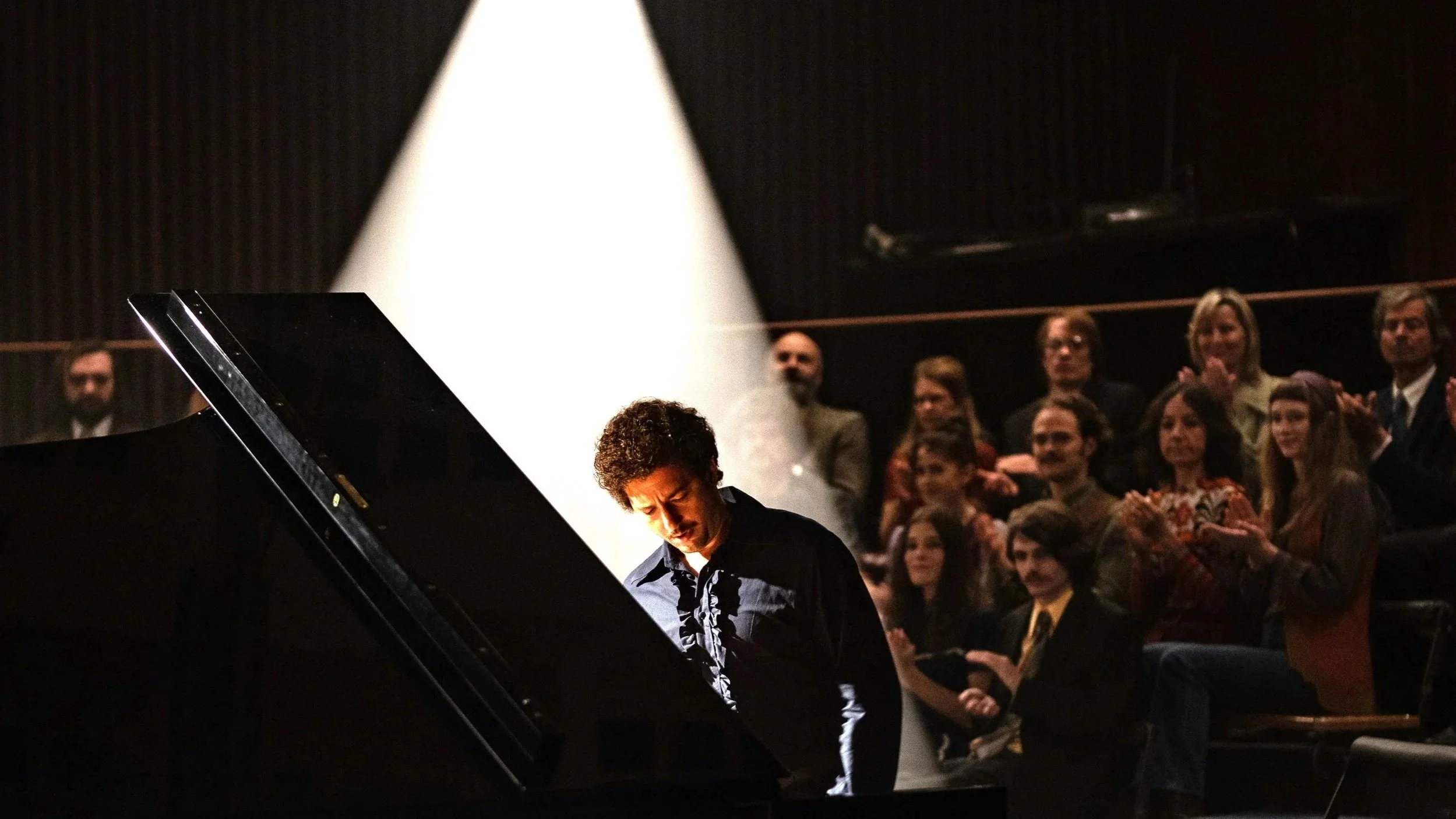
Key player: John Magaro
Photo courtesy of Vue Lumière.
by MANSEL STIMPSON
Jazz aficionados will immediately realise from its title that Ido Fluk’s film is centred on the improvisatory piano performance by Keith Jarrett which took place in Cologne on 24 January 1975 and which, having been recorded on the spot, yielded what became the best-selling solo jazz album of all time, ‘The Köln Concert’. Fluk is also the writer here and, once having decided to use this event as a key feature in his projected film, he approached Jarrett, now aged 81, seeking permission to use his music. The request was rejected and, whatever may have been intended originally for his film, what has emerged is a piece in which Vera Brandes (Mala Emde), the young promoter of the concert, has become the central figure. That is not to say that Jarrett played by John Magaro is other than a major figure in the tale but many who seek out the film may well be expecting if not a documentary then at least a work in which the famous performance is represented by more than the sight of an enthusiastic audience and the sound of their applause.
Clearly aware of expectations that may not be met, Fluk astutely uses an invented character, a jazz critic named Michael Watts (Michael Chernus), to tell us at the outset in voice-over that the film is not about the performance itself but about how it came about, the scaffolding as he calls it without which the event would not have taken place. As such it is the story of a headstrong girl of eighteen, that being Vera, who overcoming the disapproval of her father (Ulrich Tukur) made her own way as a booker of jazz gigs for the likes of Ronnie Scott (Daniel Betts) and then gambled her all on setting up a late evening slot for Jarrett on the huge stage of the Cologne Opera House. Her more sympathetic mother (Jördis Triebel) had helped with a loan, but only on condition that if her daughter were not able to repay it no more support for her ambitions would be forthcoming.
Once you know what story is being told here, it sounds as though Köln 75 might be a very worthwhile film and it has indeed picked up some awards. One of them was for Mala Emde who brings real energy to the role of Vera and the idea of showing her endeavours, the troubles encountered along the way (not least the discovery that the piano provided was seriously deficient) and her eventual success against the odds sounds very workable. Although filming took place in appropriate locations (Germany and Poland), Fluk himself is an Israeli based in New York City, but in essence Köln 75 is a German film and it could well be that in developing Vera’s story he had in mind one of German cinema's most popular successes of the last fifty years, Tom Tykwer’s Run Lola Run (1998). There we saw Franka Potente’s hugely engaging Lola running at pace here, there and everywhere and what Vera does here carries strong echoes of that.
But, if the prospects for this approach looked promising, Fluk undermines them totally by the way in which he handles the material. If Vera Brandes is to be our heroine, we need to believe in her and in her abilities and to sympathise over the mishaps that she faces. However, from the outset Fluk in dealing with these real events opts for a mode that is unsuited to that. Köln 75 begins years later when the fifty-year-old Vera (Susanne Woolf) is celebrating her birthday and her father declares to her face that she is his greatest disappointment. Looking direct at the camera Vera calls out "Let's do this again" and the film promptly begins afresh now starting in 1973. This is when Ronnie Scott is in Cologne, meets this unknown girl who lies about her age and at once and quite regardless of her complete lack of experience asks her to book tours for him and his trio. When she attempts to do so, she clearly has no idea what she is doing and, while this is clearly meant to be comic, it is the kind of exaggerated comedy which negates any sense of credibility. Fluk encourages fast editing from Anja Siemens but, if that adds to the energy, it also increases the sense of stylisation. The breaking of the fourth wall continues and there is an episode involving Vera, a man she has picked up for sex and the unexpected arrival of her boyfriend (Enno Trebs) which is then topped by her mother turning up too. It's a scene of sheer farce and it plays like one.
Suddenly remembering that Jarrett himself is important to the film, Ido dumps Vera for a quarter of an hour or more to portray the car journey to Cologne by Jarrett and the producer Manfred Eicher (Alexander Scheer) who give a lift to the jazz critic heard at the start of the film and who had been promised an interview with Jarrett. Here the tone becomes more serious as we hear something of the downside in Jarrett's career, his health issues (he has a bad back) and the financial struggles of an artist who is following his own path in the less commercial field of improvisation. Then it's back to Vera on the day of the concert, the crisis of the bad piano (Jarrett refuses to play on it) and an opera house which on a Friday at 4.00 pm has only one member of staff on duty despite the concert being due to follow an evening performance of Berg’s Lulu. There is a desperate bit to find another piano (again quick edits abound) and Jarrett is confronted by Vera eventually succumbing to her entreaties and agreeing to go ahead "just for you". Thereafter Vera is on the streets imploring busy passers-by to buy a ticket – until, of course, she is suddenly told that the concert is sold out. When it comes to the event itself and we see Jarrett at the piano, the music heard on the soundtrack is orchestral (Debussy’s ‘Prélude à l’Après-midi d’un faune’!). After the applause is heard there is a bit more of Vera at fifty and then a cut back for another glimpse of Keith Jarrett. In the latter role John Magaro is quite good enough to have deserved a much better film than this but, for all her valiant endeavours, Mala Emde fails to be engaging because the screenplay so readily presents Vera as a young woman who, although determined, is incompetent and indeed inept to a degree that frequently renders her unbelievable too.
Cast: Mala Emde, John Magaro, Michael Chernus, Alexander Scheer, Shirin Lilly Eissa, Enno Trebs, Leo Meier, Leon Blomm, Ulrich Tukur, Jördis Triebel, Susanne Wolff, Daniel Betts.
Dir Ido Fluk, Pro Sol Bondy and Fred Burle, Screenplay Ido Fluk, Ph Jens Harant, Pro Des Jutta Freyer, Ed Anja Siemens, Music Hubert Walkowski, Costumes Ola Staszko.
Extreme Emotions/One Two Films/Lemming Film Belgium/Alamode Filmproduktion-Vue Lumière.
116 mins. Germany/Poland/Belgium. 2025. US Rel: 17 October 2025. UK Rel: 5 June 2026. Cert. 15.