
La grazia

Toni Servillo once again unites with Paolo Sorrentino to great effect.
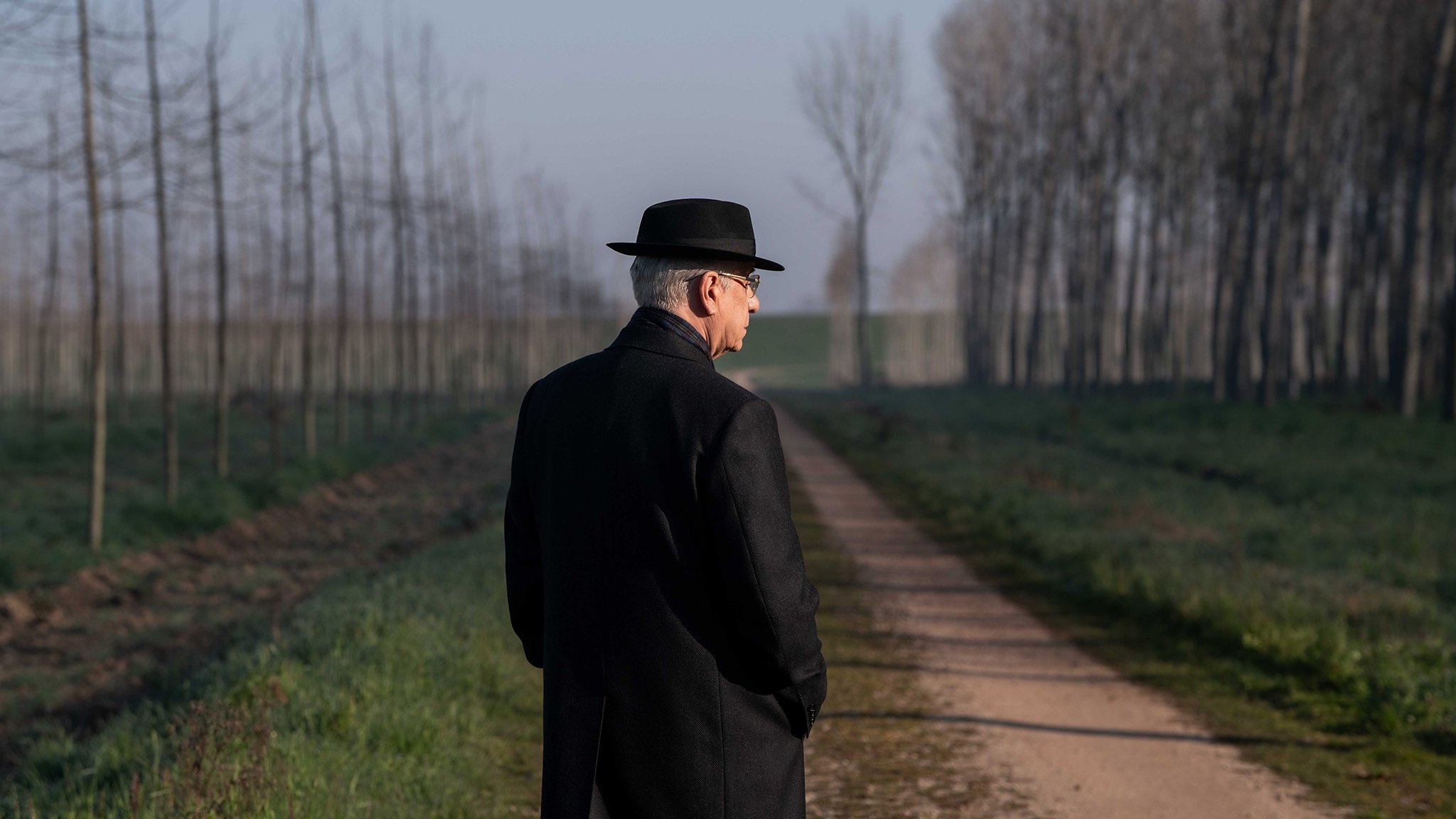
Image courtesy of Mubi.
by MANSEL STIMPSON
The Italian writer/director Paolo Sorrentino is still in his fifties but his latest film, La grazia, has old age as a central concern. In fact this is not the first time that it has featured in his work since, notwithstanding its title, his somewhat undervalued film Youth (2015) focused on two elderly men played by Michael Caine and Harvey Keitel. This time the actor playing the aged central figure is the great Toni Servillo who attained international prominence through his lead role in Sorrentino's Il divo (2008) and has frequently appeared in his films. In both Il Divo and Loro (2018) he played a real life politician but in La grazia his character – that of the Italian president Mariano De Santis – is fictional. Nevertheless political and social issues remain a central feature even though the stress on later life and looking back– the president is in the last six months of his term and will be stepping down – links this film more closely to Youth than to other works by Sorrentino.
Throughout his career Sorrentino has exhibited a remarkable sense of cinema and has collaborated with great photographers such as Luca Bigazzi and more recently Daria D’Antonio who is once again the photographer here. But, while even Sorrentino's best films have often been lengthy, much of his recent work has come to seem self-indulgent. Furthermore, many have questioned its tone due to being made uneasy by the prominence of shots expressing the male gaze in a manner that has come to feel inappropriate in this #MeToo age. La grazia is again quite long (133 minutes) but in other respects it is in marked contrast to the tone and character of its recent predecessors. The outcome is a film which is Sorrentino's best work for years.
Servillo is an actor gifted with the special ability to draw an audience into a state of fascinated belief in the characters that he plays even when no big narrative is driving the film. This is particularly useful here since La grazia rather than offering a strong storyline invites the audience to share the world of Mariano De Santis and to interpret it in their own way. He is a popular president yet somebody who, following the death of his wife, has lost any sense of passion for life and readily acknowledges that he could be regarded as boring. He recognises that as a man of the law he is a traditionalist out of tune with modern times despite which he unexpectedly finds rap music appealing. Although his son lives in Canada, his daughter, Dorotea (Anna Ferzetti), who is unmarried, helps him in his work albeit aware of the extent to which her father by choosing not to interfere in the lives of his children has become something of an unknown figure to both of them. As somebody whose duties involve taking decisions, her father has become known for holding back and hesitating and, if there may be wisdom in that, it often irritates Dorotea. The last months of his presidency find him confronted by three matters requiring his attention which he needs time to consider: a bill promoting euthanasia which awaits approval and two petitions for clemency to be assessed.
As regards the bill, we find that the Pope (Rufin Doh Zeyenounin), who is a friend of his, is not surprisingly keen to discourage the president from signing while the issue of the possible pardons becomes a concern for both father and daughter. Each of these cases is centred on a convicted spouse who has been jailed for killing their partner but the circumstances are notably contrasted in more ways than one even though a pardon is arguably justified in both instances. These matters provide effective dramatic threads which support the film’s central character study. That extends to portraying how the president’s deep and continuing love for his late wife coexists with what has become an obsessive hurt over the fact that once, some forty years earlier, she had had an affair. A friend, Coco Valori (Milvia Marigliano), a woman who is always lively company, knows who the lover was but she has refused to say. Nevertheless the president has come to believe that the person with whom his wife had betrayed him is the man who is now the justice minister (Massimo Venturiello) and who has hopes of becoming the next president.
The magnetic Servillo is admirably supported by the other actors and all of the characters here are totally convincing both in their political dealings and in their personal lives. There are also some nice touches of humour in the dialogue especially early on and, if the various elements never build into a big plot, they do encourage the viewer to consider his or her own responses. That applies to several issues: to one’s view of how right it would be in each case to grant the pardon requested, to what extent the president is right to dwell so much on the past even if his obsession over an old betrayal is misjudged and to one's view of the value or weakness in the president's old fashioned mindset especially as evidenced by his refusal to rush into making decisions. Despite the Italian context of La grazia,British viewers might compare this to Keir Starmer refusing to be hurried into backing the war on Iran!
Just occasionally Sorrrentino opts for touches of stylisation. Early on in the film slow motion adds to the comic impact when a politician on the red carpet finds himself buffeted by wind and rain. But less clear in its function is the inclusion much later of shots of a robot dog in two brief street scenes and there is also a symbolical image at the very end of the film when the president is seen floating free in a spacecraft. But what really counts in La grazia and what makes it so effective is the freedom offered to the audience. Rather than being asked to follow a clear-cut story to which an evident response is built in, they are able to consider what they feel about this president and about those around him and to relate that to their own experience of life. Whatever conclusions you choose to draw, you will believe totally in this man for once again Toni Servillo is at the very top of his form.
Cast: Toni Servillo, Anna Ferzetti, Orlando Cinque, Massimo Venturiello, Milvia Marigliano, Rufin Doh Zeyenouin, Linda Messerklinger, Vasco Mirandola, Giuseppe Gaiani, Giovanna Guida, Alessia Giuliani.
Dir Paolo Sorrentino, Pro Annamaria Morelli, Paolo Sorrentino, Andrea Scrosati, Massimiliano Orfei, Luisa Borella and Davide Novelli, Screenplay Paolo Sorrentino with Umberto Contarello, Ph Daria D’Antonio, Pro Des Ludovica Ferrario, Ed Cristiano Travaglioli, Costumes Carlo Poggioli.
Fremantle/The Apartment/Numero 10/Piper Film-Mubi.
133 mins. Italy. 2025. US Rel: 5 December 2025. UK Rel: 20 March 2026. Cert. 12A.
