
Leonora in the Morning Light

Olivia Vinall excels as the surrealist painter Leonora Carrington in a biopic that seems a wasted opportunity.
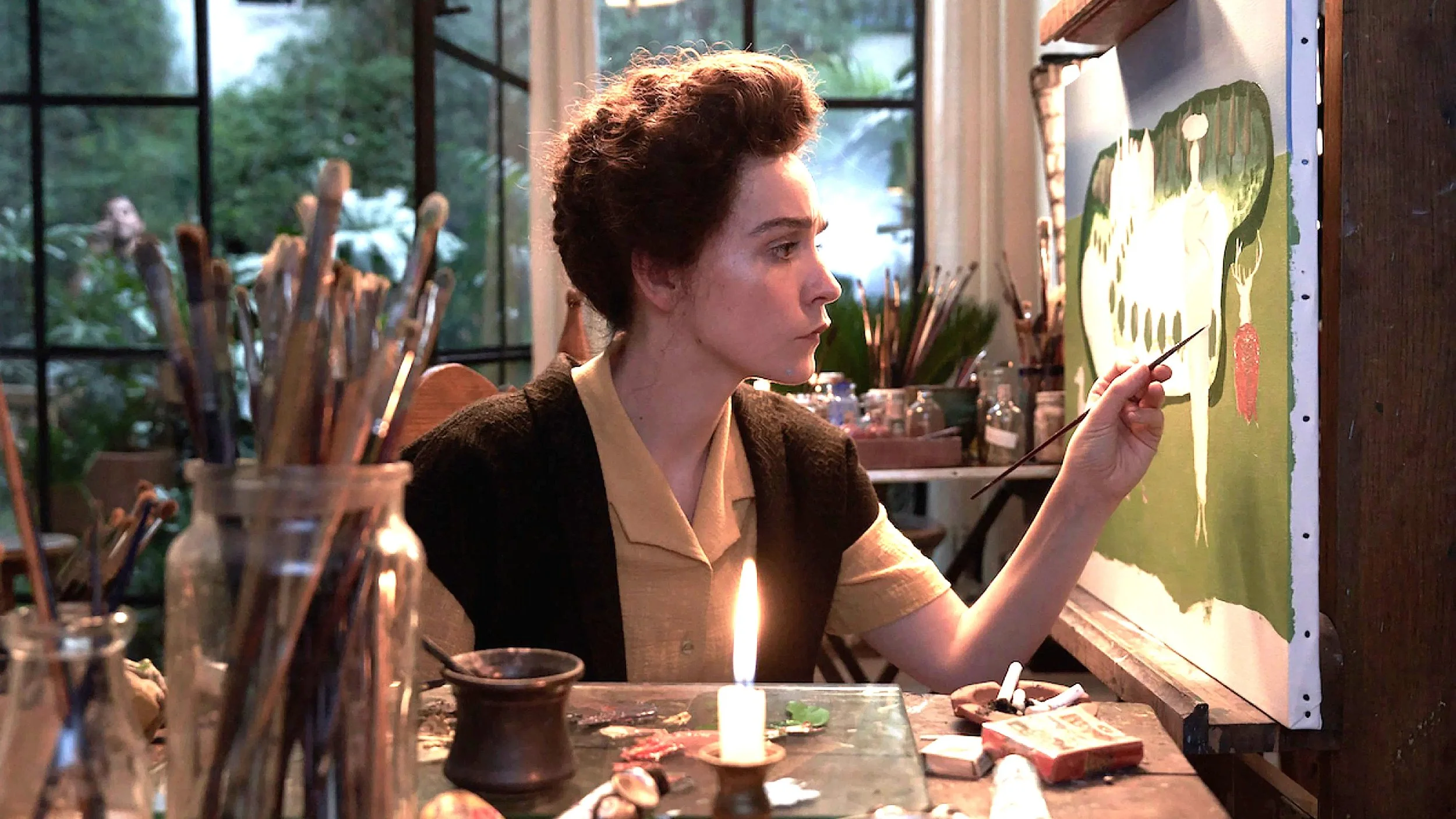
Olivia Vinall is Leonora
Image courtesy of Modern Films.
by MANSEL STIMPSON
The Leonora of the title is the artist Leonora Carrington who was born in Lancashire in 1917 but who, following time spent in Paris in the 1930s, would then settle in Mexico where she died in 2011. She was not only a significant surrealist painter and a novelist but in later life she became a noted activist for the women's liberation movement. Although as with many other female artists Carrington's work has received fresh acknowledgment in recent times, I am probably not alone in not being aware of her (for me the name Carrington brings to mind instead another British painter, Dora, who was associated with the Bloomsbury Group). Consequently, I came to this film hoping that it would be a useful and insightful introduction to the artist and her work. But in the event its approach strikes me as inappropriate and even bizarre. The film’s screenplay is by its directors Thor Klein and Lena Vurma, but it acknowledges as its source the novel Leonora by Elena Poniatowska so it may be that the focus and structure of the film are down to that.
The film’s one great asset is Olivia Vinall whose performance as Leonora is deeply felt and committed. We see her first in Xilitla in the Mexican rainforest in 1951 and this seems a strange place for the film to start since her haunted face and obvious fragility immediately emphasise her mental health issues. In addition, references to tarot cards and to readings that could point to death add to the sense that this is first and foremost a portrait of a deeply troubled woman. She has come to this particular location as a possible refuge, one suggested by a friend, the British poet Edward James (Ryan Gage). She arrives there with her husband, Chiki Weisz (István Téglás) who cannot stay since he must return to look after their young sons. When Leonora attends a party a song is sung, not a jolly piece but one that declares that "my sorrows went to heaven”.
If this opening section suggests that mental problems and suffering will be central features, that is not misleading. The film soon moves back to 1938 and to the time when Leonora had become the lover of the painter Max Ernst (Alexander Scheer) and was moving in circles that included André Breton (Denis Eyriey) and Salvador Dali (Cat Jugravu). The talk here is very high-flown (which it may indeed have been). But for the average viewer it hardly helps engender understanding when the dialogue has Leonora asking Ernst if the distinction between blue abstraction and reality is not dangerous only to be told that he can't imagine living any other way. This footage leads on to world events impacting their world when Max's nationality results in his arrest following a decree in 1939 that all Germans living in France should be interned. Leonora now seeks to get into Spain and she succeeds. However, in 1940 her mental state led to her undergoing electroshock therapy administered by one Dr Morales (Luis Gerardo Méndez). He advised her that she was the author of her own suffering but that she could be treated successfully if she took responsibility for it.
The film will ultimately move on a full eleven years and return to the Mexican setting present at the outset but, before it does so, flashbacks are incorporated about her childhood and about the controlling father whom she hated and who had her put in the doctor’s care. These scenes include time spent with a nanny (Vivienne Soan) who talked to the child of spirits and of their taking on animal form and we have already been made aware of Leonora’s attachment to animals and of her liking to talk to them. As with the Mexican beliefs touched on, it is not always clear if the film is asking us to subscribe to ancient beliefs or is finding in them further pointers to Leonora’s lack of stability. What does become clear is that, although Leonora is able to exhibit her paintings in Mexico, she increasingly shows the signs of madness which would cause her to seek shelter in the rainforest as shown in the film’s opening section (some scenes are now repeated).
By concentrating in this way on certain portions of Leonora Carrington's life, the film sidesteps being a full bio-pic but also makes her health (her attacks of hysteria, her depression) a central issue. If it wanted to suggest that there was an upside to this and that they contributed to her artistic vision, it fails to do so. Indeed, although we occasionally glimpse her artwork, we get no real impression of its place and quality within the surrealist movement. Since Klein and Vurma cite a novel as their source, it could be that they have not appreciated that, whereas Poniatowska was not using a form in which the art could be revealed, a film about Carrington cries out for her work to be seen and explored.
When it comes to a short final scene of the artist preparing to work – a virtual coda incorporating the credit titles – there is a written description of the way that her art blends European surrealism with Mesoamerican cultures thus redefining a long-lost female spirituality. But this is what the film itself should have conjured up. At least the central performance is strong but the subsidiary figures are not well served by the time jumps. One character, the Spanish artist Remedios Varo (Cassandra Ciangherotti) who helps and befriends Leonora achieving a sister-like bond, appears at intervals but is not really integrated into the narrative. This is again the case with Leonora's husband (actually her second). Chiki Weisz was a Hungarian photographer and the father of her two children but the jump from 1940 to 1951 renders him a presence who is suddenly there but only as a background figure. The narrative omissions – the decision to ignore her later life except to describe it is stable and fulfilling and the inadequate illustration of her work – make this film a bodged opportunity: it even lacks the ability to make us see Leonora Carrington as a significant artist in her own right, one who overcame suffering and triumphed against the odds in an art world dominated by men. She may indeed have done just that, but regrettably Klein and Vurma’s film fails to make the case properly.
Cast: Olivia Vinall, Alexander Scheer, Ryan Gage, Cassandra Ciangherotti, Luis Gerardo Méndez, István Téglás, Yoshira Escárrega, Mercedes Bahleda, Denis Eyriey, Cat Jugravu, Vivienne Soan, Wren Stembridge.
Dir Thor Klein and Lena Vurma, Pro Lena Vurma, Paul Zuschler, Monica Moreno, Alejandra Malvido and James Heath, Screenplay Thor Klein and Lena Vurma, from the novel Leonora by Elena Poniatowska, Ph Tudor Vladimir Pandaru, Pro Des Josefine Lindner and Noemi Gonzalez, Ed Matthieu Taponier, Music Mariá Portugal, Costumes Gudrun Leyendecker and Laura Garcia De La Mora.
Dragonfly Film Productions/Meli Melo Cultura/Randan/Framebreed/ZDF/Arte-Modern Films.
103 mins. Germany/Romania/Mexico/UK. 2025. UK Rel: 29 May 2026. Cert. 15.
