
Little Amélie or the Character of Rain

Amélie Nothomb’s novel based on her childhood in Japan takes on a new form in Maïlys Vallade and Liane-Cho Han’s Oscar-nominated cartoon.
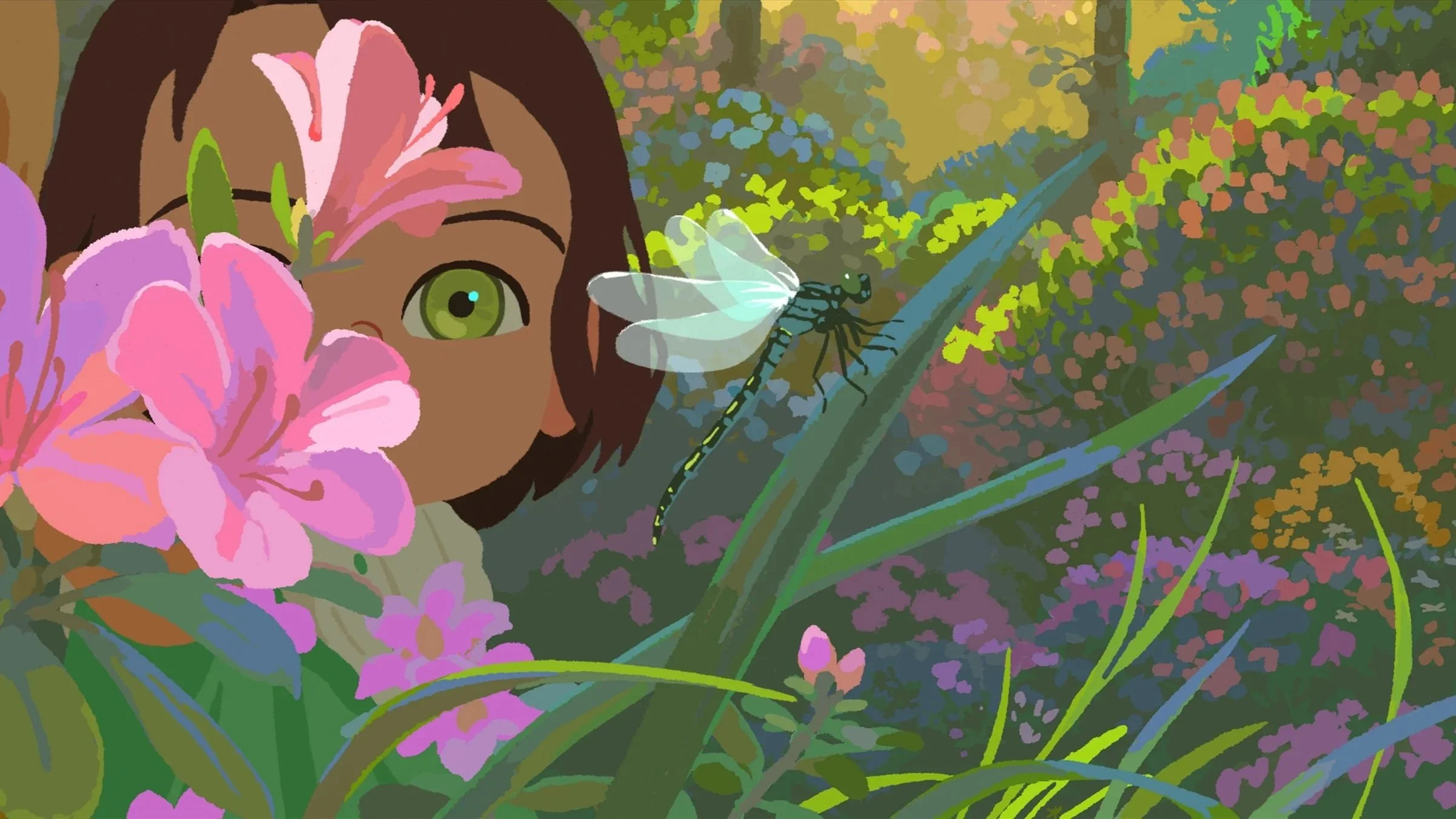
Image courtesy of Vue Lumière.
by MANSEL STIMPSON
In Little Amélie we have an animated film about childhood which is more likely to appeal to adults than to children. That may sound surprising, but it is less so if one is aware that this is an adaptation of a novel by the idiosyncratic Belgian writer Amélie Nothomb. If her books are short, they are also prolific and her voice is one that is often provocative, takes on elements of the surreal and the mythic and yet frequently combines these elements with material that draws on the autobiographical. Not least when it comes to portrayals of childhood her approach has been called philosophical and symbolic and this arguably unique mix found in her writing provides something of a challenge for anybody adapting her work for the cinema. Even so, Little Amélie is not the first of her many novels to be adapted for the screen. Alain Corneau’s Fear and Trembling (1999) was impressive and was seen in the UK, but other films taken from her work have not gained distribution here until now with the arrival of this Belgian animation by Maïlys Vallade and Liane-Cho Han.
Although sometimes known simply by its shorter title, the full version of it is Little Amélie or the Character of Rain since The Character of Rain is the English language title of Nothomb’s novel Métaphysique des tubes which appeared in 2000 and which is the basis of this film. It is a work that is characteristic of the author in that it draws directly on her own experience, in this case that of living in Japan between the ages of two and five. This came about because she was the daughter of a Belgian diplomat in Kobe who would then be uprooted and sent to China. In those very early years Amélie became devoted to her Japanese nurse Nichio-san and that period of her life and especially their attachment is central to this film. But, being a work by Nothomb, the factual is interlaced with imaginary features. Thus the tale is told not by Amélie as an adult looking back but by the child herself whose early linguistic ability is taken a step further by presenting her as a fluent narrator expressing her own view of the world. That extends to ironic comments on the behaviour of adults and even to the child’s belief that being aware of her own existence and seeing herself as the centre of her world means that she is God.
The opening comment in the film sets its unusual tone by declaring "In the beginning there was nothing" to which is added after a brief pause “nothing except God". Nevertheless, although the novelty continues by having this oddly sage child approaching her third birthday as the film’s narrator and thus providing a source of comedy, this unusual angle does not prevent the film from portraying convincingly what life is like in a household such as this one. It contains three children (Amélie has a brother, André, and a sister, Juliette) and their parents, Patrick and Danièle. Indeed, these are the real names of Amélie Nothomb’s parents and siblings and Little Amélie is set in 1969 when the author was in her second year. Perhaps even more crucially Nichio-san is a real person and in this film, one patently made with affection, it can be said that the warmth of the relationship between the young girl and her nursemaid is so well conveyed that it is central to the movie’s appeal. The film's voice cast duly subtitled in the version I watched speak in French or where appropriate in Japanese and Loïse Charpentier as the voice of Amélie and Victoria Grosbois who voices Nishio-san are ideal choices. It is, of course, equally important that the animation is so adept that the characters – and these two in particular – come fully to life. Amélie's forceful personality is all the more potent for her being given strikingly turquoise eyes and the skill of the filmmakers is no less apparent in the way that the child’s bond with Nishio-san is portrayed so tellingly and without ever being weakened by slipping into sentimentality.
As it is, this central concern is portrayed with the same sense of realism that is found elsewhere in the film including Amélie's tricks to get her own way and the manner in which at times the older siblings play her up. Furthermore, Little Amélie does not hesitate to bring in serious issues as when Amélie, who had been drawn to her grandmother when she visited from Belgium, has to be told that she will not see her again because the grandmother has now died. Equally willing to face a reality particular to the film’s setting, the tale includes a landlady who lost relatives in World War II and whose attitude to these foreigners, even to a young child like Amélie, is influenced by that. For that matter the film is no less ready to have Nishio-san describe how she was buried as a youngster when bombs fell on Kobe and how all her family died. The inclusion of such elements in an animated film provides a link between Little Amélie and some of the films of Hayao Miyazaki.
Most of this works admirably but I am less happy about the extent to which the film lets the visual style become less naturalistic. However surreal some of Nothomb's ideas may be, to fully indulge their fanciful nature in the images sometimes feels at odds with the more realistic elements. This is particularly so late on when a dramatic incident in which Amélie might have drowned is handled in such a stylised way that it could be seen as dreamlike or even symbolical. Consequently, this undermines the real-life drama. There are enough instances of overelaborate visuals for me to feel that Little Amélie is not quite the delight that it might have been. But nevertheless it is a very engaging work and many adult viewers will find quite enough truth in the piece for it to evoke reminders of their own childhood experiences. That aspect of the film’s appeal is one of the reasons why this could well be a work better appreciated by adults than by children. And, whatever weight one gives to the philosophical ideas present as to identity already being shaped in early childhood, Little Amélie is certainly a fitting tribute to the role that Nishio-san played in the childhood of Amélie Nothomb.
Note: the UK release comprises both the original and a dubbed version.
Original title: Amelie et la métaphysique des tubes.
French voice cast: Loïse Charpentier, Victoria Grosbois, Yumi Fujimori, Cathy Cerda, Marc Arnaud, Laetitia Coryn, Haylee Issembourg, Isaac Schoumsky, François Raison. English Voice Cast: Lily Gilliam, Francesca Calo, Page Leong, Jayne Taini, Brent Mukai, Jessica DiSalvo, Avril Kagan, Rhodes Carroll, Michael C. Pizzuto.
Dir Maïlys Vallade and Liane-Cho Han, Pro Nidia Santiago, Edwina Liard, Claire la Combe and Henri Magalon, Screenplay Liane-Cho Han, Aude Py, Maïlys Vallade and Eddine Noël, from the novel Métaphysique des tubes by Amélie Nothomb, Pro Des Eddine Noël, Ed Ludovic Versace, Music Mari Fukuhara.
Maybe Movies/Ikki Films/2 Minutres/France 3 Cinéma/Puffin Pictured/22D Music-Vue Lumière.
78 mins. France/Belgium. 2025. US Rel: 31 October 2025. UK Rel: 13 February 2026. Cert. PG.
