
Little Trouble Girls

With her debut feature, the Slovenian director Urška Djukić explores the interior sexual world of a 16-year-old virgin.
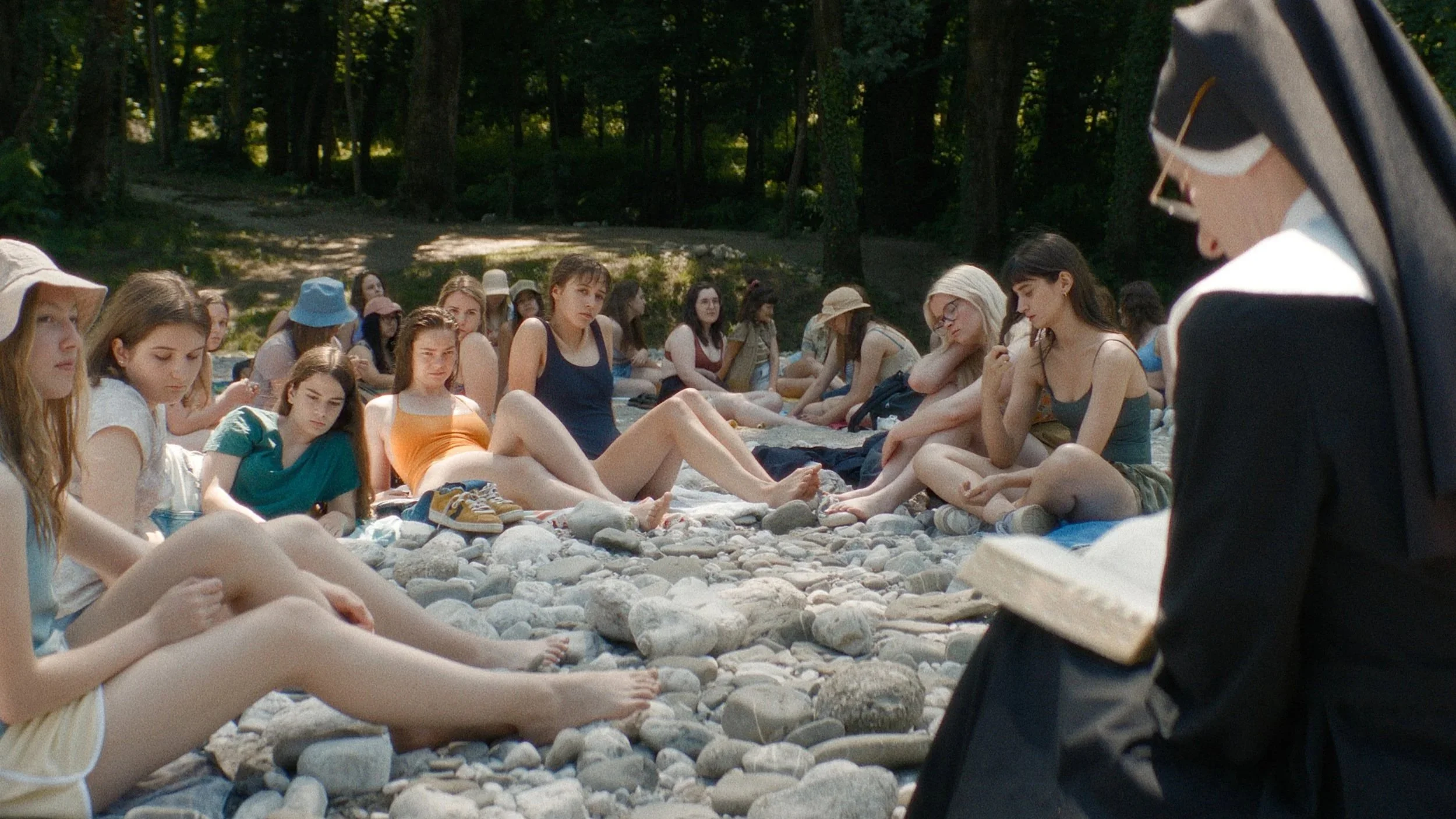
Image courtesy of BFI Distribution.
This debut feature by the Slovenian director Urška Djukić has made quite an impact and has picked up no less than four awards included the coveted FIPRESCI prize at the 2025 Berlin Film Festival. In some respects that is unsurprising for Little Trouble Girls reveals Djukić to be a filmmaker with a style that is very much all her own. Furthermore, the film is extremely well photographed by Lev Predan Kowarski and in an impressive cast the young lead actress Jara Sofija Ostan is totally assured. Hers is yet another outstanding performance in a year in which actresses continue to stand out. However, for all the praise that has been bestowed on this work I am not convinced that the screenplay – written by Djukić herself with Maria Bohr – has sufficient purpose to make this a satisfying film.
The central figure played by Ostan is a 16-year-old named Lucia who is attending a Catholic school where she is a member of its choir. Under choirmaster Bojan (Saša Tabaković) preparations are in hand for a concert and this is taken so seriously that the choir are sent away to a monastery in the north of Slovenia for three days of intense rehearsal. This puts the sexually inexperienced Lucia in close contact with girls like Ana-Maria (Mina Švajger) and her sidekicks Uršula (Mateja Strle) and Klara (Staša Popović) who are far more knowing about sex and at the very least talk about it a great deal. This is in total contrast to what Lucia experiences at home. Her dad is often sound asleep and her mother (Nataša Burger) is firmly opposed to her daughter wearing lipstick and changes TV channels when a programme proves to include a sex scene. But, if Ana-Maria appears to be befriending Lucia, there is no doubt that she likes to domineer and she enjoys drawing Lucia into becoming more sexually aware and participating in a game of truth or dare.
Little Trouble Girls tells a specific tale about these adolescent girls and their behaviour but Djukić’s intention here is to present the material from Lucia's viewpoint and in doing so to portray a world where at her age a sense of sex and sensuality seems to exist everywhere. Djukić captures all this most imaginatively and her individuality immediately reveals itself in the way in which she uses the widescreen for intimate close-up shots of faces – or, indeed, of just parts of a face. Since many scenes feature the choir and their renditions of Slovenian folk songs another favourite image is one showing rows of girls. Once again the faces are featured but now with extra play over the way in which the focus is set. We get too a montage emphasising the mouths of the girls as they sing while a sensuous element is also apparent in the use of sounds including that of water. One song entitled ‘Something in the Air’ in itself feeds into this atmosphere as does the inclusion of artworks which carry sexual connotations. The fact that the nudity included in the film is seen very briefly in no way lessens the film’s evocation of a highly sensualised world.
In the light of this aim, one might have expected that Little Trouble Girls would take advantage of the story’s Catholic background to stress religion's role in seeking to repress sexual urges considered to be a sin and to do this in a strongly critical way. In passing there is talk of how stealing the shirt that an attractive male builder had worn should be considered a sin requiring atonement, but the film contains no real onslaught on the Church. In line with this a scene in which celibacy is discussed with one of the sisters is handled with respect, even if Ana-Maria herself mocks the choice made by the nun. However, a dare does lead to a striking episode involving Lucia and a damaged statue of the Virgin Mary and this is the kind of scene which at one time would have caused outrage to some viewers and made the film notorious.
As the film proceeds one assumes that the storyline will lead somewhere. The opportunity seems to be present whether it lies in concerns about possible lesbianism or over the relationship between Lucia and the choir master Bojan who draws Lucia to confide in him but subsequently goes out of his way to humiliate her. But, instead of either of these aspects leading to some kind of effective conclusion (which it seems reasonable to expect in this context), the last stages of the film fall into stylised dream-like images before it concludes with a more naturalistic coda which tells us nothing. Any viewers content to forego a story with a resolution and to settle for a mood piece about adolescent sensual feelings will find much to admire here especially the distinguished filmmaking displayed in the direction and photography and in the performance of the lead actress. But I for one felt that a full-length feature like this required more than that and all the more so because the situation depicted seemed to lend itself to providing a dramatic climax of some kind which in the event is exactly what Djukić has chosen not to give us. I was reminded of the famous song lyric which puts it so well: ‘Is that all there is?’.
Original title: Kaj ti je deklica.
MANSEL STIMPSON
Cast: Jara Sofija Ostan, Mina Švajger, Saša Tabaković, Nataša Burger, Mateja Strle, Matia Casson, Saša Pavćek, Stasa Popović, Spela Frlic, Irena Tomazin Zagoričnik, Marko Mandic, Lotos Vincenc Šparovec.
Dir Urska Djukić, Pro Jožko Rutar and Miha Černec, Screenplay Urska Djukić with Maria Bohr, Ph Lev Predan Kowarski, Pro Des Vasja Kokelj, Ed Vlado Gojun, Music Lojze Krajnca, Costumes Gilda Venturini, Sound Julij Zornik.
SPOK Films/Staragara It/Non-Aligned Films/Nosorogi/Sister Production-BFI Distribution.
89 mins. Slovenia/Italy/Croatia/Serbia. 2025. UK Rel: 29 August 2025. Cert. 15.
