
Madfabulous

The flamboyant life of the outrageous Marquess of Anglesey is given a most shallow and unconvincing reading in Celyn Jones’ period romp.
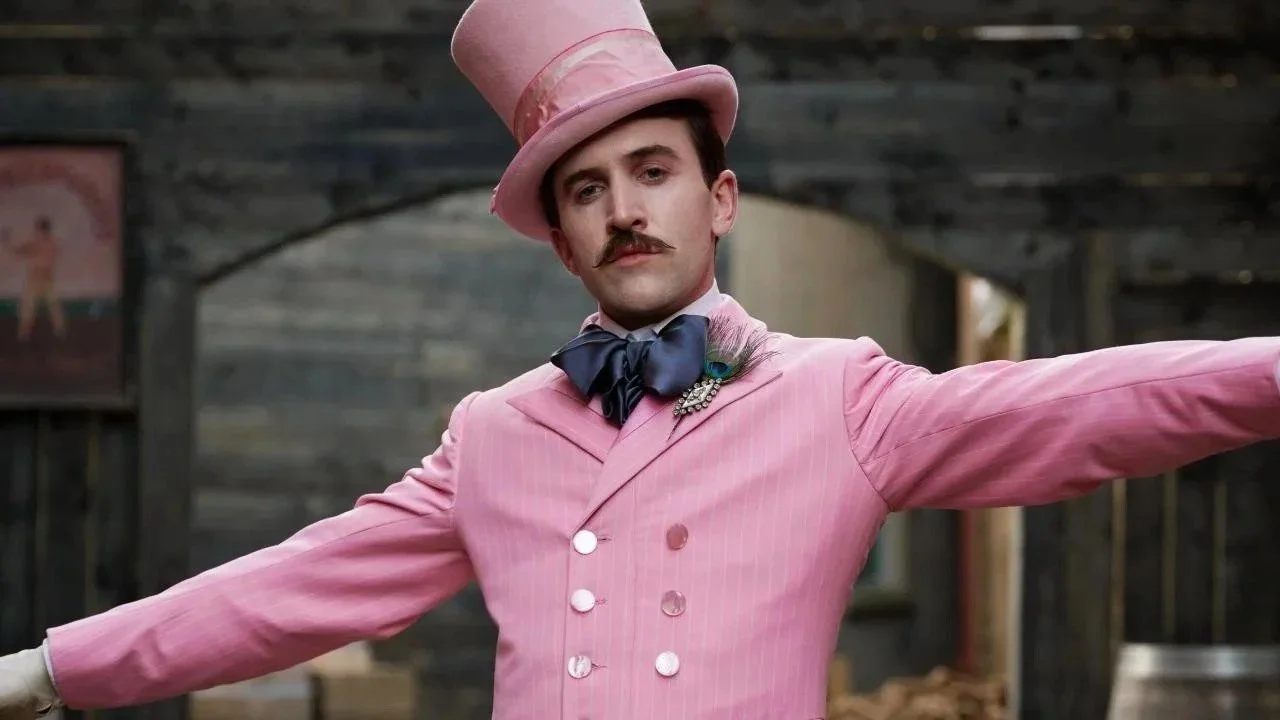
Pretty in pink: Callum Scott Howells
Image courtesy of Icon Film Distribution.
by MANSEL STIMPSON
It was in 2019 that Sally Wainwright's television drama Gentleman Jack became such a huge hit that it was subsequently extended and given a second series. The inspiration for it was a real-life figure who lived from 1797 to 1840. That was Anne Lister, a lesbian who inherited her uncle's estate in the West Riding of Yorkshire and made a success of it. Another 19th century figure, Henry Cyril Paget, now becomes the central figure in Madfabulous, a film written by Lisa Baker and directed by Celyn Jones. It tells the story of how this man born in 1875, apparently the eldest son of the 4th Marquess of Anglesey but rumoured nevertheless to be illegitimate, did indeed become recognised by his distant father as his heir and succeeded him in October 1898. Whereas Lister left diaries which confirmed her own sexuality, in Paget's case his appearance and behaviour strongly suggested that he was homosexual but no confirmatory evidence exists.
It could be that the making of Madfabulous has no connection with the success of Gentleman Jack, but it would be easy enough to believe that Sally Wainwright's work was an influence in bringing it about. But, if that was the case, it may have been overlooked that Anne Lister's life had far greater potential as the basis of an effective drama. Even when choosing to concentrate on her last decade, Wainwright could reference various lovers that she had and then concentrate on the special relationship with Ann Walker which was for them akin to marriage. Furthermore, Lister's life stood out as an extraordinary one for a woman in a patriarchal society. Compare that with Paget and the material is thin. It is, of course, colourful since he favoured cross-dressing and was involved in extravagant parties and theatrical performances presented on his own property. He even donned a robe of voluminous transparent white silk which in movement suggested wings and enabled him to perform a version of the Butterfly Dance for which the American dancer Loie Fuller, a lesbian, was famous. Paget took on acting roles too, including that of Lord Goring in Oscar Wilde’s An Ideal Husband. As against that, however, the fact that he had no known lovers severely lessens the dramatic possibilities desirable when it comes to providing a screen treatment of his life.
One would like to be able to say that despite the challenges involved Madfabulous proves to be a success, but that is far from being the case despite several factors that benefit it. Shot in Wales, the production is handsomely mounted and photographed in colour and wide screen with some distinction by Laurie Rose. It also has the not insignificant advantage of having well-cast actors in the three leading roles. Callum Scott Howells, probably best remembered for his appearance in a TV miniseries, It's a Sin, properly relishes the role of Henry Paget. Equally adept is Ruby Stokes who plays Henry's first cousin, Lily, who marries him to escape becoming the wife of an unwelcome suitor. She brings out the non-conformist spirit, rare in a woman of that period, which allies her with Henry and makes her in effect his co-conspirator (as it turned out in 1900 the marriage would be annulled for non-consummation). The third central role, by no means minor, is that of the faithful butler who, expected by the family to keep a restrict eye on Henry, is in fact sympathetic to him and deeply loyal. This man, Gelert, is played by Rupert Everett in a beautifully judged performance. Whatever the weaknesses in Lisa Baker’s screenplay, putting this quiet but dependable figure in a central position so that it sets off the uninhibited tone that Howells brings to Henry is a great success: indeed, it is a perfect match of opposites.
Yet in spite of these assets Madfabulous proves to be a failure and that is increasingly evident the longer it lasts. The opening scenes play as camp comedy in a way that is quite promising: we witness Henry's unrestrained manner as he settles in on arriving at Anglesey and observe the horror of the neighbours and most family members over his appearance, posture and behaviour. Dan Baboulene's music score adds to the tone and for a while Madfabulous is spirited enough to please. But before too long it becomes obvious that its only development takes it in directions that clash with the initial concept. Subsidiary figures are often one-dimensional types set up to be disliked (Lord Penrhyn played by Paul Rhys; Neville, a family member played by Louis Hynes) or, if not that, are either unconvincing (Tom Rhys Harries as a stage director who joins Henry promising to make him a star) or undeveloped (Louise Brealey's Lady Chetwynd). Even more importantly, Lisa Baker’s screenplay lacks the ability to find the depth which might have resulted in some sympathy for Henry even when his excessive expenditure led to the huge wealth that he inherited being swallowed up. For that matter, the fact that Henry is consumptive rather than introducing some pathos merely seems out of place (and clichéd too when early on he coughs up blood). And, although Howells does well when it comes to Henry's violent emotional response to the death of the father who had so long ignored him, the writing is not adroit enough for his father's neglect to arouse our sympathy for the son.
Those involved in the film have stressed how remarkable it was that a figure as unusual as Henry Paget should have been liked by the people of Anglesey and a better screenplay would have found a way to bring that out and to make it believable. But, as it is, the film’s conclusion, one in which Henry now bankrupted leaves the island, finds the locals including the shopkeepers left as creditors suddenly switching from hostility to regret (that even applies to Neville who suddenly sheds his intense dislike in a complete volte-face). It is the fact that the film’s finale is so stretched out and is so patently seeking tears that are not forthcoming that underscores the failure of Madfabulous. Condolences to the actors and to the other contributors whose efforts were strong yet ultimately in vain.
Cast: Callum Scott Howells, Ruby Stokes, Rupert Everett, Paul Rhys, Siobhán McSweeney, Louis Hynes, Louise Brealey, Greta Jones, Kevin Eldon, Steve Spiers, Tom Rhys Harries, Ini Adegbenro.
Dir Celyn Jones,Pro Nadia Jaynes and Sean Marley, Screenplay Lisa Baker, Ph Laurie Rose, Pro Des Keith Dunne, Ed Kevin Jones,Music Dan Baboulene, Costumes Francisco Rodriguez-Weil.
Mad As Birds/Creative Wales-Icon Film Distribution.
94 mins. UK. 2025. UK Rel: 5 June 2026. Cert. 12A.