
The late Eleanor Coppola shines a compassionate light on her daughter Sofia’s modus operandi and on the production of her 2006 biopic.
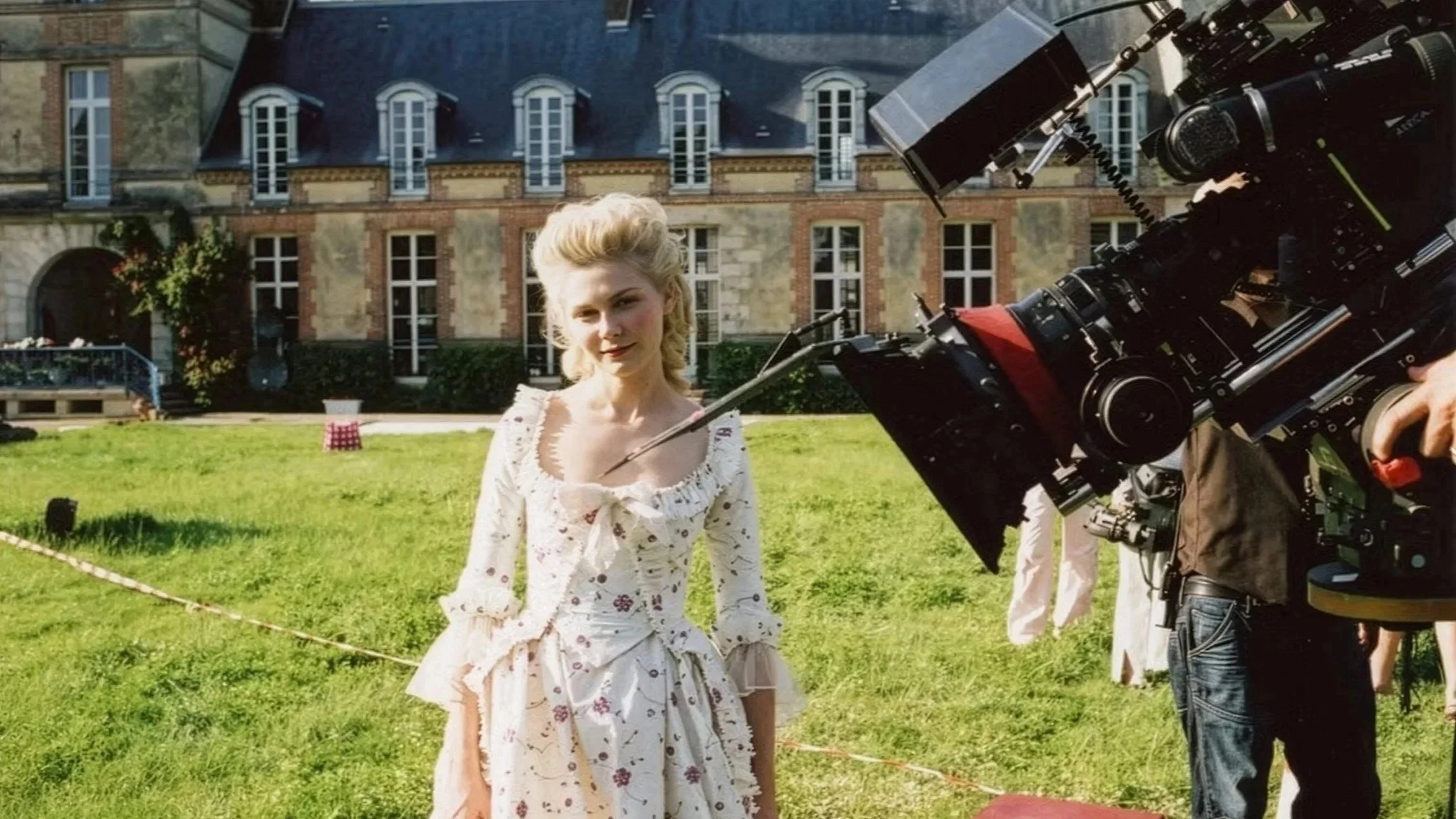
Kirsten Dunst
Image courtesy of Mubi.
by MANSEL STIMPSON
The title of this film is a precise definition of what this documentary offers. Other works which focus on a movie from the past tend either to analyse it or to look back on the difficult circumstances of its production. One of the most famous of the second type is Hearts of Darkness: A Filmmaker’s Apocalypse made in 1991 by Eleanor Coppola and others which put on record for posterity the extraordinary problems that arose when Francis Ford Coppola was engaged in making his 1979 Oscar-winning film Apocalypse Now. But what we have here is something different in that it is an on-the-set record of a shoot without special complications. Directing Marie Antoinette in 2006 may have been a demanding venture for Sofia Coppola because it was a period piece which was a more costly venture than any previous film of hers, but nevertheless it came in on time and on budget.
Subsequent to the success of Hearts of Darkness Eleanor Coppola would eventually go on to make two feature films with actors, but most of her other filmmaking was devoted to short pieces either on video or for television. The majority of these items would document either her husband or her daughter Sofia at work and she did that in relation to The Virgin Suicides, The Rainmaker and Youth Without Youth. In the case of Marie Antoinette, its DVD release was accompanied by a comparable video by Eleanor lasting some 26 minutes. Indeed, the present film release is a substantial elaboration of that material. It came about because during her last years Eleanor Coppola developed the notion that what she had shot during the making of Marie Antoinette deserved to be converted into a feature-length work. In the event due to Eleanor's death in 2024 it was left to Sofia herself to complete this project, but nevertheless it was substantially done by her mother as her final contribution to cinema and it runs for a full 86 minutes.
Making Marie Antoinette emerges as a modest endeavour but one which has been well carried out on its own terms. In its new form it presents the most detailed study yet of how Sofia Coppola functions as a director and as such it must mean a great deal to the Coppolas as a family for whom cinema means so much. Similarly, the audience most eager to see the film will be admirers of Sofia Coppola’s work, but it also has the wider appeal of revealing in an informal way the atmosphere that her approach created on set.
We see Sofia taking a detailed interest in every aspect of the production extending to detailed discussion with the photographer Lance Acord and the production designer K.K. Barrett in addition to displaying the utmost interest in the work of the costume designer Milena Canonero (on this film she created no less than seventy-two dresses for Kirsten Dunst alone). The special degree of involvement might be expected given that in addition to directing, Sofia wrote the screenplay herself. Nevertheless, it links with her desire to create a relaxed and friendly atmosphere during a shoot in deliberate contrast to the behaviour of directors who are egocentric and pushy with it. Having done some acting herself, she is sensitive to the needs of her players and this film offers ample evidence of her rapport with Kirsten Dunst who in playing the title role would be in virtually every scene. At the same time, we see the strength that Sofia knew she needed to show if she were to succeed in realising her own vision since this was an expensive movie which save for herself was set up and made by men (in a posed photograph of the crew she is the only woman and all female directors know that in that profession they are very much in the minority). Indeed, we can see that for all the emphasis on creating a warm atmosphere she is definitely the one in charge.
Eleanor Coppola is occasionally glimpsed around the set always seeking to be unobtrusive in her own filming so as not to be a distraction, but in a neat move she is given her own voice here through the inclusion of extracts from her diary heard on the soundtrack read by Diane Lane. Her comments include remarks which stress the disadvantage that women have in the world of cinema, a factor which restricted her own opportunities to write and direct but which served to increase her admiration for what Sofia achieved.
One of the notable features of Marie Antoinette lay in permission having been obtained to shoot inside the Palace of Versailles and the visual impact of that setting naturally contributes to the appeal of what we see here (the documentary contains substantial footage inside the main building with occasional scenes in the grounds and one in the Petit Trianon, in addition to which we observe one set-up staged separately in Paris in the Opera Garnier.) But, despite the grandeur of the setting, what comes across in this documentary is the intimate almost family feel of the shoot. In some respects that was literally the case. Whilst Sofia is the central figure, we also see much of the actor playing Louis XVI, Jason Schwartzman, who is in fact first cousin to Sofia and helping in the production’s second unit was her brother Roman to whom she was close and whose presence was very supportive. In addition, albeit briefly, there are visits from Francis Ford Coppola himself who was an executive producer. Other cast members appear too, of course, and, if some are just there in the background, there is a short but decidedly memorable appearance by Marianne Faithfull who, like Sofia, comes across as her own woman. This documentary shows us a filmmaking endeavour which went well and, while it was at times exhausting for those involved, its tensions seem to have been limited to those early moments when Sofia had a coughing problem which proved to be bronchitis. That does mean that Making Marie Antoinette is devoid of any strong drama but it stands as sympathetic record of a female filmmaker from a very special family going about things in her own individual way.
Cast: Sofia Coppola, Kirsten Dunst, Jason Schwartzman, Roman Coppola, Rose Byrne, Ross Katz, Christophe Cheysson, Milena Canonero, Francis Ford Coppola, Lance Acord, K.K. Barrett, Marianne Faithfull, Eleanor Coppola, and with the voice of Diane Lane.
Dir Eleanor Coppola, Pro Sofia Coppola, Rachel Denzig, Mario Gianini, Youree Healey and Lorenzo Mieli, Ph Eleanor Coppola, Ed Aaron Matthews and Sofia Coppola, Music Aaron Maine.
Entourage Pictures/Mediawan Rights/Our Films-Mubi.
86 mins. USA/Italy. 2026. UK and US Rel: 23 October 2026. Cert. 12A.