
Marlee Matlin: Not Alone Anymore

The Oscar-winning deaf actress Marlee Matlin tells her own story in her own way.
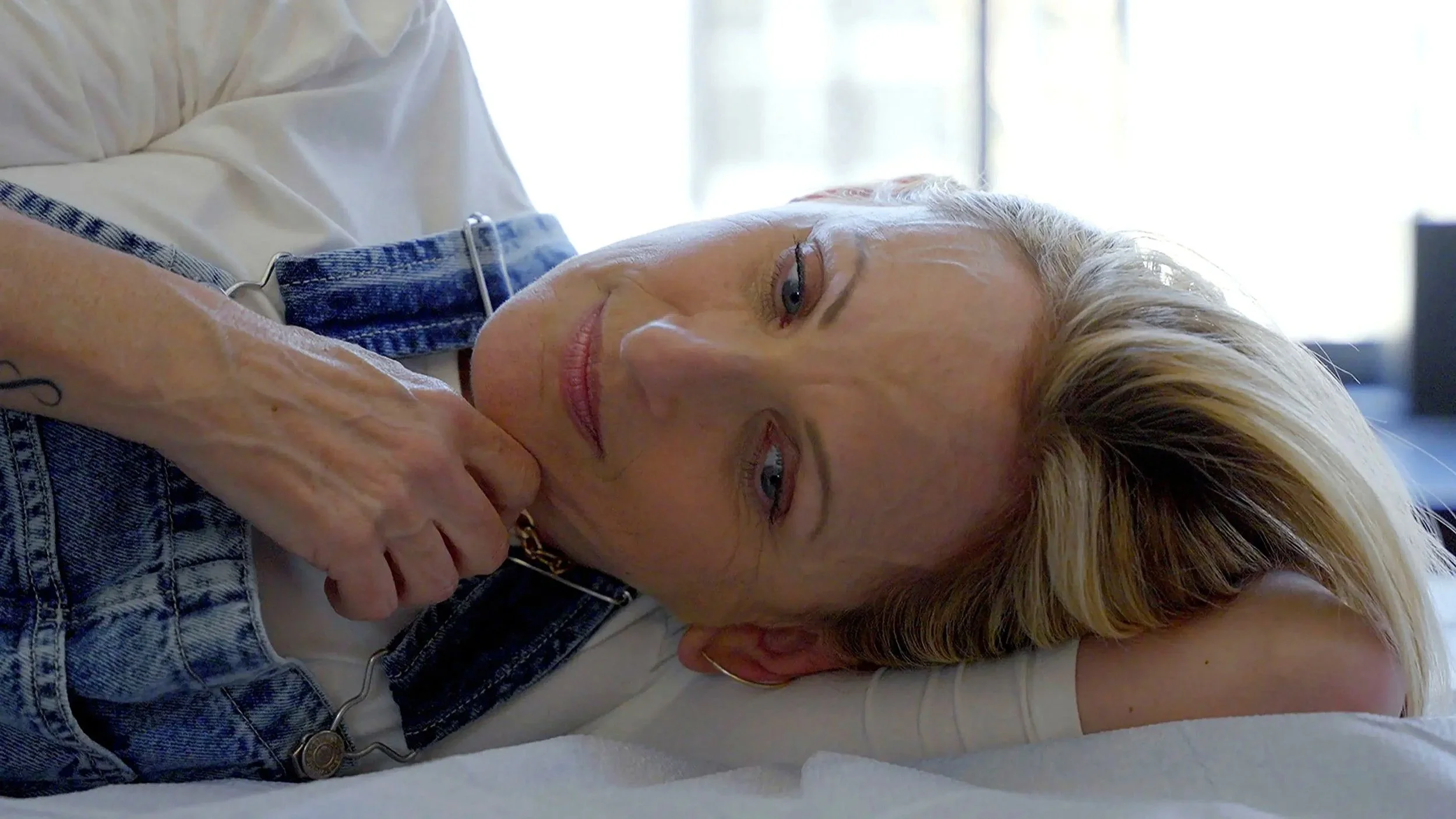
Image courtesy of Dogwoof Releasing.
Shoshannah Stern is an actress well established on American television who here turns to directing for the first time. Born in 1980 she is one of the fourth generation of a deaf family and, while she is able to speak, she regards American sign language as her main form of communication. It is clearly this background that has led to this new enterprise which finds her doing a good job in the director’s chair. But what makes her film special is the natural rapport between her and Marlee Matlin who is its subject. Matlin is, of course, the actress who had an extraordinary success in the 1986 film Children of a Lesser God. She made it at the age of nineteen having not acted in a film before and went on to win the 1987 Oscar as Best Actress for her performance. That was remarkable in itself but even more significant was the fact that she was an actress who was herself deaf playing a central character who was deaf. In earlier days Hollywood would always give such a role to a hearing actress as illustrated by the casting of Jane Wyman in Johnny Belinda (1948) and Patty Duke in The Miracle Worker (1962). Marlee's Oscar success went down in cinema history as the first such award to be won by a deaf player.
In Matlin's case she was the only deaf person in her family losing her hearing when she was just eighteen months old. Like Stern she is able to speak but her natural form of expression is through American sign language and it is that which accompanied by subtitles is used in this film throughout the lengthy conversations between her and Stern which provide the spine of the movie. Patently at ease and relaxed in each other's company, for these two to be working together on this film is an ideal partnership. That's all the more so because Marlee Matlin comes across as somebody who doesn't need a skilled interviewer to draw her out but is instead somebody who wants to be honest about herself. Two areas of her life illustrate this very clearly. One is her relationship with William Hurt which lasted for two years. She first encountered him as the male lead in Children of a Lesser God and she continues to speak highly of him as a mentor despite the fact that domestic abuse on his part became increasingly prominent and insufferable and would lead to her ending the relationship. Her balanced view of him is very much to her credit. She is equally honest about her own behaviour admitting how rebellious she was as a teenager when she was into drugs and boys and acknowledging her time undergoing rehab at the Betty Ford Clinic. When she wrote an autobiography in 2009, she would also disclose how she had been sexually abused both as a child and as an adolescent seeing her own story as one that might help others.
Stern’s film begins and virtually ends with her best-known films. Randa Haines the director of Children of a Lesser God appears early on to talk about the filming of it and another contributor is the actor Troy Kotsur who starred with Matlin in 2021’s CODA and who for his performance in that film would win an Oscar becoming the second deaf player to do so (this film’s title references that since the phrase "not alone anymore” relates to Kotsur’s recognition following on from her own). But, if her two big cinema successes are prominently featured, the film also gives a good indication of the vast amount of work that Matlin has done for television. Indeed, Aaron Sorkin puts in an appearance talking about how he created a role in The West Wing especially for her. Even so, the acting career is hardly the main focus here since at the centre of this documentary is the extent to which Matlin’s fame as an Oscar-winning actress made her into a spokesperson for the deaf. Pleased as she was to become a role model for what deaf people could achieve, this could also have its downside as was shown by the controversy unintentionally provoked when, as the presenter of an Oscar a year after her win, she chose to speak a few words as well as using sign language. However, later on she would become a champion for the needs of the deaf being met and would play a strong role as a spokeswoman for the National Captioning Institute promoting the belief that titles should always be available on television programmes.
The outline of Matlin's life that the film gives us looks back to her childhood in Illinois and there are contributions by her brothers, Eric and Marc, and by her sister-in-law, Gloria. Even more telling is the footage featuring the actor Henry Winkler who for Marlee became a true friend in times of need. She is now the mother of four having married in 1993 and her oldest daughter is also seen here although her husband, Kevin Grandalski, only appears in the background. In effect Marlee Matlin: Not Alone Anymore is a documentary blending three elements: the acting career, the personal life and the role that Matlin has played as a member of the deaf community. Appropriately it is that latter aspect which is underlined here not only by comments that she makes regarding the importance of sign language but by being a central feature of this film, the authentic form of expression when Matlin and Stern are together.
MANSEL STIMPSON
Featuring Marlee Matlin, Shoshannah Stern, Randa Haines, Sian Heder, Jack Jason, Troy Kotsur, John Maucere, Lauren Ridloff, Aaron Sorkin, Liz Tannebaum, Henry Winkler, Gloria Matlin, Eric Matlin, Marc Matlin, Sarah Grandalski, Kevin Grandalski.
Dir Shoshannah Stern, Pro Shoshannah Stern, Robyn Kopp, Justine Nagan and Bonni Cohen, Ph Jon Shenk, Ed Sara Newens, Music Kathryn Bostic.
Actual Films/American Masters Pictures/Impact Partner/Independent Television Service-Dogwoof Releasing.
96 mins. USA. 2025. US Rel: 20 June 2025. UK Rel: 8 August 2025. No Cert.
