
My Father’s Shadow

Akinola Davies Jr’s worthy directorial debut takes a look at the struggles of Nigeria in 1993.
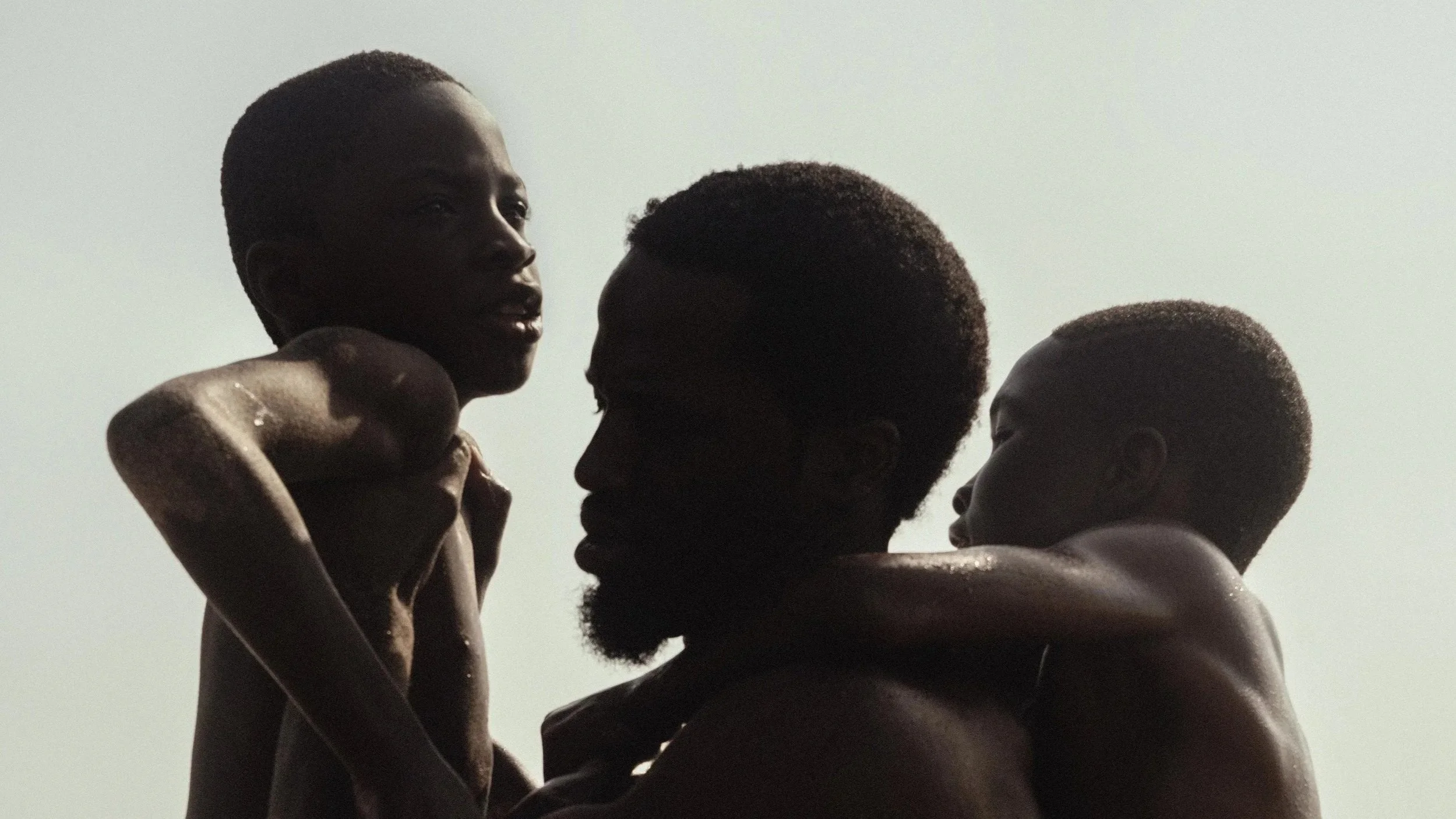
Image courtesy of Mubi.
by MANSEL STIMPSON
Nigeria's mainstream film industry is sufficiently established to have become known as Nollywood but My Father’s Shadow, the work of the British-Nigerian director Akinola Davies Jr and co-written by him and his brother Wale, has made a mark of a different kind. It became the first Nigerian feature to be screened at the Cannes Film Festival where it won a special mention in the Camera d’Or category. In addition, it has won awards in various other countries and I wish that I could feel more enthusiastic about the film than I do. I found myself admiring its intentions but the director’s approach was one that failed to draw in this viewer despite what should have been the ready appeal of its subject matter.
The tale told in My Father’s Shadow is in essence a simple one. Folarin (Sopé Dìrísù) is married to Bola (Winifred Efon) and they have two young children, Remi and Akin, played by two real-life brothers Chibuike Marvellous Egbo and Godwin Egbo. The home is a simple, rural abode and Bola works nearby in a village but to earn better money Folarin has sought employment in Lagos with the result that he is away for much of the time and the children miss him. However, what unfolds on screen appears to cover just two days in June 1993. We see the boys and their makeshift games at the outset but, in the absence of their mother, their father declares that he has to return to Lagos immediately and that he wants his sons to accompany him to see the city. If that journey provides the first part of the film, its middle section shows what happens to them in Lagos and the final scenes return to the rural setting.
Viewed as a personal tale what occurs is less concerned with dramatic events as such than with what we see of the relationship between Folarin and his sons. He is a loving father but his decision to prioritise making money to support his family has led to such long absences that both boys, eleven and eight years old respectively, start to question what he feels for them and are aware too that his time away is making their mother sad. The film may take place over just two days but as told from the viewpoint of Remi and Akin it is all about building up understanding and rapport. When it comes to narrative action as such much of the film turns on the fact that Folarin’s return to Lagos is a desperate bid on his part to face his employer and to demand payment of the wages which have been outstanding for six months. This aspect may indeed touch on the way in which working in a city like Lagos can lead to exploitation of those in need but its main function here is to make the employer’s temporary absence from his business premises a reason why Folarin and the boys should remain in Lagos for more than a day and have more opportunity to develop their bond.
For a full-length feature film and even one lasting for no more than 93 minutes this could sound to be a slight tale but Folarin’s situation and the audience’s hope that his sons will come to appreciate him gives the narrative a warmth and one that is aided by the able players and by Sopé Dìrísù in particular. Furthermore, My Father's Shadow is buttressed by a further element since it is not by chance that our travellers are depicted as arriving in Lagos on 12th June 1993. My Father’s Shadow is certainly a family tale, but it is also a political work since the date in question was the occasion when people like Folarin had hoped that the result of the election taking place would lead to M.K.O. Abiola as the candidate of the Social Democratic Party becoming president. Instead, as portrayed in the film, the news broke that the incumbent in order not to lose has declared the election annulled due to irregularities. This news led to violence in the streets and at this stage the story told in My Father’s Shadow takes on an extra level of drama (the military presence in the streets has been noted earlier but the threat now emerges on a different level).
To tell his story – one that has autobiographical elements for the filmmaker – is something that deserves praise both on account of the tale’s human appeal and as a potent reminder of a tragic moment in Nigeria’s history when a chance for democracy was lost. However, I feel that the former element cries out for a simple uncluttered narrative style in the mode of, say, Satyajit Ray while the political aspect needs to be presented in a way that makes things clear to viewers unfamiliar with Nigeria's history at this time. In neither case does it help that it is the perspective of the two youngsters that the film follows. It means, for example, that when Folarin meets acquaintances in Lagos, we often don't know either exactly who they are or what part they have played in his life because the boys don't know that either. Nor would they be of an age to really appreciate the political situation, but the film could deal with that by starting out with some informative on-screen written statements before the story starts. It is all too characteristic of My Father’s Shadow that early on we hear “M.K.O.” without any explanation and only subsequently realise that this is a reference to Abiola and later still his connection with the SDP.
These are to my mind drawbacks but so too is the film’s directorial style which favours quick edits that are self-conscious and often cuts up footage with inappropriate inserts. The latter even happens in one of the most telling scenes when father and son are talking in a revealing and intimate way. It is also the case that the film begins with flourishes of a confusing kind and a child's voice referencing his father and declaring "I will see you in my dreams". This is revisited when My Father’s Shadow reaches its conclusion and those who see this as an indication that we should regard the film as made up of dreamlike memories rather than the events of an actual couple of days may be justified. That could even explain some of the odder moments but to recast the nature of the piece in retrospect is too late to give satisfaction. Despite the awards earned by this film I find the director’s chosen style distracting and regret it all the more because the subject matter is so worthwhile. Furthermore, given the very adroit casting of Sopé Dìrísù, it should have been possible to give us a film about Nigeria as potent as my favourite documentary of 2025, Sudan, Remember Us, a comparable piece so far as the politics go.
Cast: Sopé Dìrísù, Chibuike Marvellous Egbo, Godwin Egbo, Winifred Efon, Tosin Adeyemi, Adesina Babalola Gbemi, Patrick Diabuah, Lawrence Chu, Martha Ehinome, Paul Edobor, Yetunde Victoria Coker.
Dir Akinola Davies Jr, Pro Rachel Dargavel and Funmbi Ogunbanwo, Screenplay Wale Davies with Akinola Davies Jr, Ph Jermaine Edwards, Pro Des Jennifer Anti and Pablo Anti, Ed Omar Guzmán Castro, Music Duval timothy and CJ Mirra, Costumes PC Williams.
BBC Film/British Film Institute/Crybaby Films/Element Films-Mubi.
93 mins. UK/Germany. 2025. UK and US Rel: 6 February 2026. Cert. 12A.
