
With its story of loss and loneliness, Argentine filmmaker Sofía Petersen’s first feature reveals a remarkable artistry.
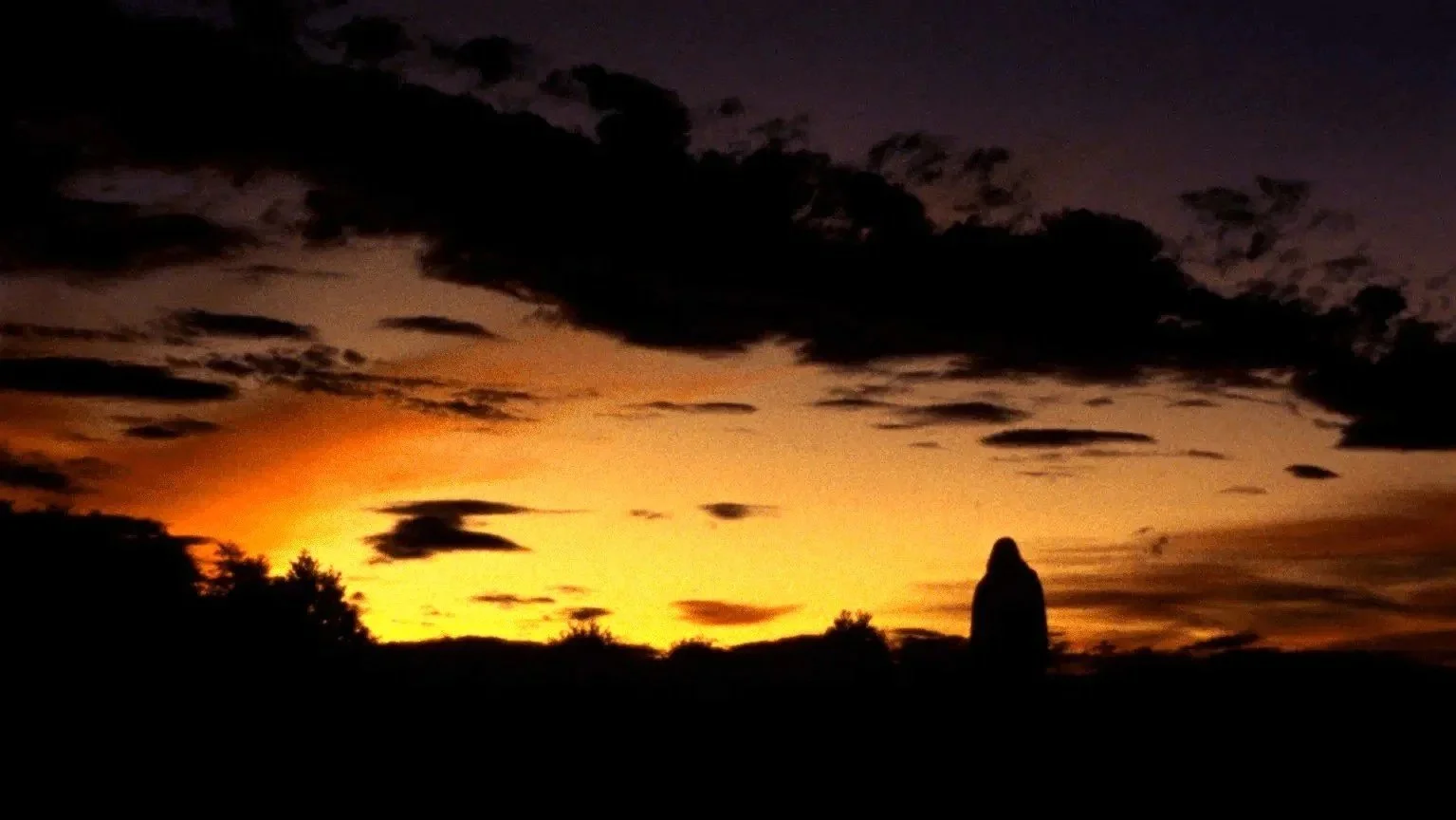
Image courtesy of Miracle/Animitas Cine.
by MANSEL STIMPSON
Olivia is the first feature film by the Argentinian filmmaker Sofía Petersen and it gained attention at the 2025 Locarno Film festival although it failed to win the Golden Leopard award for which it had been nominated. Even so - and despite it not having a name attached that would help to sell it - it is now being distributed in the UK. Adding to the surprise of that is the fact that Olivia is a decidedly experimental film and avant-garde works of this kind often have a very limited life outside of film festivals. Nevertheless, it is indeed the case that Petersen’s film contains much that is impressive even though there is no doubt at all about this being a film of highly specialised appeal.
Olivia takes place in Tierra del Fuego and its plot can be described in terms which, if unusual, still make it sound quite approachable. The titular figure played by Tina Sconochini lives in a remote rural area in what in appearance is closer to being a pyramidal hut than a standard house. The only other occupant is her father (Dario del Carmen Haro Santana) who travels daily to a slaughterhouse where he works. One day he goes missing and, seeking to find out what has happened to him, Olivia now takes that journey herself. Such a situation could have been the basis for a plot-driven film, but in fact it provides a mere thread of narrative that is eked out to yield a film lasting over two hours.
Importantly one finds that the storytelling very much yields pride of place to the images themselves and it is here that Petersen’s special skills quickly become apparent. She is working with the photographer Owain Wilshaw using 16 mm Kodak Ektachrome and the pictorial impact is strong from the very start. In the opening moments we get more than one close-up of Olivia's eye and see shots involving fire. Furthermore, thunder is heard and we quickly realise that wind and other natural sounds will be used tellingly and with great precision. For a few minutes the soundtrack lacks a music score, but as soon as it emerges one realises that Ustav Lal’s music is another key contribution to this work. In the early stages the film concentrates on father and daughter in their lonely abode alongside images that might well represent dreams. Later on, however, substantial passages feature the work that is carried on in the slaughterhouse. This part of the film was shot in a municipal slaughterhouse with the men seen there being actual workers and not actors. Both settings are strikingly handled and in the case of the slaughterhouse scenes potential viewers should be warned that they are graphic. The editing by Petersen herself adds to the impact and indeed the outstanding attribute to be found here is Petersen’s cinematic eye. Not infrequently when a film contains notable images the effect is painterly and the precise composition of shots is the crucial element. But here what most takes the viewer’s eye is not what is static but resides instead in light and movement: Petersen's vision is very specifically cinematic in the fullest sense and is allied to an acute ear for the contribution that sounds can make whether they be natural or musical.
In its chosen style this amounts to great filmmaking, but the film is much less inviting if you are looking for a clear-cut and satisfying story or even for some kind of fable. One even finds this lack of clarity at the outset: Olivia is found wandering outside the hut and we soon discover that she sleeps for much of the day when her father is away working. It has been suggested that she might be suffering from narcolepsy while others have remarked more vaguely that she seems to have some condition that holds her back. At one point she speaks of losing the notion of time but Petersen never seeks to clarify this. What we do see is Olivia turning to entomology as she regularly collects and pins down insects. Meanwhile, talk with her father is limited and often downbeat. Typical of this is when the end of the world is broached and they ponder whether it is more likely to be a case of the planet freezing or going on fire.
Much of the film takes place at or towards night with great shots of coloured skies but in contrast slaughterhouse scenes are introduced before Olivia journeys there. It is characteristic of the piece that when she does so there is little revealing discussion about her father although she interacts with the men and a doctor in attendance treats a wound that she has received. She does, however, encounter one female worker, Mari (Caroline Tejeda), who will reappear later. The question of dad’s fate is not ignored, but Olivia can only be regarded as a work which invites the viewer to draw his or her own conclusions as to what lies at the heart of it. The suggestion heard that life is like a river running to be lost in the sea seems to confirm the general pessimism of the work, one which portrays the world as male-dominated and often gives the impression that, like the cows at the slaughterhouse, Olivia is entrapped. The notion that time erodes everything hardly contradicts that and when, late on in a bar, Olivia dances she does so alone. When Mari comes back into the story, she offers consolation but it is an open question whether their bonding should be thought of in terms of lesbianism or direct female sisterhood. You are again invited to respond in any way that you wish both to that and to the fact that the film’s last shot brings in a younger woman showing concern.
What is absolutely clear-cut is that Olivia is an artistic endeavour of some distinction but that anyone looking for a well-told tale that has a clear meaning will find it totally off-putting. It can be recommended on its own terms to the right people and I hope that my description of it will lead readers to know where they stand in that respect.
Cast: Tina Sconochini, Carolina Tejeda, Dario del Carmen Haro Santana and workers from the Rio Grande Municipal Slaughterhouse including Francisco Barria and Francisco Alberto Oliva.
Dir Sofía Petersen, Pro Shaun Finneran, Screenplay Sofía Petersen, Ph Owain Wilshaw, Pro Des Mia Casaretto, Ed Sofía Petersen, Music Utsav Lal.
Animitas Cine/Vitrine Filmes/Elías Querejeta Zine Eskola-Miracle/Animitas Cine.
126 mins. Argentina/UK/Spain. 2025. UK Rel: 24 April 2026. Cert. 15.