
Itab Azzam and Jack MacInnes’s ambitious documentary covering ten years in the life of a Syrian refugee just attempts to cover too much ground.
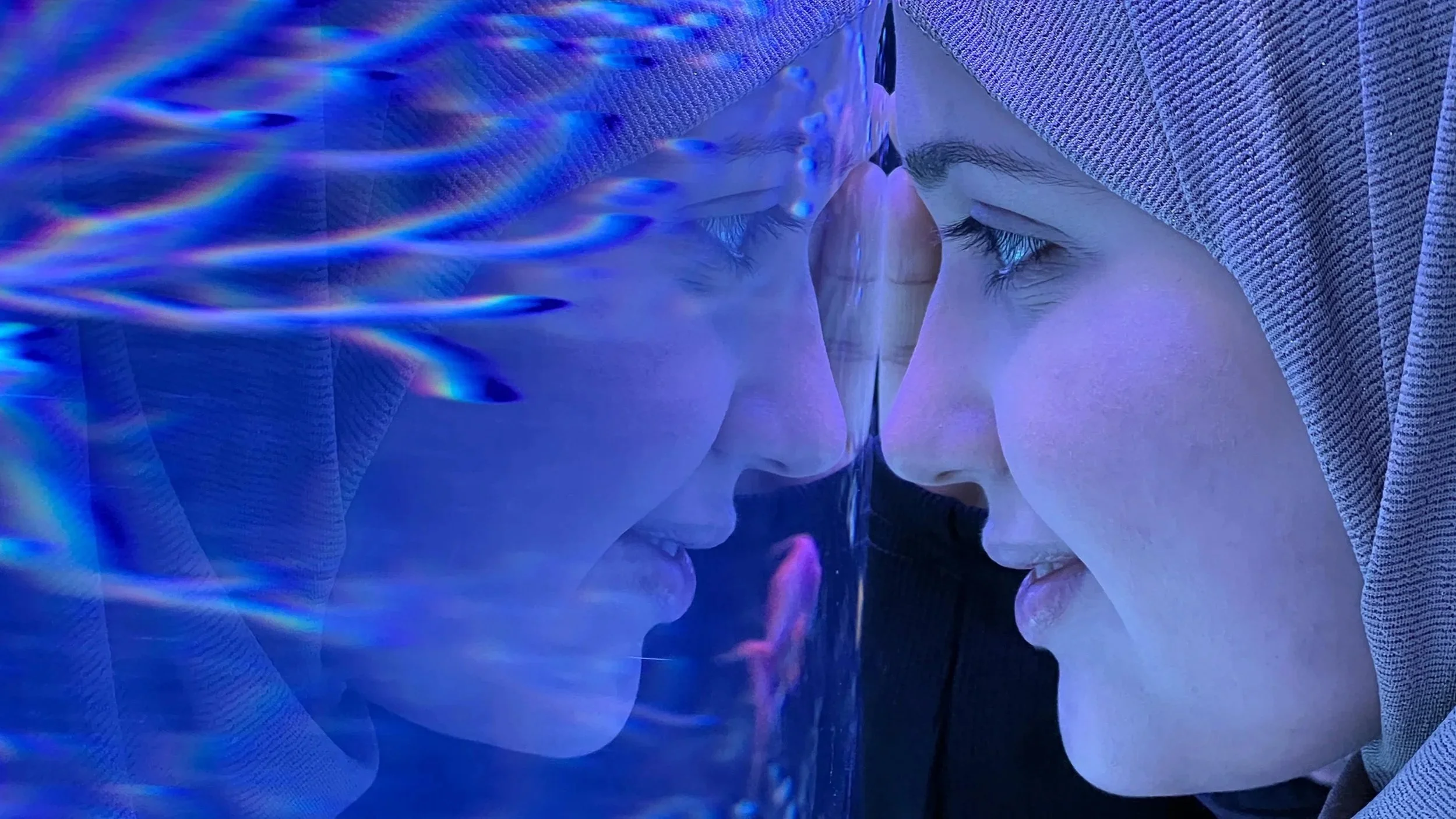
Image courtesy of Dogwoof Releasing.
by MANSEL STIMPSON
When Richard Linklater made Boyhood he not only gave us a masterpiece but gathered headlines for the innovation of shooting it over twelve years so that the actors could age in line with the characters that they were playing. The nearest equivalent to that in documentary film-making probably lies in Phil Grabsky charting the life of an Afghan boy, Mir Hussain, over twenty years. However, in that case what was involved was not a single film but three of them which appeared in 2004, 2017 and 2021 respectively. Nevertheless, the third work incorporated footage taken from the preceding ones and was indeed entitled My Childhood, My Country: 20 Years in Afghanistan. Consequently, that work did study Mir's life over that period showing him as he grew.
Now in One in a Million, a documentary made by the husband-and-wife team of Itab Azzam and Jack MacInnes, we have a film which for the first time shows us footage which they took between 2015 and 2025. The central figure here is a Syrian refugee named Israa and at the start of that decade she was just eleven years old. The bombing of the house in Aleppo where she had been living with her parents, Tarek and Nisreen, had led to the family leaving Syria for Germany, a journey which would take them through Turkey, Greece, Macedonia, Serbia and Austria en route. It was early in that long and arduous trek that the filmmakers encountered the family and photographed Israa for the first time, that being on the streets of the Turkish city of Izmir.
It must have been apparent at once that Israa was remarkably engaging: talkative, lively despite her circumstances and already somebody possessed of qualities unusual in one so young. In deciding to follow the family as they continued their journey, Azzam and MacInnes could not have known where it would lead since the fate of Israa and the others might have developed in so many different ways. In the event they got to Germany, settled in Cologne where Israa grew up and met her husband-to-be, another Syrian refugee named Mohammed. She would not see the country of her birth again until after the fall of its dictator Bashar al-Assad in 2024 by which time it was a moot point as to whether Syria or Germany was the place that she could regard as her true home.
There is in every sense a lot of ground being covered here and with the aid of their editors, Iain Pettifer-Moth and Alec Rossiter, the two directors have achieved a film which moves at a good pace but without feeling rushed. It is also the case that as she grows older Israa remains well suited to being central to the narrative, someone with whom the viewer readily sympathises. Arguably, the title of the film could be regarded as being in one sense somewhat misleading. If one knows that its subject is a girl from Syria seeking to reach Germany, the phrase ‘one in a million’ suggests that it is all about a refugee seeking asylum and indeed those words come up in exactly that sense early on. Consequently, it's a title which might suggest that the whole of the film would be taken up with that journey but in fact only half an hour of the work’s 106 minutes has passed when the family reach their destination. However, since the film begins with footage of Israa back in Syria on a visit, it must be acknowledged that in the event there is an immediate indication that One in a Million is a film which will take the story forward.
In doing just that, the film certainly sustains our interest for its full length and always remains sympathetic, but it also involves aspects that work less well. Even in the earliest stages one is aware that, although Israa's parents feature effectively, her siblings are rather sketchily presented and to a large extent fade from sight in the second half of the film. Nevertheless, a central concern of One in a Million as it develops is the way in which a family that has abandoned its roots to live elsewhere can thereafter find it difficult to feel fully at home in another country. That was a situation explored in rather different circumstances but in much more depth by Shoaib Sharifi in her splendid film I for India (2005). That work centred on her father, a doctor, who came to Britain to earn and to improve his lot and later, following an ill-fated attempt to return to India, ended up living in the UK. Thinking of that film makes it clear how it managed to be far more detailed and moving on this issue with the viewpoints of all the family effectively brought out.
One in a Million does convey the extent to which Israa's mother embraced in Germany the freedom available for women that she had discovered there for the first time while the father, Tarek, reacted the other way. His close bond with young Israa seen early on demonstrates his affection for her very clearly, but later he would become a disciplinarian ready to abuse the women in his family in order to keep them in line. While this is made clear, it is very suddenly that we hear that Israa's parents have divorced and a late reconciliation between Tarek and his daughter needed to be investigated in more detail to make us understand it. Furthermore, the middle passages of the film concentrate on Israa's rebellious adolescence so it is difficult to know how much or how little of that stems from the situation of a Syrian girl finding herself in a different society as opposed to one going through a typical teenage phase. It is to be noted too that, although the portrayal of the Germany in which the family arrive stresses its receptive stance towards refugees, the later scenes ignore the subsequent changes in attitude despite that surely being a factor if Israa has to decide whether her future lies there or in Syria.
One in a Million is an engaging undertaking certainly, but perhaps not one best suited to the form of a single feature film. Given the elements that are not filled in and the sense that more footage was needed to capture the family’s experiences fully, it seems apt to conclude that Azzam and MacInnes for all their good intentions were taking on too much here. What might have made an effective TV series comes in this format to feel crammed into a standard-length documentary when it needed more space. Even so, Israa in particular is memorable and this is an interesting work despite its shortcomings.
Featuring Israa, Tarek, Nisheen, Mohammed, Jana, Shahad, Ammar, Rami, Ramiz, Hayyan.
Dir Itab Azzam and Jack MacInnes, Pro Itab Azzam, Jack MacInnes, Raney Aronson-Rath, Will Anderson, James Bluemel and Andrew Pamer, Ph Itab Azzam, Jack MacInnes and Will Pugh, Ed Iain Pettifer-Moth and Alec Rossiter, Music Simon Russell.
Keo Films/PBS Distribution/Frontline Features/BBC Storyville/Placeholder Films/Impact Partners-Dogwoof Releasing.
106 mins. USA/UK/Germany. 2026. US Rel: 21 October 2026. UK Rel: 6 November 2026. Cert. 15.