
Our Land

Orban Wallace's documentary explores the right to roam in the English countryside.
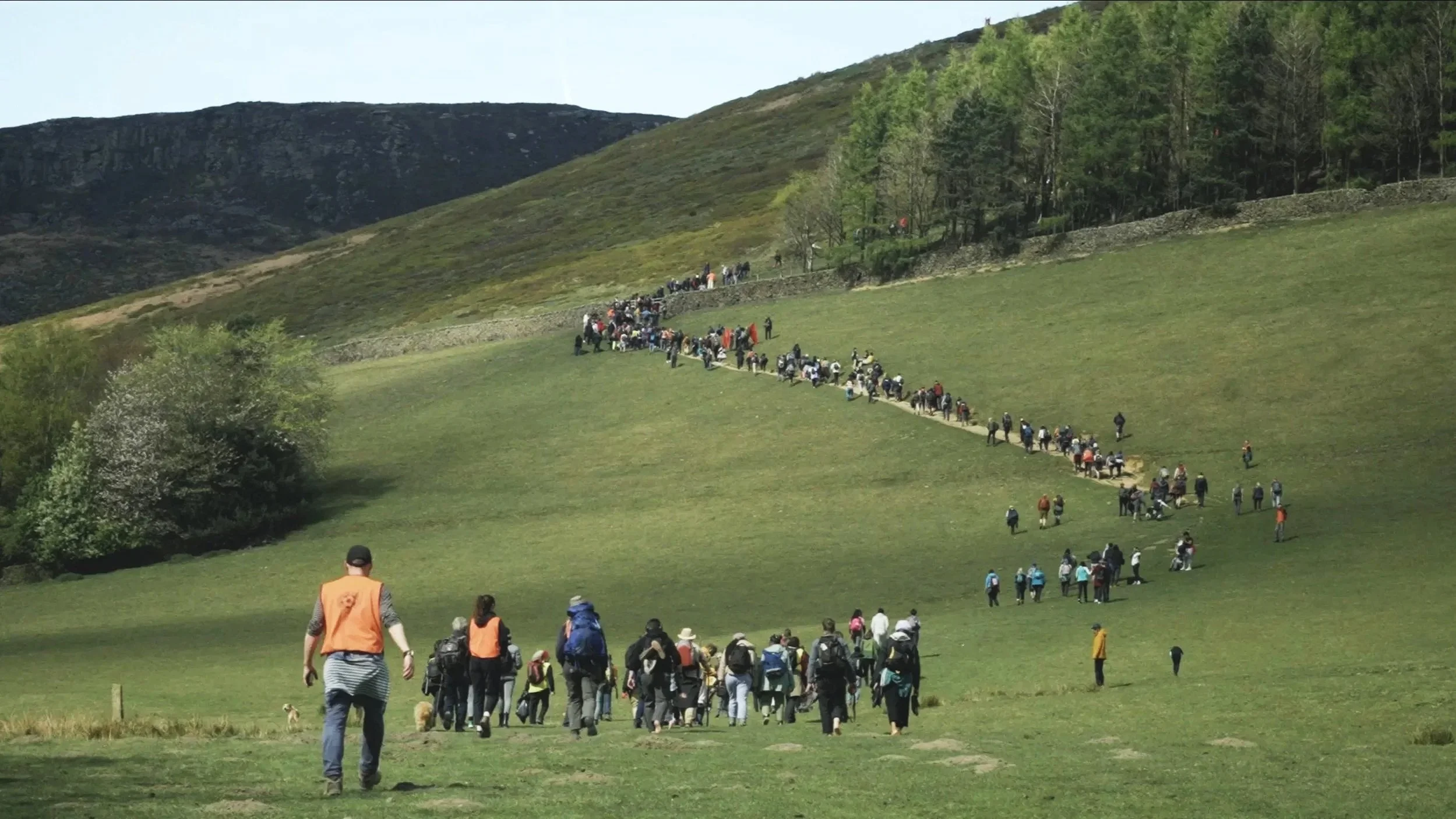
Image courtesy of MetFilm.
by MANSEL STIMPSON
Our Land, a documentary feature by Orban Wallace, is concerned with the belief that the English and Welsh countryside should be accessible to the public in much the same way that the Land Reform Scotland Act of 2003 authorises it in that part of the UK. Central to this film is the work of the movement set up in 2020 by Nick Hayes and Guy Shrubsole that goes by the name of Right to Roam. Both men are among those seen on screen here and the film could well be regarded as a platform for their campaign. The fact that it contains so much footage of our countryside admirably photographed in colour by Jamie Wolfeld means that Our Land could also be regarded as a film promoting the rural beauty to be found in the UK and in that it succeeds handsomely. However, the promotion of Right to Roam strikes me as handled in a way that is ill-judged.
It is, of course, likely that the majority of those who elect to view Our Land will be people drawn to the film because they already espouse this particular cause. My own position, however, is that of someone who is not unsympathetic but has not given much thought to this issue. Consequently, my idea of good publicity for it would be a reasoned work which allowed one to consider the case in the round, a film with an investigative approach and in which a range of views were expressed. In theory Our Land might appear to be that film. While Hayes, Shrubsole and an ardent supporter named Nadia Shaikh speak up for Right to Remain, we also hear from several landowners. One of these is an amiable estate owner from Staffordshire, Hugh Inge-Innes-Lillingston who regards his triple-barrelled name as an inheritance that could be off-putting to many but which he has to accept for what it is. Equally pleasant and sensible is John Mildmay-White of the Flete Estate in Devon. Both men see themselves as being stewards of the land which they own and, while they may be doubtful about the wider access desired by Right to Roam, regard a form of managed access in a positive flight.
However, although these two are given a fair opportunity to express their views, Wallace's film when dealing with landowners gives pride of place to another Devonian, Francis Fulford of The Dansford Estate. Fulford doubtless sees himself as a patriotic traditionalist who feels proud to be just that. But, in fact, his extreme views are such that many who see him here will take against him. That probability stems from the fact that his comments include describing the general public as stupid and asserting that blacks have no interest in venturing into the countryside. The response thus encouraged is surely something that the filmmaker, whose own sympathies are abundantly clear, recognises as a card to play. Whether or not that is indeed the case, it is unquestionable that Fulford’s remarks unintentionally help the case being made by Hayes, Shrubsole and Shaikh. The latter is as firm in her views as Fulford and does not hesitate to regard the lack of direct land access as being the consequence of colonialism and imperialism. In line with that view, she describes the ownership of land as a clever way of holding power, of separating the masses and turning them against each other. This degree of emphasis turns up again in another form when the film incorporates a section showing how Fulford relishes pheasant shoots on his estate: it's strong stuff admittedly but not really a matter directly relevant to the argument about public access to the countryside. If that sequence illustrates what gives Fulford pleasure, there is no doubt at all that quite as much delight is taken by Right to Roam in a whole series of mass trespasses designed to draw attention to their aims. Any illegality in their actions is pushed aside with an observation that ‘trespass’ is a really vague word.
Quite late on the film crosses the border and takes us into Scotland where we hear from John Grant, 13th Earl of Dysart, who has welcomed that country’s wider freedoms to roam and has made a success of it on his own lands. In the process he has found ways to educate the public in how to respect the rights they possess. Given these greater rights that have now existed there for some years, one would like to know whether there have been problems or not. Consider the risk of litter being left, the need to protect animals that could be endangered and the view that estates can best be preserved by owners who feel a real responsibility for what has been in their family for generations: these are all points which call for considered investigation as to the extent that they may be overstressed or may in some cases clearly exist but can be covered well enough by being handled in an appropriate way.
It is the engaging, thoughtful John Mildmay-White who, aware of both sides of the question, declares that there is an interesting debate to be had. It is just that which I would like to have seen here with more detailed facts and figures. In particular one would welcome a look at what specifically can be learnt from what has been done in Scotland. Reference is made in that context to the Scottish Outdoor Access Code. However, few details of it emerge even though it could be that its provisions might be such as to give reassurance to doubters: comparable requirements could answer their worries were the rest of the UK to follow suit. There is mention of a court case concerning Dartmouth National Park where the owner chose to prohibit wild camping and initially won his case but which then went on to be overturned on appeal. To hear some of the arguments that were made for and against could well have been informative, but that is passed over. That Our Land misses out on developing these aspects serves to underline how limited its approach is. I can well believe that strong supporters of Right to Roam will be far more likely than I was to see this as good filmmaking. Visually it is fine and Daniel Inzani’s music score is well-judged but, when a film comes over as a promotional piece, I regard it as a failure if the strongest impression that it gives is that the viewer is being got at. Here one feels that one is being hounded and that is not the way to win people over.
Featuring Nick Hayes, Nadia Shaikh, Francis Fulford, Hugh Inge-Innes-Lillingston, Guy Shrubsole, John Mildmay-White, John Grant, Maxwell Ayamba, Andy Wightman
Dir Orban Wallace,Pro Charlie Phillips, Leo Smith and Rebecca Wolff, Ph Jamie Wolfeld, Ed Xanna Ward Dixon,Music Daniel Inzani, Animation May Kindred Boothby.
Gallivant Films/Grasp The Nettle Films/I Am Charlie Prods/BFI Doc Society Fund/Intermission Film-MetFilm.
91 mins. UK. 2025. UK Rel: 8 May 2026. Cert. 12A.
