
Palestine Comedy Club

Alaa AliAbdallah’s disjointed documentary looks at how Palestinian comedians use humour to combat the current tragedy of their lives.
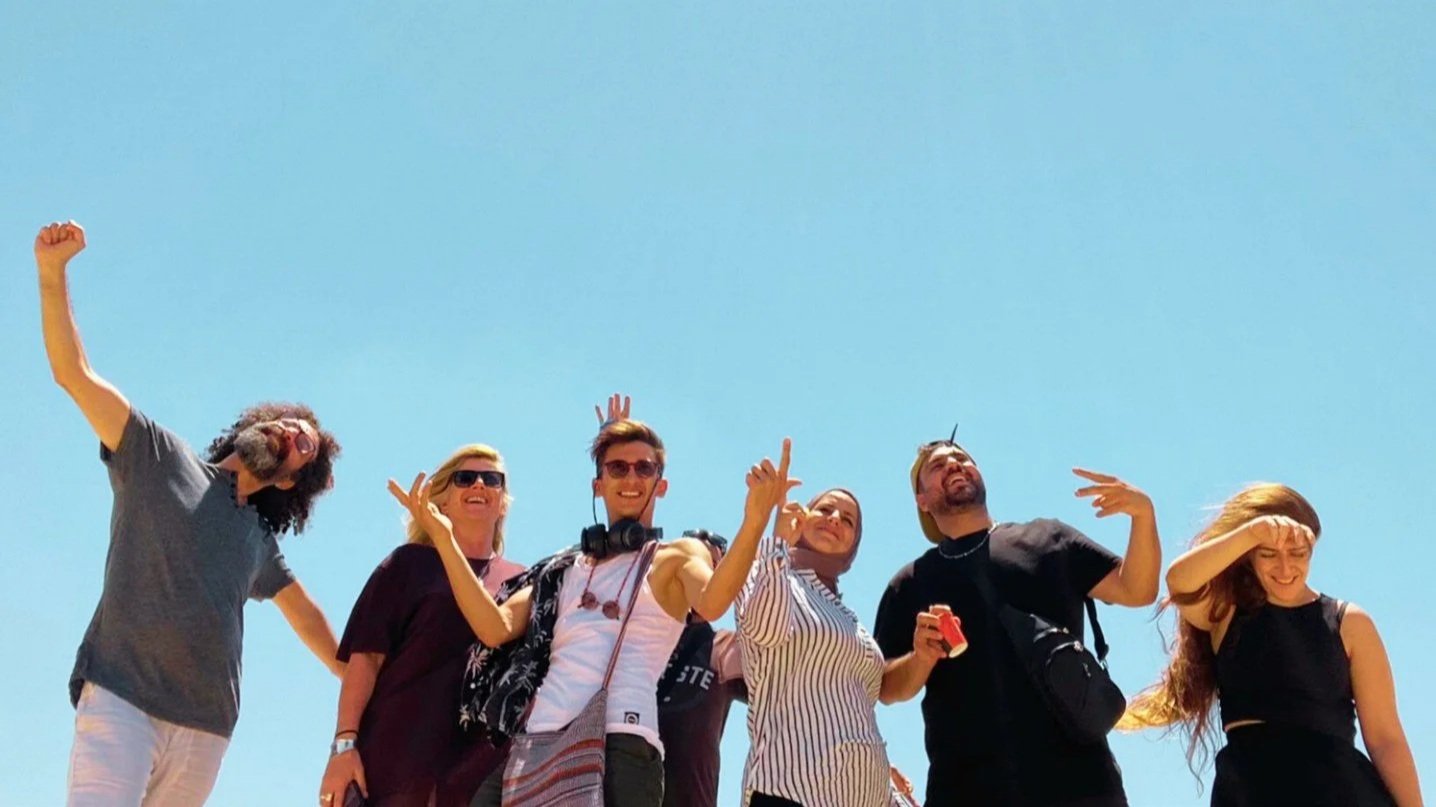
Image courtesy of Tough Crowd Limited.
by MANSEL STIMPSON
The human appeal to be found in this documentary is its most appealing feature. At the outset Alaa Shehada tells us in voice-over how in August 2022 he founded the Palestine Comedy Club to utilise stand-up comedy as a format that could be of value in tragic times. Initially playing in various parts of the West Bank, the company would then spread out more widely to visit Israel and eventually would become international including an appearance in London. But in the film’s first major scene featuring Shehada himself he is in Jenin with his mother and it is their warm rapport that draws us in. Thereafter, we become familiar with the five other performers in the club. Two of them are women, Ebaa Monther from the Golan Heights and Diana Sweity from the town of Beit Awwa. Their male colleagues alongside Shehada himself are Raed Al-Shyoukhi from Hebron, Khalil Al Batran from Ramallah and Hanna Shammas a Palestinian from Haifa. A sixth person involved is British and she is Sam Beale who acts as the company’s artistic director and who co-founded it with Shehada who states that she was his inspiration in setting it up.
The film unfolds in chronological order and, as we follow the company on tour performing in such places as Ramallah, Nablus, Haifa, Nazareth and Jerusalem, we get to see them on stage including part of their very first show which was in Ramallah. An opening number introduces them as a group who individually announce their names and backgrounds and, as the film goes on, later extracts from their appearances put the spotlight on each artist in turn. By now we are aware that all of them are engaging people trying to do something of value. However, the approach taken by the film’s director Alaa AliAbdallah, usually referred to as Regash, is best summed up as having a character akin to a scrapbook. He records event sympathetically but the flavour of the piece is not so far removed from home movies rather than being a film that delves deeper.
There is talk in the early stages of how the times are so tragic that Palestinians can only benefit from seeing entertainment that encourages laughter. Nevertheless, the purpose of the comedy club is such that there is another deeper aim. The humour is not deployed to escape from what is happening but to enable the artists to talk in a personal way that reflects their own experiences. Shehada stresses that the group come from different backgrounds and that life in Palestine contains so many stories. The company take note of contrasted ideas of what it means to be Palestinian and the club’s observational comedy encourages a questioning attitude. There is clearly a desire to open the eyes of their audiences in this way.
We are told that the company seeks to challenge beliefs without attacking those who hold them and that lines spoken on stage may be changed from place to place after consideration has been given to the varying sensibilities to be expected in the audience. Assessing such matters is not always easy as witness the trepidation felt on one occasion over the inclusion of references to women wearing the hijab. Despite that anxiety, females who were present proved ready to shake hands afterwards. But, although that incident is recalled, we don't have footage in which members of the audience comment direct. We are told that the company had a tough reception in Jerusalem yet that just seems to mean there had been less laughs. A much fuller investigation into the material used by the company and into the extent of hostility provoked would have been welcome, as would examples of occasions when responses were far more positive than expected. Unfortunately, the outline of their aims is generalised when what we really want are detailed examples of what they say on stage and of what influence it can have.
When it comes to taking their show outside the West Bank itself (Haifa being a case in point) those who encounter problems in obtaining permission to travel but choose to go regardless find themselves at risk of being spotted and arrested. The danger thus involved makes us all the keener to know just how much their work achieves. Later, when they perform in London, they may in some instances be revealing much about life in Palestine unknown to some of their audience. But, since their visit coincided with the Hamas attack of 7th October 2023, one would like to know about mixed reactions to their show and on that the film is silent.
At 96 minutes, Palestine Comedy Club is not excessively lengthy, but because what we see of the company and its performances is rather superficial the film does come to seem over long. It is also the case that, despite eventually offering voice-over comments by most of the company, one feels that the portraits of the individuals involved could have been fuller and more rounded. Furthermore, transitions between settings and the various people commenting are at times rather abrupt. The film does become more personal later on when the devastation around the West Bank after the infamous Hamas attack of 7th October 2023 is reflected in further scenes in Jenin and Ramallah. However, while at this point we undoubtedly feel for the Palestinians, here the film has less to do with the club itself and is more akin to other reportage on the war that we have seen.
Towards the end of this documentary we learn in rather bitty scenes that some of the artists are staying put but that others have moved to Berlin and to Amsterdam. There is a reunion on Zoom before the film’s close but, just as Sam Beale's role as artistic director is never really studied and elaborated, it is not clear if the personnel of the company is changing as they move apart or if London was a stage towards global expansion (there is a vague reference to New York). In theory it may round things off to bring back Alaa Shehada’s mother once again but then to feature him going on stage and declaring “Let's start the show” as a way of ending the film doesn't feel right. As presented here, it puts the focus on him more than on the club and is too nebulous as to where things are going from there.
That said, while I wish that the film had greater depth, I return to my opening assertion that Palestine Comedy Club has undoubted human appeal. To share the lives of the people on screen at this terrible time is to appreciate their situation on a direct level and to applaud their resilience. Regardless of any aspects of the piece that fall short, this documentary will be welcomed by audiences who are eager to respond in common humanity and ready to applaud a graffiti message glimpsed in the film which declares ‘Resistance Through Art’.
Featuring Alaa Shehada, Hanna Shammas, Diana Sweity, Ebaa Monther, Khalil Al Batran, Raed Al-Shyoukhi, Sam Beale, Alaa AliAbdallah (‘Regash’).
Dir Alaa AliAbdallah (‘Regash’) and Charlotte Knowles, Pro Charlotte Knowles, Ph Abdallah Juneidi, Ahmad Alawneh, Ahmad Saleh, Alaa AliAbdallah (‘Regash’), Charlotte Knowles and Shadi Jararaa, Ed Libby Knowles, Music Faris Amin and Khalil Al Batran.
Tough Crowd Limited/First Hand Films/Counterpoints/LDNO Productions/X Equals Productions-Tough Crowd Limited.
96 mins. Palestine/UK. 2025. UK Rel: 27 February 2026. Cert. 12A.
