
Pillion

Harry Lighton’s BDSM biker romance set in England’s South-East proves to be an extraordinary achievement.
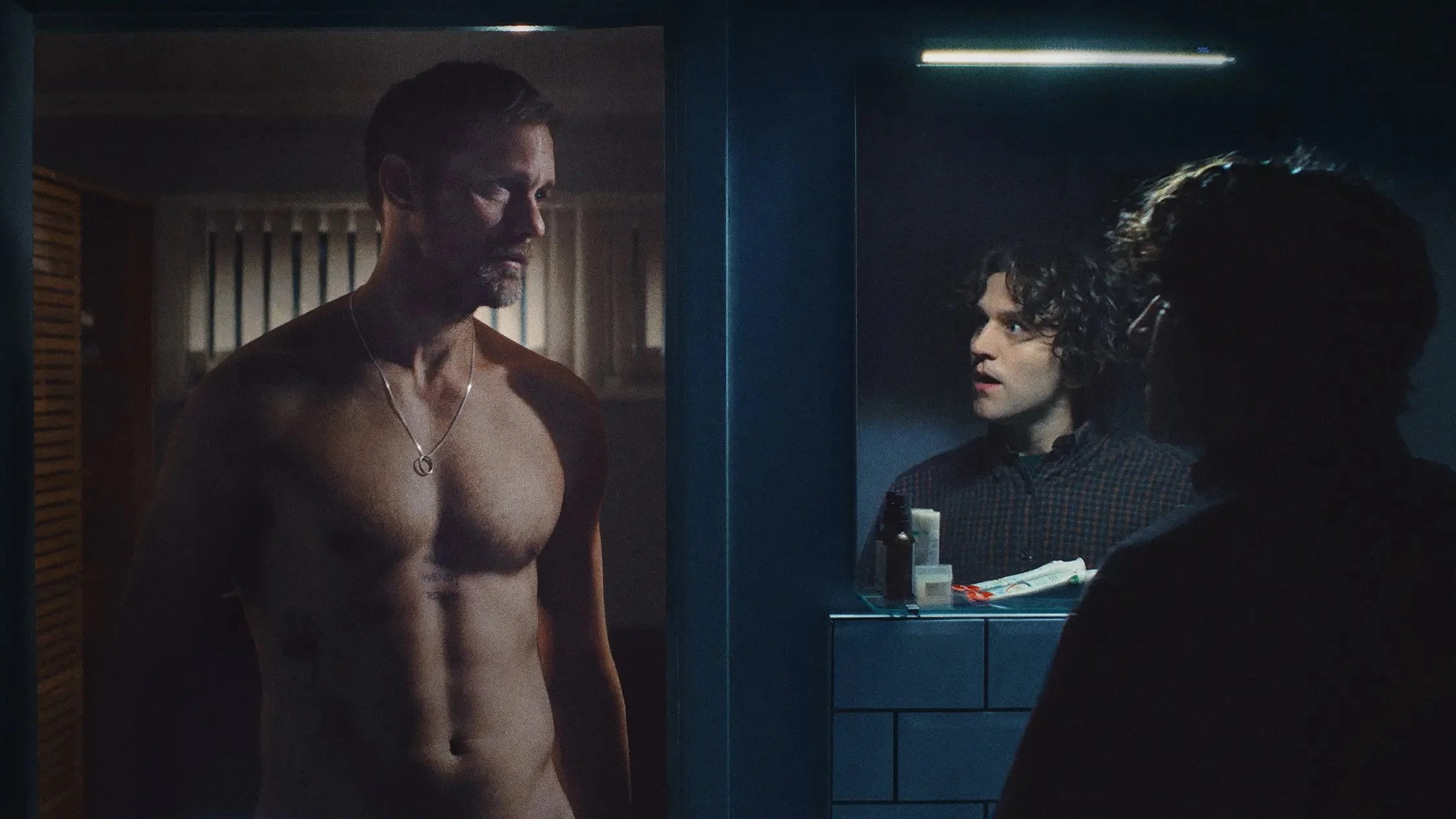
Alexander Skarsgård and Harry Melling
Image courtesy of Picturehouse Entertainment.
This film marks the feature debut of the writer/director Harry Lighton and it is an extraordinary achievement. Indeed, it had seemed likely that I would declare it to be a masterpiece until late in the day when I found myself unconvinced by a turn of events key to the story. But, even if my experience in this respect is one that is shared, this is a film that demands attention and a great deal of admiration. It might have been expected that the film would mainly be notable for its daring choice of subject matter. It is, of course, the case that we are living in an age when there are plenty of films that deal very frankly with gay lives and include explicit sex scenes. Pillion, however, is centred on a gay relationship involving an inexperienced young man named Colin (Harry Melling) who readily takes the submissive role with a biker, Ray (Alexander Skarsgård), who is into men that he can dominate. The fact that it portrays this kind of sexual relationship and does so in such an uninhibited way is enough in itself to make the film stand out. But in the event, it is the astute tonal variations in the tale’s telling that constitute its most remarkable feature along with the fact that the casting of the main roles is so brilliantly realised.
I gather that, despite being based on the 2020 novel Box Hill by Adam Mars Jones, the film is very much its own thing and not least because it is now set in the present day and is thus able to avoid such issues as the couple facing homophobia and having to be closeted. Just as striking is the fact that a story which might well have been presented in dark, earnest tones is handled in a way which is often humorous and romantic while never being sentimentalised or untrue to life. Pillion begins when Colin, who works as a traffic warden, drives to a pub to sing in an a cappella group. It is here that he and Ray see each other for the first time and on Christmas Day Ray invites him out for what proves to be oral sex in a quiet side turning. Colin's parents (Douglas Hodge and Lesley Sharp) are well aware that their son is gay and even encourage him to find a boyfriend, but they have no idea that he will be drawn to somebody who wants to dominate him. However, as the film develops we see Colin regularly spending time with the handsome Ray and discovering that he is happy to do his bidding even though this means cooking for him, doing his will to order and at night sleeping not in his bed but on the floor. As the submissive Colin wears a choker collar and as the months pass Colin joins in outings with Ray and his biker friends (apparently many are played by members of the Gay Bikers Motorcycle Club).
The story of Colin and Ray is told by Harry Lighton with not a single wasted frame and, if the tonal blends are perfectly judged, equally adroit is the way in which the narrative is meticulously constructed to bring out convincingly the points that Lighton wants to make. I had thought it likely that those whose sexual tastes are far removed from those depicted here would be at the very least distanced by what is shown, but Lighton when portraying Colin’s sexual subservience counters our possible disapproval by emphasising the pleasure that it gives to Colin (Melling excels in expressing this without relying on words). Later there is a key moment in a scene in which Colin’s mother, usually so sympathetic, unexpectedly expresses disquiet when Ray finally meets Colin's parents for lunch. She is put out by Ray being so distant and uninformative about himself, something which is linked to the character of his relationship with Colin. But in response to her comments, it is asserted that what may be uncomfortable for her may not be bad for Colin. In point of fact Colin is in love and in time chooses to say so to Ray who does not welcome this disclosure. Here we have another crucial scene with Colin suggesting that his view of any real sexual relationship is that love should be at the heart of it.
Plenty of other scenes illustrate the skilled blending of tone. One such occurs three months into the relationship: it combines the romantic (Ray is playing Satie’s celebrated ‘Gymnopédie No. 1’ on the piano which almost becomes a theme tune) while Colin is trying to persuade him to have dinner with his parents and meet them for the first time, a suggestion which feels inappropriate enough to be comic. Then – daringly but effectively – the same scene becomes the moment when for the first time we are told directly that Colin's mother is dying of cancer. Much later when we know how much Colin’s emotions are involved, we have him asking Ray if just one day a week they could sleep in the same bed and wake up together. Ray is reluctant to agree and the ensuing dialogue is simultaneously both comic and touching.
I indicated earlier that I found the last section of Pillion unpersuasive. This occurs after Colin seeks to assert himself and, if his feelings make that credible, the change that then comes about in Ray seems much less convincing as presented. The eventual outcome is credible enough but by then I had lost my belief in the story. It is also the case that the last scenes of all are something of a cliché even if on this occasion they do enable the film to underline its endorsement of those whose sexual tastes are identifiable with those of Colin. But, even if the later scenes cause the story to lack the conviction that has been felt so strongly up to that point, Lighton’s direction including his ear for apt music deserves praise and so too does the acting. Lesley Sharp’s supporting performance as Colin’s mother is admirably judged and both of the leading actors deserve awards with Melling in particular triumphing in a role that cannot have been easy to pull off.
MANSEL STIMPSON
Cast: Harry Melling, Alexander Skarsgård, Lesley Sharp, Douglas Hodge, Nick Figgis, Jake Shears, Jake Sharp, Anthony Welsh, Mat Hill, Rosie Sheely, Jacob Carter, Miranda Bell, Stevie Raine, Billy King.
Dir Harry Lighton, Pro Emma Norton, Lee Groombridge, Ed Guiney and Andrew Lowe, Screenplay Harry Lighton, based on the novel Box Hill by Adam Mars-Jones, Ph Nick Morris, Pro Des Francesca Massariol, Ed Gareth C. Scales, Music Oliver Coates, Costumes Grace Snell.
Element Pictures/BBC Film/BFI-Picturehouse Entertainment.
107 mins. UK. 2025. US Rel: 31 October 2025. UK Rel: 28 November 2025. Cert. 18.
