

In Carmen Emmi’s overelaborate debut feature, an undercover police officer in 1990s New York is tasked with apprehending gay men.
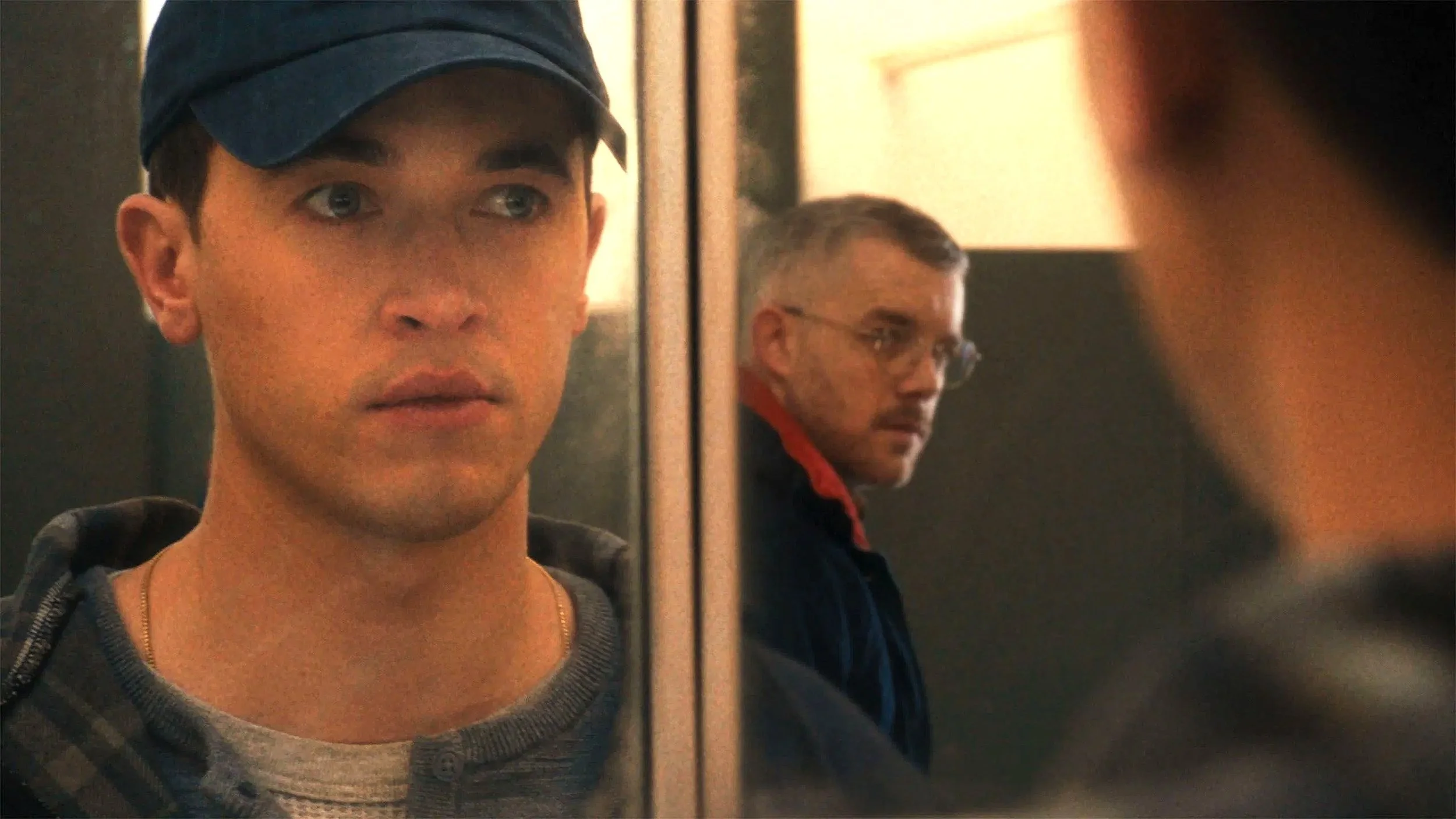
Tom Blyth and Russell Tovey
Image courtesy of Curzon Film Distributors.
For his debut feature, Carmen Emmi is both the director and the writer. Consequently, it is evident that the tale is told in the manner in which he wanted it to unfold. Nevertheless, the impression that Plainclothes left on me was of a grossly overelaborate work smothering what had the potential to be a much more direct and simple piece and one that would have been far more effective. I gather that I am not entirely alone in taking that view, but I should acknowledge that not everyone shares it since the film has won as many as six awards at festivals.
When it comes to the good things in Plainclothes two stand out and the first of these lies in the fact that for a gay movie it offers an unusual and intriguing storyline. It takes place in Syracuse in New York State in the year 1997 and setting it then does not appear to have been a matter of chance. The central character is a young cop named Lucas (Tom Blyth). In joining the force, he had been following a family tradition and when we meet him he is regularly carrying out plainclothes work. This involves him in seeking to lead on and entrap gay men in restrooms. Such police activity in the UK is mainly associated with a much earlier time, a notable example being the occasion in 1953 when the famous actor Sir John Gielgud was charged with persistent importuning for immoral purposes in a London toilet. However, it was in 1998 that the singer George Michael was arrested for a lewd act in a restroom in L.A. and that was doubtless in Emmi's mind when he set his story in that now distant yet much later period.
Portraying police work of this kind is not something that has featured very much in gay movies and certainly not in recent ones. The historical context of Plainclothes provides the opportunity to highlight it and it comes across as something of a novelty in itself. But Emmi takes this further when we realise that Lucas is himself gay but closeted. He finds himself attracted to one of the men he is expected to entrap although he refrains from doing so. This is Andrew (Russell Tovey) who, unaware of Lucas being a cop but finding him appealing, passes on his phone number which leads to a rendezvous in a cinema. It becomes clear that Andrew, who is older, is no stranger to cottaging whereas Lucas despite recognising his own sexuality has not yet acted on it. Nevertheless, both men quickly experience deeper feelings than a one-off encounter would usually involve.
This is a situation which is pleasingly out of the ordinary and Plainclothes also benefits from the fact that Blyth and Tovey, both very well cast, give lived-in performances which render both Lucas and Andrew totally believable. Lucas had previously had a girlfriend, Emily (Amy Forsyth), but it is apparent that he is now deeply in love for the first time. However, while Andrew is clearly a kind and considerate man, his gay activities are something which he keeps secret and he obviously has some other life which prevents him from believing that he and Lucas could have a lasting relationship. Lucas meanwhile is hemmed in by family considerations: he has acknowledged his gay feelings to the sympathetic Emily but no one else knows and, particularly after his father dies, he is concerned over what his mother (Maria Dizzia) will feel if she were to discover that he is gay.
Both the near documentary background of the police entrapment proceedings and the agreeably original storyline mean that Plainclothes is a work of huge promise. So, it’s unfortunate that Carmen Emmi’s approach is not only overelaborate but becomes self-consciously so. Given the tensions that exist in Lucas (his concerns about his sexuality becoming known, the guilt of being involved in work that oppresses gay men, the shock and uncertainty consequent on Andrew not choosing to develop their relationship), Emmi may be setting out to reflect in his shooting style the chaos which exists inside Lucas's head. But, whatever the theory behind it, this is a film that often interrupts a scene with intercuts some of which are sudden flashbacks to Lucas's childhood while others just exist in his mind. On occasion the intercuts can even become a montage and elsewhere a filter is applied or we are shown distorted images. Furthermore, beyond these distracting visual antics, Emmi also chooses to play with the time sequence and to present some episodes out of chronological order.
All of this happens frequently enough to become an interference which prevents the story from unfolding more straightforwardly and therefore becoming more involving. However, there is worse ahead when the last third of the film offers two unforeseeable surprises. The first revelation builds to a scene which features in close succession most of the tricksy elements favoured by Emmi before we move on to a contrived final climax. Put these two sequences together and there is an inescapable sense that what for all the stylised nature of the storytelling had been a believably realistic tale has suddenly taken on all the trappings of melodrama. The supporting cast is a very able one, but what is really disappointing here is that Blyth and Tovey should do such fine work in a film that proves to be unworthy of them because of the way in which the material is handled. However, given those awards, this is a view with which you may disagree.
MANSEL STIMPSON
Cast: Tom Blyth, Russell Tovey, Maria Dizzia, Amy Forsyth, Christian Cooke, Gabe Fazio, John Bedford Lloyd, Alessandra Ford Balazs, Darius Fraser, Christine Albright, Joseph Emmi Sr, Lauren Stanton.
Dir Carmen Emmi, Pro Colby Cote, Arthur Landon, Eric Podwall and Vanessa Pantley, Screenplay Carmen Emmi, Ph Ethan Palmer, Pro Des Roxy Martinez-Michaud, Ed Erik Vogt-Nilsen, Music Emily Wells, Costumes Kaden O’Keefe.
Lorton Entertainment/Page 1 Entertainment/Mini Productions/TK Studios-Curzon Film Distributors.
97 mins. USA/UK. 2025. US Rel: 19 September 2025. UK Rel: 10 October 2025. Cert. 15.