
Put Your Soul on Your Hand and Walk

Both life and death in Gaza City feature in Sepideh Farsi’s documentary that has become a memorial to the Palestinian photojournalist Fatma Hassona.
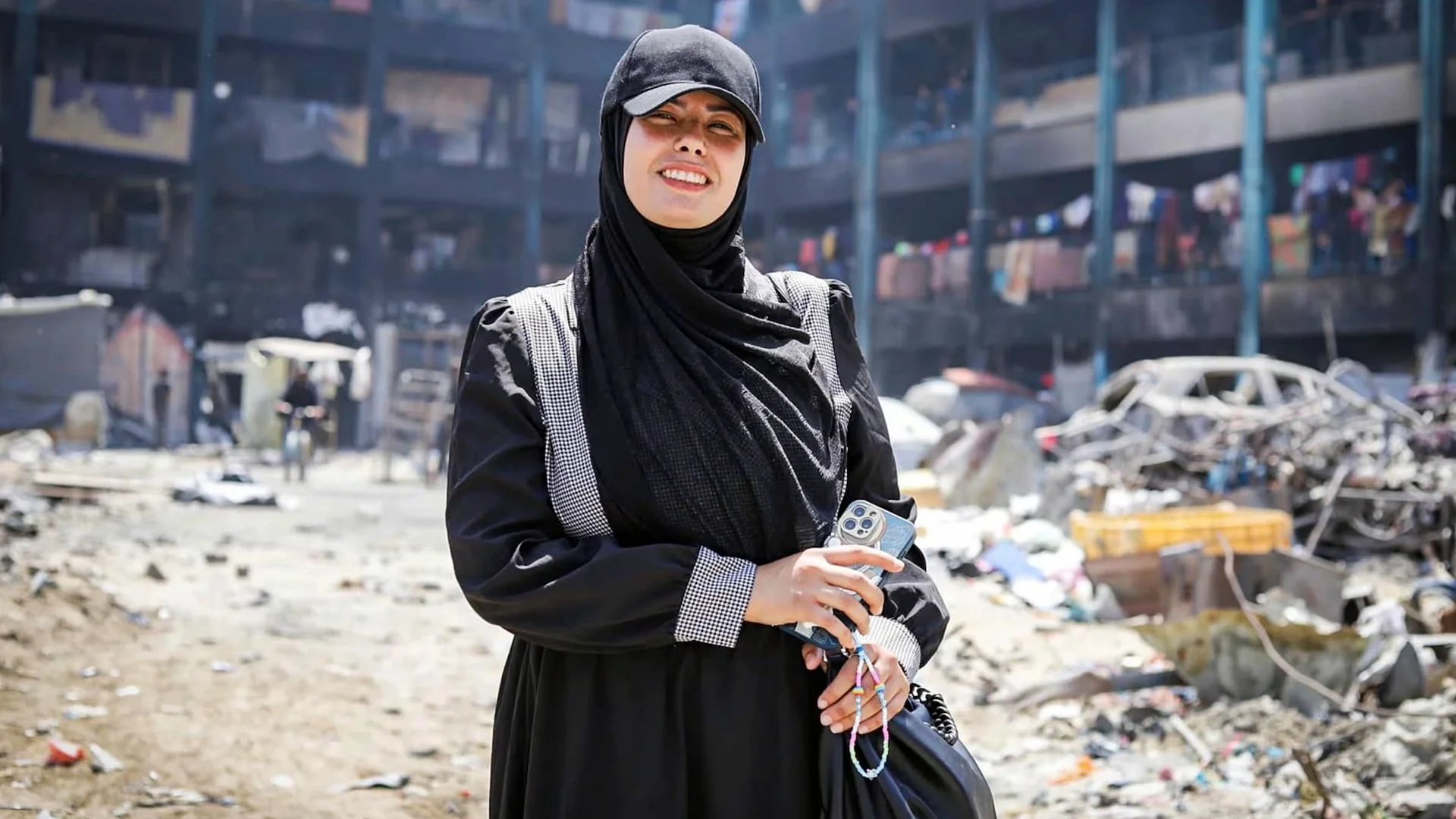
Image courtesy of Dogwoof Releasing.
Reviewing this film is an unusual experience because the circumstances in which we are seeing Sepideh Farsi’s Put Your Soul on Your Hand and Walk have turned it into something akin to the kind of tribute that might be paid at a funeral service. Farsi is Iranian but has been based largely in Paris and Athens since leaving her home country after being victimised by the authorities there. It was in April 2024 that she first contacted the 25-year-old photojournalist Fatma Hassona and recorded visually the conversation that they had when using smart phones. Farsi was in Cairo at the time and she had heard of Fatma through a Palestinian refugee who, knowing that Farsi was deeply concerned about the situation in Gaza and had been unable to get permission to go there, had suggested that she should contact Fatma who was living with her family in the Tuffah quarter of Gaza City. Once in touch through these video calls the two women quickly established a strong rapport regardless of their difference in age (Farsi had been born in 1965) and they would speak regularly in this way with Farsi calling up Fatma from wherever she happened to be (she did this from countries as far apart as France, Italy and Canada).
What this film gives us is a whole set of conversations just as they occurred which means that we witness cut-offs and reconnections and sometimes suffer visual distortions (the sound quality can vary too but while English was the language spoken subtitles are used here for clarity’s sake). These talks are the heart of the film and, while it is unconventional for a film to rely so heavily on material which can only show us people conversing through the images of them on their phones, this limitation adds to the sense of this being an unusually personal and intimate work. The majority of their talks took place between April and October 2024 but the last one was on 15th April 2025. That was when Farsi was able to inform Fatma that the film which she had made out of their conversations had been selected for the 2025 Cannes Film Festival. The very next day the Israelis would drop a bomb that killed Fatma and at least six others of her family. That information is given in a written statement at the film’s close. However, I don't hesitate to mention it here since it seems likely that most reviews will do so and in any case to have that knowledge as one watches the film only adds to the emotional engagement that is created.
In such special circumstances as these it almost seems out of place to give any detailed assessment of the film itself, but in this case doing so involves giving praise to a far greater extent than making criticisms. If I do feel compelled to include one strong reservation that is because making the viewer a direct witness of the phone exchanges eventually makes one question whether or not extra editing might not benefit the film even if it does add to our sense of being directly involved. Opting for a running time of 113 minutes mean’s that there is a certain sense of repetition and you do feel the length. But if that became apparent it was partly because the first half of the piece is so strong. Here I was reminded of that masterly film about Ukraine, Mstyslav Chernov’s 20 Days in Mariupol, which through its direct reporting at feature length brought the occupation of that city to vivid life in a way that went deeper than any TV news report or press article. Here one finds that just to have two women talking at length as Fatma describes her daily life in Gaza City brings home the suffering of Gaza’s ordinary citizens in an extraordinary way. That what we hear reflects the experience of one particular person in no way diminishes the impact for in effect Fatma is speaking for all in her situation. Furthermore, despite eventual moments of despair, for much of the time she is amazingly optimistic. That is all the more remarkable because she reveals so clearly that being under daily attack from bombs and being in a situation in which food is becoming increasingly scarce has over time become a new but terrible normality. This part of the film is deeply impressive and throughout its length the documentary also gains from intercutting which at intervals features Fatma's own photographs depicting what she is seeing around her. If occasional news clips taken from television and illustrating the wider picture are no more than useful reminders of particular developments in the war, Fatma’s photographs display real quality and add to the film’s emotional impact in their own right.
In passing a question or two do arise. Exterior shots on film of Gaza City appear late on without explanation as to their source (they may have been filmed from a car by Fatma herself but all the other images taken by her are still photographs). Also, while Fatma’s lament for human suffering in war appears widespread, Farsi, ever sympathetic, does not press her on her view of the Hamas attack on 7th October 2023. These are minor points when considered in the context of this film which by making Fatma Hassona into both an individual whom we get to know and a representative of her fellow citizens in Gaza stands as a deeply humane portrayal of an inhuman situation. If Fatma was ultimately a victim, she was also an everyday heroine whose loss will surely affect all who see this film. It is mentioned at the close that over two hundred journalists have been killed in Gaza and, although the possibility is not commented on here, a research agency known as Forensic Architecture which functions in the UK has concluded that Fatma was killed in a targeted attack. While her early death can only be considered tragic, it is good to know that she lived just long enough to be aware that Put Your Soul on Your Hand and Walk would play at Cannes, an event which would ensure that even after her death her voice would be heard.
MANSEL STIMPSON
Featuring Fatma Hassona and members of her family and Sepideh Farsi.
Dir Sepideh Farsi, Pro Javad Djavahery, Ph Sepideh Farsi, Ed Sepideh Farsi and Farahnaz Sharifi, Music Cinna Peyghamy.
Rêves d’Eau Productions/24 Images-Dogwoof Releasing.
110 mins. France/Occupied Palestinian Territory/Iran. 2025. UK Rel: 22 August 2025. Cert. 12A.
