
Red Path

In his second feature, Lotfi Achour persuasively documents a real-life incident of regional violence in his native Tunisia.
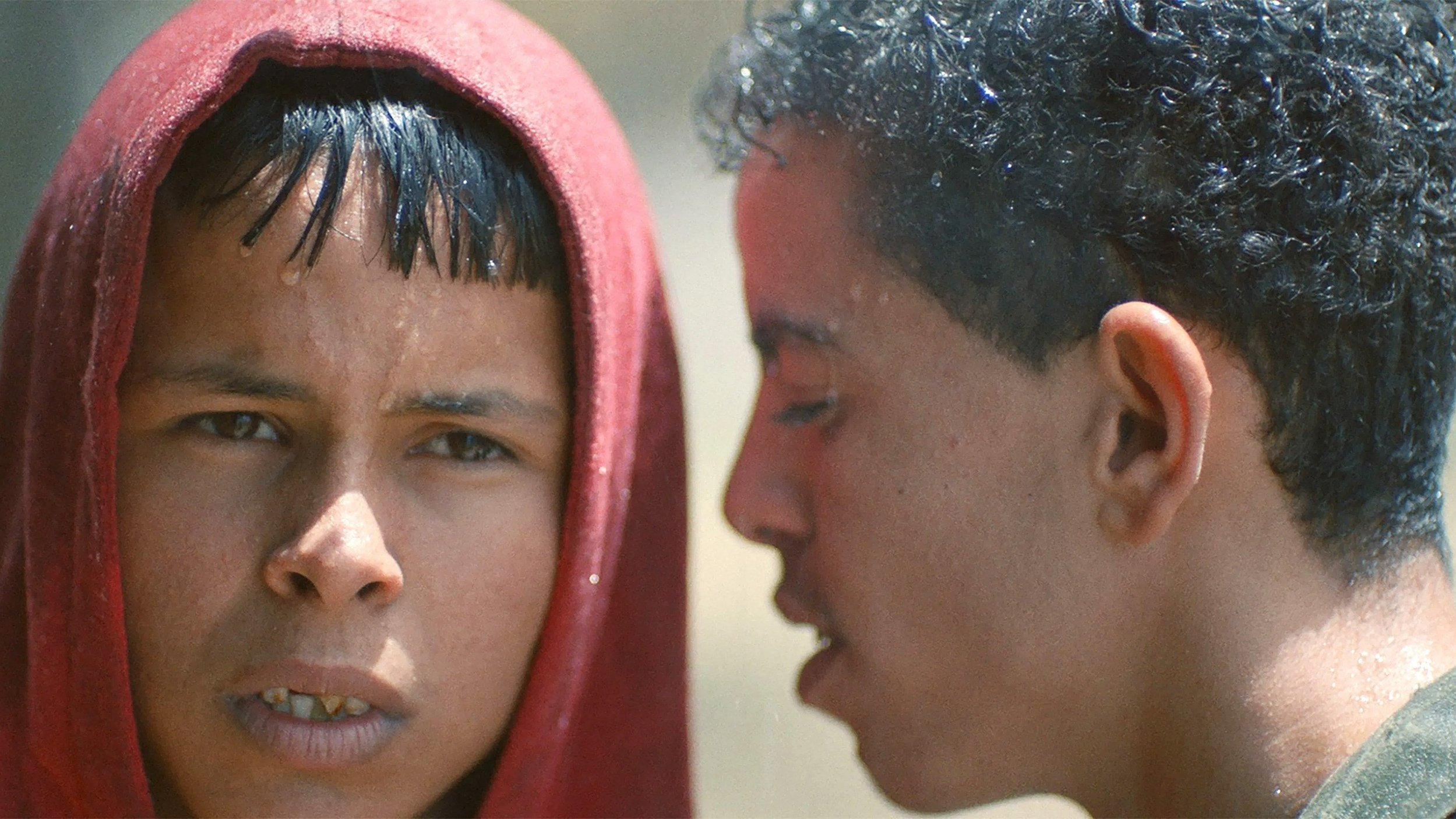
Image courtesy of Sovereign Films.
Tunisia’s Lotfi Achour is best known for his stage productions which have given him an international reputation and comprise well over twenty in number. Rather unexpectedly he has in more recent times turned to cinema and Red Path is his second feature (the first was 2016’s Burning Hope which was not released in the UK). Within its first few minutes this is a work that very clearly reveals his skill in this medium and the material that he has chosen which is based on real events is well worthy of being dramatised for the screen.
Red Path has been shot in widescreen and its opening immediately makes an impact as we take in the scenery (the setting is the Mghila Mountain) and observe two boys herding goats. They are cousins living in the same village and one of them, Achraf, who is fourteen years old and is played by Ali Helali, becomes the film’s central character. The other boy, a year or two older, is Nizar played by Yassine Samouni and in due course we will meet the families. Achraf’s father is an absent figure since he is in Algeria, but the boy lives with his mother, Zina (Salha Nasraoui). In Nizar's household the central figures are his mother Mbarka (Lalifa Gafsi) and his older brother Mounir (Younes Naouar).
The film’s opening few minutes quickly capture the bond between the young cousins and their ease in a landscape where you can find a resting place beneath a tree or enjoy relaxing in the sun. But soon enough we will come to realise that Red Path is a film about the extent to which ordinary Tunisians can find themselves endangered by the nearby presence of Islamist jihadists. Indeed, a killing by them which is pivotal to the story told here is based directly on a crime committed in 2015 and, while some reviews of this film may describe in more detail what is involved, I feel that it is better to let that revelation be experienced in the course of watching the film. What I can say is that young Achraf’s involvement in this incident understandably has a traumatic effect on him and the narrative of Red Path in effect unfolds through his eyes.
A further leading figure in the film is Nizar’s girlfriend, Rahma (Wided Dabedi), and all of the players contribute to the conviction that Achour brings to his portrayal of this community and to the impact of what the Mujahideen settled in this mountain area have done. It is interesting too to note the extent to which the authorities when called upon to help only put in an appearance belatedly after the villagers concerned have had no alternative but to act alone.
Red Path has won no less than twelve festival prizes of which five were audience awards and if it had kept to a naturalistic mode throughout, I would have thought it worthy of them. However, while the circumstances entirely justify Achraf being portrayed as suffering after-effects akin to those of soldiers experiencing PTSD due to their wartime experiences, Achour has chosen to present this through stylised images. These play a substantial part in the film and are expressed in a variety of ways from flashback memory shots to dreams to wholly imaginary encounters. The real difficulty with this is not that they are inappropriate to Achraf’s mental state but that they come across as a filmmaker’s self-conscious endeavours to express them and in doing so they clash with the realism of the main narrative.
In point of fact, there is one other aspect of Red Path which is also less than ideal. In following the facts of the case on which it was based, the film gives us a narrative that is more powerful in the first half than in the second. Consequently, the drama risks a sense of anticlimax. Ironically what partially saves it from that are not the last scenes that we witness but the unusual power of the written statements which when written up on the screen are used to complete the story and end the film. That Red Path should have these weaknesses is disappointing because so much of it is not just well made but deeply impressive and in all of those scenes it measures up to what the subject-matter deserves.
Original title: Les enfants rouges.
MANSEL STIMPSON
Cast: Ali Helali, Yassine Samouni, Wided Dabedi, Younes Naouar, Lalifa Gafsi, Jemii Lamari, Salma Nasraoui, Mounir Khazri, Noureddine Hamami, Eya Bouteraa, Rayen Karoui, Sana Ben Med Jabaalah.
Dir Lotfi Achour, Pro Anissa Daoud, Sébastien Husseno and Lotfi Achour, Screenplay Natacha De Pontchara with Doria Achour, Sylvain Cattenoy and Lotfi Achour, Ph Wojciech Staroń, Pro Des Mohamed Mouhli, Ed Ewin Ryckaert, Malek Chatta and Anne-Laure Guégan, Music Jawhar Basti and Venceslas Catz, Costumes Nabila Chérif.
Artistes Producteurs Associés/Versus Production/Shipsboy/La Luna Productions/Bord Cadre Films/Sovereign Films-Sovereign Films.
100 mins. Tunisia/France/Belgium/Saudi Arabia/Qatar. 2024. UK Rel: 20 June 2025. Cert. 15.
