
Riefenstahl

Andres Veiel’s detailed study of the controversial German director Leni Riefenstahl allows the archive footage to speak for itself.
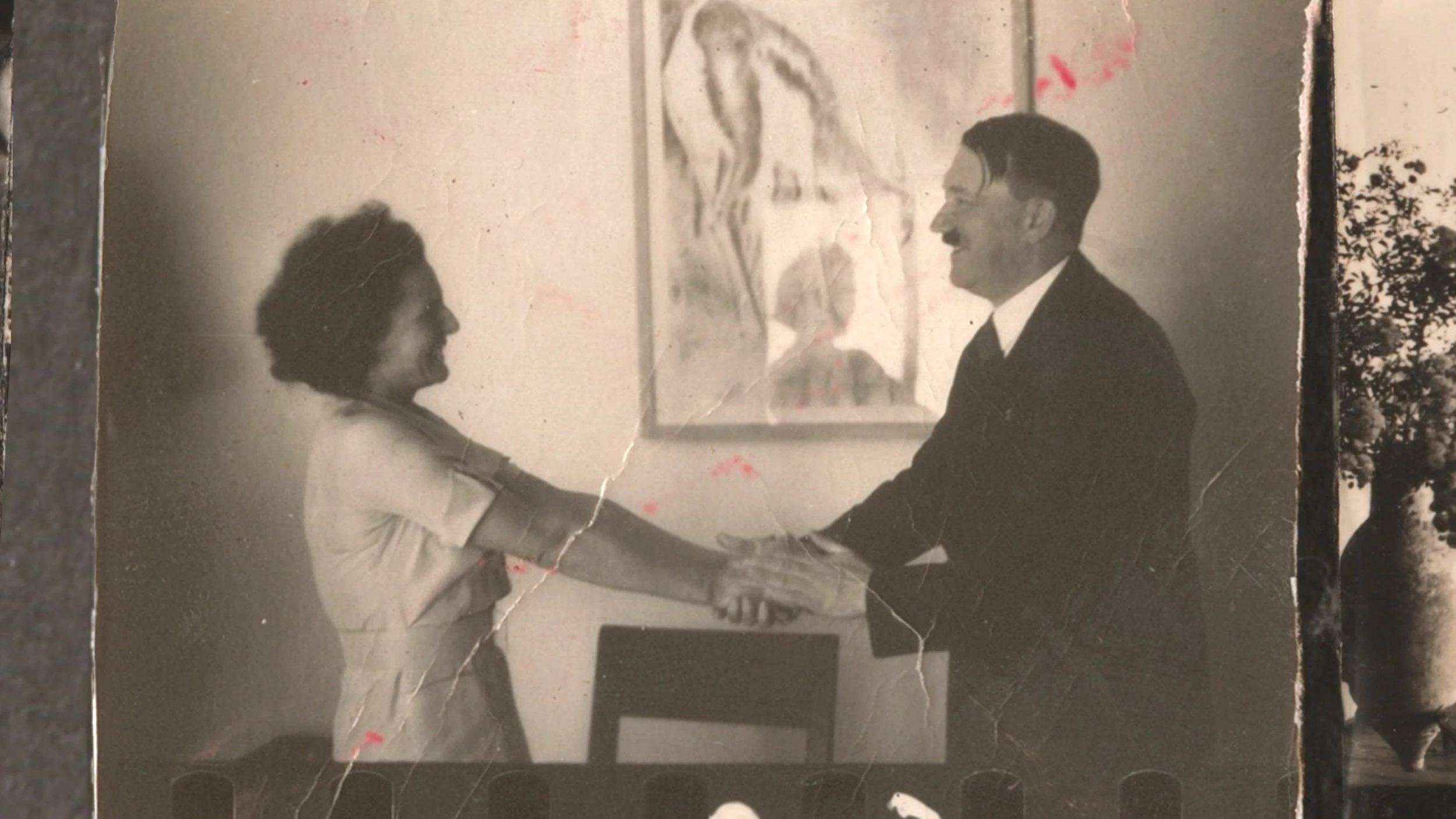
Leni and Adolf
Image courtesy of Dogwoof Releasing.
The filmmaker Leni Riefenstahl, who was born in 1902 and lived to the age of 101, was talented enough to earn a place in German cinema history but over and above that she is a major figure of wider relevance because of the role that she played in Nazi Germany. She entered cinema through acting most notably in popular mountaineering dramas such as The White Hell of Pitz Palu (1929) and Storm over Mont Blanc (1930) both directed by Arnold Fanck after which she took a further step forward in another film of this kind, 1932's The Blue Light. This time she was also a director and editor as well as the star and thereafter her work in film took a fresh course: she claims that she first met Adolf Hitler in 1932 and she became his favourite filmmaker. She was the key figure behind two documentary classics The Triumph of the Will (1935) and Olympia (1938). The former was a record of the Nazi party’s Nuremberg rally of that year (she had already filmed a comparable rally in 1933 under the title Victory of the Faith) and the latter was centred on the Berlin Olympics of 1936. She had come into her own being credited here as director, producer, writer and editor and the extracts from these works that we see are clear evidence of her innovatory images and superb editing skills. But it was these films which, featuring personal appearances by Hitler, soon came to be recognised as brilliant propaganda for the Nazis.
We live in times when filmmakers can be called out for their unsavoury lives thus giving rise to much discussion as to whether or not the work of artists thought to have behaved badly should itself be rejected. This is not a new thing, of course, and in classical music Wagner and his antisemitism have long provoked conflicting opinions as to how far great art should be applauded regardless of the bad character of its creator. More recently that issue has led to strongly held and opposing views especially when the artist concerned is accused of sexual misbehaviour but denies it thus creating a situation in which the truth remains unsubstantiated.
Riefenstahl’s case is in a class apart, however. That is partly because her finest art is actually found in the very films which, by playing up to Hitler, are central to the accusations against her. But there is another major factor too in that she devoted the rest of her long life after 1945 to denying that she had been aware of such matters as the concentration camps until the truth came out at the end of the war. There were also other specific allegations. One was that during a short period when she was a war correspondent filming in Poland she had directly witnessed acts of Nazi brutality but she would deny this. Similarly, she questioned charges connected with the fate of Roma from a concentration camp whom she had employed on her final film Tiefland (Lowlands) which would ultimately not be completed until 1954. A third major factor regarding Riefenstahl is that, whether one can or cannot give some credence to her claim that she was a passionate artist concerned with beauty rather than politics and therefore falsely accused, one is confronted by what appears to be a total lack of regret on her part. She admits to an excited admiration for Hitler from their first encounter but, having gone on to make films which honoured him and embraced Nazism, not to express remorse for them after the full horrors became clear in 1945 surely condemns her. She would readily sue those who would not accept her assertions of innocence and Edith Piaf's theme – ‘Non, je ne regrette rien’ – could be considered to be the driving force as it were of her later years.
In making this film Andres Veiel, himself German and born in Stuttgart in 1959, might have set out to argue a particular viewpoint but that is not his aim. The film does use a narrator to guide us through the history (Andrew Bird voices it) but the footage is all archive material and it provides resources that are rich indeed. Not least from the year 1976 there are memorable interviews and talk shows while Riefenstahl’s own archive of items connected with her career incorporates many tapes. In addition, Veiel has access to films made about her earlier and in which she appeared even extending to previously unreleased footage from them. This is treasure trove indeed which sometimes finds Riefenstahl contradicting herself or later ignoring what she had previously asserted (details of a sexual assault on her by Goebbels and a tale of her father beating her were voiced but were not reiterated by her later as one would expect). Such seeming inconsistencies make her a very enigmatic woman and add to the sense that Riefenstahl was not somebody who should readily be trusted, all of which makes it very appropriate for Veiel to invite the audience viewing his film to draw their own conclusions.
Riefenstahl is a consciously serious study, a detailed work which is in many ways chronological but not altogether so in the sense that some interviews seen early on will be drawn on again later. Similarly, her partner after 1967, Horst Kettner, is introduced fairly early on and well before her 1944 marriage to the Nazi Peter Jacob is mentioned but then reappears much later on. This slightly loose structure perhaps adds to the sense that at 115 minutes the film is on the long side but it does seek to be comprehensive and extends to footage of Riefenstahl in Sudan in the 1960s taking photographs for a book that would be published as The People of Kau. One 1976 TV show features more than once but contains a sequence that stands out for being particularly disturbing. It sees Leni Riefenstahl with another woman in her seventies, Elfriede Kretschmer, who cannot for a moment accept either her excuses or her denial of knowing what was happening in Germany when she was making her classic films. One notes Riefenstahl’s utter distain for this woman but what is most alarming is that Riefenstahl kept all the correspondence to her generated by that show and most of it supported her side of the argument. When dismissing the hostile ones she received she describes them as letters from those with different views such as Communists and Jews. This small segment of Veiel’s film arguably tells us what our verdict on Leni Riefenstahl should be.
MANSEL STIMPSON
Featuring archive footage of Leni Riefenstahl, Adolf Hitler, Jospeh Goebbels, Horst Kettner, Elfriede Kretschmer, Albert Speer, with narration by Andrew Bird.
Dir Andres Veiel, Pro Sandra Maischberger, Screenplay Andres Veiel, Ph Tony Cornish, Ed Stephan Krumbiegel, Olaf Voigtländer and Alfredo Castro, Music Freya Arde.
Vincent Productions/WDR/SWR/NDR/Rai Cinema-Dogwoof Releasing.
115 mins. Germany. 2024. UK Rel: 9 May 2025. Cert. 15.
