
Romería

Family secrets and old memories converge in Carla Simón’s deeply personal, disappointing Spanish drama.
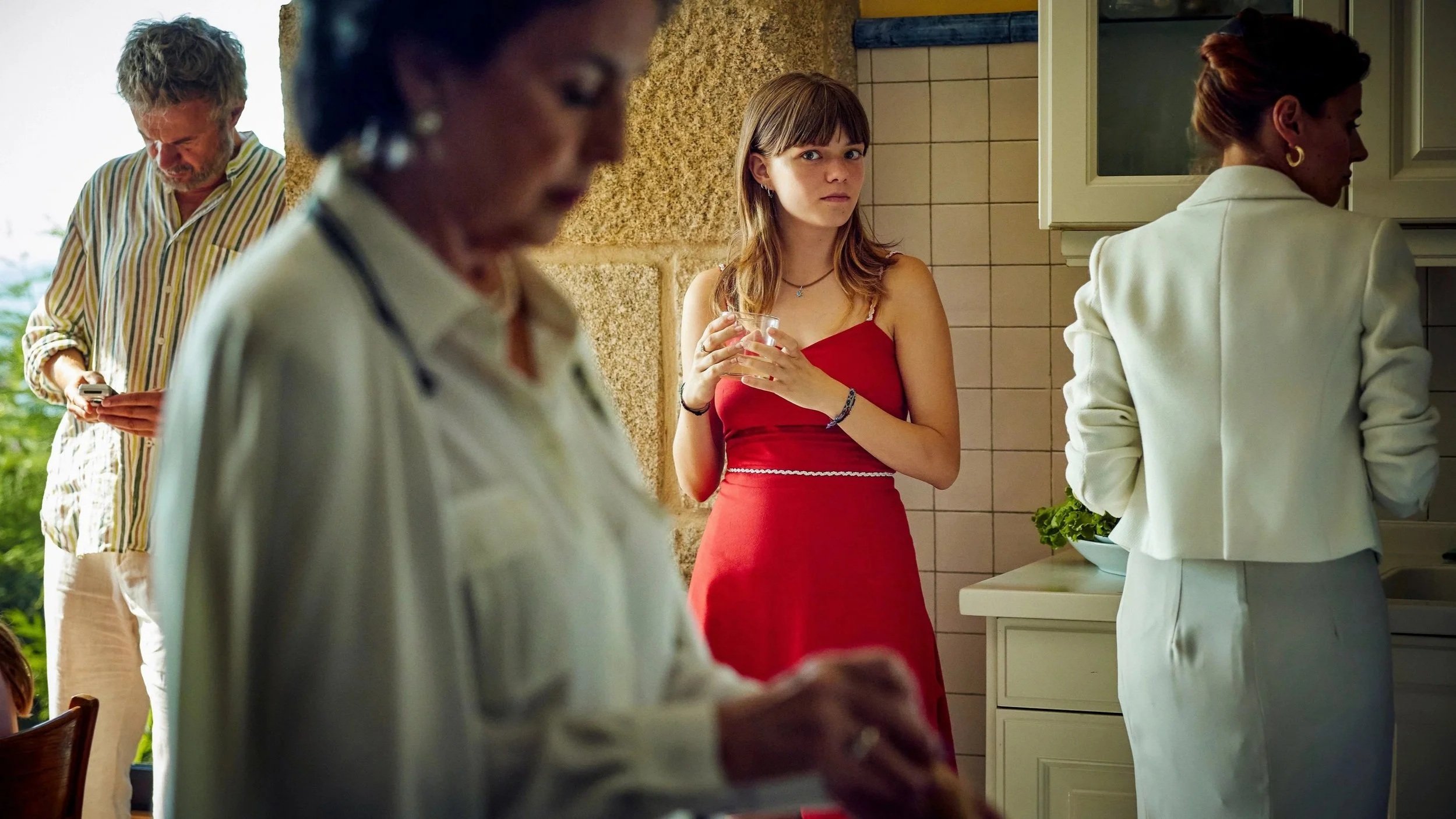
Image courtesy of Curzon Film Distributors.
by MANSEL STIMPSON
Writers embarking on a first novel often turn to material that is to some extent autobiographical. Similarly, many film directors who work from their own screenplays may well offer a first feature which draws to some extent on their own experience. But, if one is seeking a prime example of a filmmaker whose work follows this pattern, Spain’s Carla Simón stands out. Her feature debut, Summer 1993, a film focused on childhood, appeared in 2013 and made use of her own early years (she had been born in 1986). Furthermore, it was followed by Alcarràs (2022) which again drew on a place known to her (rural Catalonia) and now we have Romería which, despite containing fictional elements, is closer than ever to being autobiographical.
The central figure here is 18-year-old Marina (Llucia Garcia) who lives in Madrid and has ambitions to become a filmmaker. She is currently seeking a film school scholarship but to apply for it she has to produce papers which will confirm that she qualifies and that includes a certificate which contains details of her biological parents. In fact, both of them are dead and details in the civil registry are incorrect extending to no mention of Marina's birth. Since her adoptive parents have no standing to correct the information on record, she is advised that what she needs is an appropriate signed and sworn statement from her grandparents. A helpful uncle, Lois Piñeiro (Tristán Ulloa), invites her to his home in the town of Vigo on the Atlantic coast in Galicia and will put her in touch with the grandparents (José Ángel Egido and Marina Troncoso) who live nearby. Romería follows her on this journey and shows how past family history influences the way in which she is received. It appears that her father, Fon, had died of AIDS in 1992 and that the family had felt that the form of his death had disgraced them. Much earlier the grandfather, already disapproving of Fon’s behaviour and of his involvement with Rosalia (she who would become Marina's mother), had hoped in vain that a payment in cash would discourage Fon from continuing their relationship.
The extent to which telling such a story draws on Carla Simón's own experience is apparent when one learns that her own parents died of AIDS and that in 2004 – the year in which Romería is set – she set out to discover more about her parents. She has pointed out that her own quest took her not to Galicia, but to Madrid, yet she acknowledges that what is presented in the film in the form of voice-over diary entries written by Rosalia in the 1980s is indeed based on actual letters written by her own mother to friends. Looking back to that period, she comments on the extent to which a whole generation celebrated the post-Franco era by too readily embracing a freedom that encouraged the taking of heroin leading to overdoses and premature deaths. In this sense Romería is at one and the same time a specifically personal tale and a broader comment on Spanish society in the 1980s, one which asks for understanding rather than any condemnation of those whose lives ended in that way. As for young Marina and her discovery of facts about her parents that have been hidden, this leads to her forming her own attitude and plays a part in bringing her to maturity.
There is no doubting the compulsion that led to Carla Simón making a film as direct as this and, by refusing to be rushed, she has come up with perfect casting for the key role of Marina. Llucia Garcia had no previous film experience but is no less than ideal for the part: her remarkably engaging face and expressive eyes draw one in immediately and she is fully up to the demands of the role. For two thirds of its length, Romería offers a naturalistic portrayal of the five days during which Marina, hopeful of a positive result, links up with members of the Piñeiro family and all of the players involved are readily believable. Nevertheless, to my mind there is a snag here. Life in Vigo, where much time is spent on a family yacht, is vividly realised but, if we readily register uncle Lois and Marina's cousin Nono (Mitch), taking on board other members of the family is far from easy (they include another uncle, two aunts and many of a younger generation). The problem is one that is not new in Simón's work: in Summer 1993 it was the subsidiary figures who tended to confuse, but in Alcarràs the tale contained so many related characters that it was difficult to distinguish them and to grasp their relationships. Here names are often revealed belatedly, if at all, and possibly it stems from Simón being so close to her characters that she fails to recognise that some viewers will be put off by this lack of clarity.
I did feel that this issue somewhat weakened the first two thirds of Romería but without destroying the pleasure to be had from the performances (Garcia in particular) and from Simón's evident commitment. But what for me makes the award-winning Romería much less appealing than its two predecessors is the decision to change the character of the piece for most of the last third. The earlier introduction of a number of extracts from Rosalia's diaries may be done in a slightly self-conscious way, but it is acceptable enough and it works. But now and without warning we see Marina climbing a rope ladder to the top of a tall tenement block and finding on its roof her dead parents. Some have described what follows as introducing an element of magic realism into the film, but it leads to substantial footage in which we see a version of what is described in the diaries. This is made even more unreal by the fact that Llucia Garcia and Mitch now take on the roles of Rosalia and Fon respectively. These scenes increasingly involve the taking of drugs but Simón’s wish not to be judgmental of her parents means that this is portrayed without comment. What is more these scenes seem to add little to the theme of Marina’s discoveries which by then have emerged well nigh fully. Day 5 of the tale deals further with her responses to what she has learnt but by that stage the long imaginary flashback has made the film come to seem broken-backed. For that reason, I can only regard Romería as being overall a disappointment, but the discovery of Llucia Garcia is anything but that.
Cast: Llucia Garcia, Mitch, Tristán Ulloa, Miryam Gallego, Marina Troncoso, José Ángel Egido, Alberto Gracia, Janet Novás, Celine Tyll, Sara Casasnovas, Toño Casais, León Romagosa, Gala Rodríguez.
Dir Carla Simón, Pro Maria Zamora, Screenplay Carla Simon with Valentina Viso and with diary based on letters by Neus Pipo Simón, Ph Hélène Louvart, Art Dir Monica Bernuy, Ed Sergio Jiménez and Ana Pfaff, Music Ernest Pipo, Costumes Anna Aguila.
MK2 Films/Ad Vitam/Elastica Films/3Cat/Crea SGR/Netflix/Ventall Cinema-Curzon Film Distributors.
112 mins. Spain/Germany/USA/France/UK. 2025. UK Rel: 8 May 2026. US Rel: 26 June 2026. Cert. 15.
