
Sanatorium

Gar O'Rourke’s deeply humane documentary sheds a fresh perspective on life in present-day Ukraine.
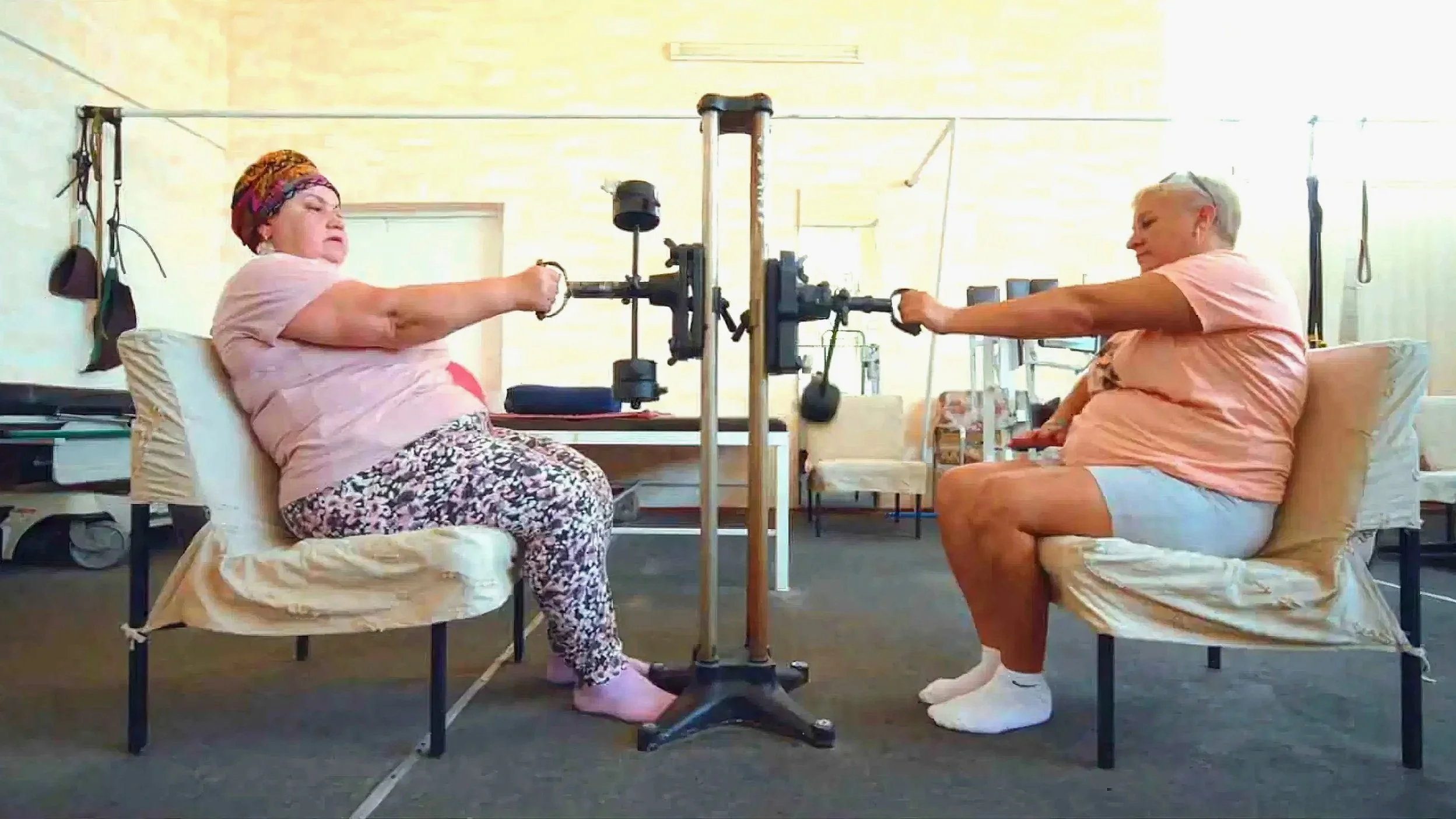
Image courtesy of MetFilm Distribution.
For his first feature film the Irish director Gar O'Rourke has opted to make it in the Kuyalnyk Sanatorium which is situated on the bank of the estuary of that name outside Odesa. This area has functioned as a resort for more than 180 years and it was here that the oldest mud baths in Ukraine were established. The fame of that treatment is such that, while various individual sanatoriums have come and gone there, the present establishment continues to provide medical rehabilitation even if the numbers attending have dropped, the continuing war in Ukraine inevitably being a factor in that. But even now, as the film puts it, the mud is black gold for them.
Because of the war we have had a considerable number of documentary films emanating from Ukraine, many of them highly distinguished, but Sanatorium carries the advantage of its approach being quite different from any of its predecessors. As an example of a film influenced by the war but adopting an oblique approach to it, the work that comes nearest to this one is the 2024 documentary Porcelain War in which Ukrainian art and its survival provided a central feature. Here O'Rourke is focused throughout on the work being done in the sanatorium at Kuyalnyk featuring both the staff who run it and those who go there for treatment (the range of the issues they cover is wide extending from psoriasis to infertility and back pain). In literal terms the war comes into this film in only two ways: one is the air raids which mean that those in the sanatorium have to take to a shelter whenever an alert is sounded and the other is the fact that some of those staying there have been victims of the war (those we meet here include a widow whose husband was killed in the fighting and a wounded soldier who, following surgery, is now being helped towards a successful mental recovery).
O’Rourke has opted for a film that offers no commentary as such but which, along with scenes which include direct spoken comments, frequently features voice-over comments from many of the sanatorium’s inhabitants. They include quite a number of those being treated including a mother and her unmarried son who are there together and an elderly man who is a retired uranium mine worker. Equally we hear from members of the staff and in particular from Olena the devoted medical director. She makes it clear that she regards her role there as one which requires her as far as possible to put a positive a slant on things in order to aid recovery. We certainly see plenty of scenes of treatment and exercise, but the sanatorium is also designed as a place for relaxation. Consequently, O’Rourke chooses to underline this in musical terms: quite apart from Denis Kilty's music score having a light and upbeat tone, it is heard alongside devotional choral music chosen for its soothing nature. Furthermore, although there are financial problems causing drawbacks (some visitors dismiss the cheaper rooms as shabby and there is repair work needed for the concert hall which is not operating), the look of the sanatorium is bright and appealing in Denys Melnyk’s excellent wide screen photography. In contrast to those around him, the manager is a man who is always swearing (this is probably the reason for the film’s ‘15’ certificate) but one feels that his heart too is in the right place.
The most rewarding thing about Sanatorium is that, by introducing us to so many people going about their daily lives in a manner with which we can so readily identify, the film enables viewers to recognise for themselves the poignancy that lies in what we see. What we already know about the war in Ukraine causes us to feel this: as we observe those in the sanatorium, ordinary people whose concerns and hopes make us respond to them just as we would to our own friends and neighbours, our minds call up our knowledge of the war and its horrors. The tone of the film is admirably judged and, aided by his editor John Murphy, O’Rourke draws us in even though the film’s character is that of an observant documentary rather than a work possessed of any great dramatic shape. Even so, it is the case that as we approach the film’s concluding scenes we witness the season coming to an end and O’Rourke incorporates a climax of a kind by featuring scenes with flags and a speech by Olena on the occasion in August when Ukraine's Independence Day is celebrated. Nevertheless, the impact of the film's first half is arguably the more potent since that is when its qualities reveal themselves whereas much of what we get later could be considered very similar to what has preceded it. But that is to quibble. Sanatorium is a deeply humane and worthwhile work and one which in reflecting conditions in Ukraine has a voice of its own. As evidence of the range of the film’s appeal, it is pleasing to learn that at this year’s Kraków Film Festival it won the Student Jury Award.
MANSEL STIMPSON
Featuring Olena, Dmitriy, Natalia, Andriy, Elena, Volodymyr, Valeria, Oleksiy, Inna.
Dir Gar O’Rourke, Pro Andrew Freedman, Ken Wardrop and Samantha Corr, Ph Denys Melnyk, Ed John Murphy, Music Denis Kilty.
Venom Films/2332 Films/Petite Maison Production/BBC Storyville-MetFilm Distribution.
91 mins. Ireland/Ukraine/France. 2025. UK Rel: 5 September 2025. Cert. 15.
