
Sentimental Value

The Danish-Norwegian director Joachim Trier reaches new heights with his family drama set against a film and theatre background featuring no less than three outstanding performances.
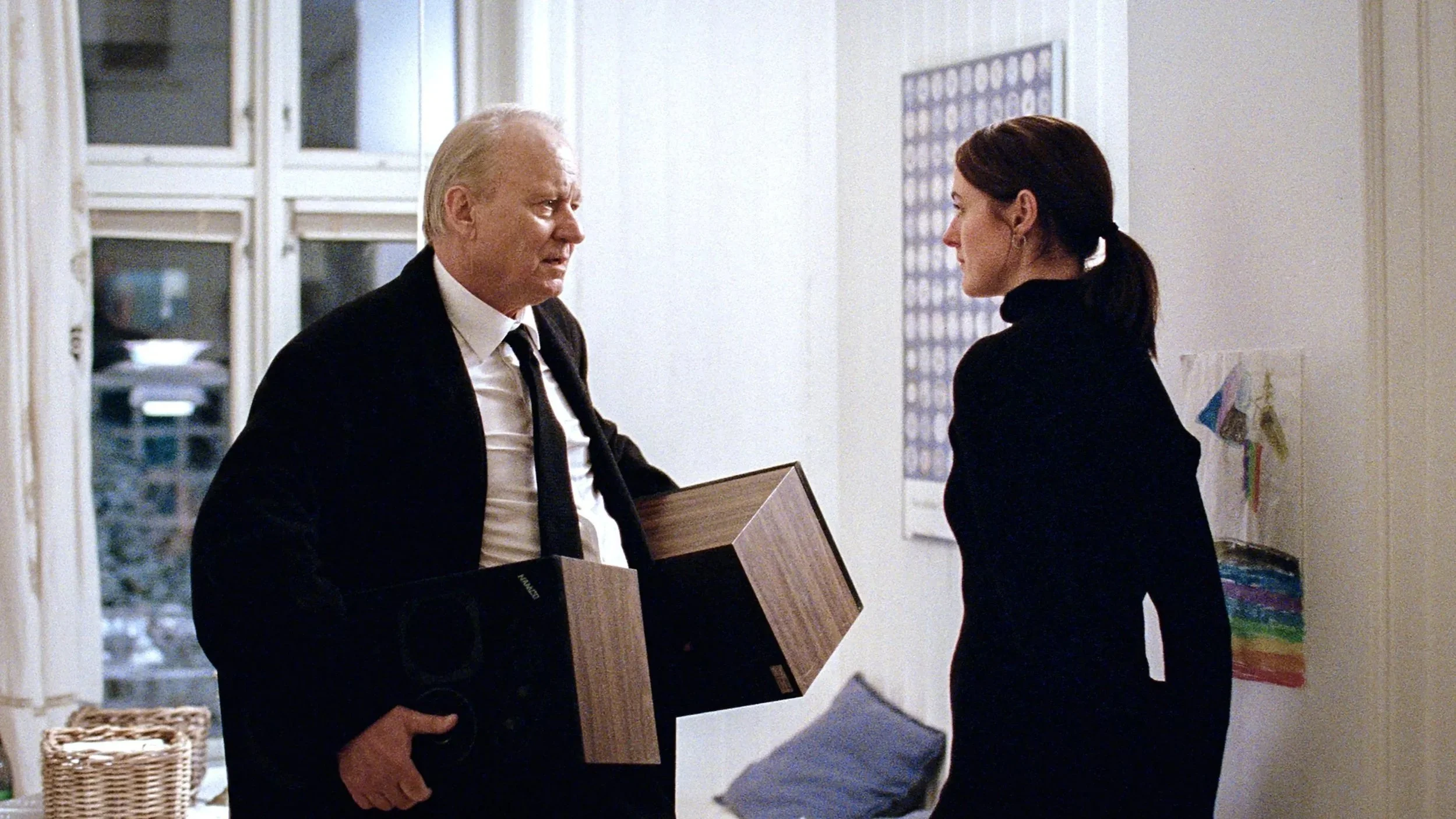
Stellan Skarsgård and Renate Reinsve
Image courtesy of Mubi.
by MANSEL STIMPSON
All five of Joachim Trier’s earlier features obtained a release in the UK and that is an achievement in itself but his new work, Sentimental Value, is being hailed as his finest to date. Its immediate predecessor, 2021’s The Worst Person in the World, was widely acclaimed as was its star Renate Reinsve, but even so the praise for Sentimental Value has been even greater just as the accolades for Reinsve, who is again the lead actress here, are yet higher than before. All of this is entirely justified, but on viewing the film I experienced a reaction quite different from any I have known before. The film contains so much that is brilliant that I actually felt angry over what I regarded as its incidental shortcomings. What caused that reaction was the fact that they could so easily have been avoided and yet existed to mar from time to time what in so many respects is a truly exceptional film.
The high claims for Sentimental Value look set to be justified as soon as the film begins. It is a family drama centred on three figures in particular: a father who is a film director, Gustav Borg (Stellan Skarsgård), and his two daughters, Nora (that’s Reinsve’s role) and Agnes (Inga Ibsdotter Lilleaas). Nora is an actress mainly noted for her stage work and is unmarried. In contrast to that, Agnes, the younger sibling, is an historian with a husband, Even (Andreas Stoltenberg Granerud), and a young son, Erik (Øyvind Hesjedal Loven). Much of the film takes place in the house where the siblings had grown up with their mother (she and Gustav had divorced) and the opening scene looks back on those earlier times by recalling an essay about the house which Nora had written when she was a child. As we hear her words on the soundtrack the camera (the photography by Kasper Tuxen Andersen is admirable throughout) explores both the interior and the exterior of the property and this pre-credit sequence is masterly in every way.
What follows next is a scene set in the present which takes place in a theatre and finds Nora suffering from intense stage fright just before going on. This episode does play out in a rather extreme way, but as the film proceeds the portrayal of the Borg family could not be more persuasive. The three leading players bring such depth to their roles that they positively inhabit them: these are lived-in performances. Central to the drama is the fact that the father is so devoted to his career as a filmmaker that he has always put that ahead of his responsibilities to his family. His career has been successful enough for Gustav to be attending a retrospective tribute at the Deauville Film Festival but nevertheless in more recent times he has found it difficult to finance his more ambitious projects. Now, however, he is working on what could be a major work and one related to his own family history since the story which it tells draws on the fact that his mother, Karin, had committed suicide when he was a child and that it had happened in the family house.
In addition to utilising personal history in this way, Gustav makes it clear that he sees Nora as the ideal actress to play her grandmother and indeed her fame as a stage and TV actress might help to get it made. However, Nora has never forgiven Gustav for his treatment of her mother who has recently died and she turns down the offer. Much earlier when her younger sister Agnes was still a child Gustav had cast the girl in a film of his and in her case she had accepted the role, but it had been an experience that she had not appreciated. However, as it turns out the new project is not stalled by Nora’s refusal since a big-name star, Rachel Kemp, played with distinction by Elle Fanning, sees the role as an opportunity to show that she can take on a more demanding acting challenge.
Sentimental Value is a rich work and its qualities are again apparent in a scene which finds Gustav looking up his old colleague, Peter, who had been his regular photographer. He is hoping to engage him once again for his new film but then realises that age has taken its toll and that he is not up to it. It's a small episode but Lars Väringer who portrays Peter does so with such conviction that the unforced pathos of the scene is memorable. Indeed, it is true to say that this film functions equally well whether one views it as a family tale covering complex emotions or as a study of an aging filmmaker striving against the odds to make a new work which is important to him. As the tale proceeds it follows events in the present but past events are important too and the film seeks the kind of depth that is more often associated with a novel.
The screenplay once again finds Trier working with Eskil Vogt and arguably attaining a greater depth than they have achieved before. In the process it readily sustains a running length of 133 minutes and the casting is ideal. It is, however, unusual in being divided up not into chapters as such but into a series of sections each of which ultimately fades to black before the piece continues but without any individual headings appearing. There are times when this means that the viewer has to work out when and where the next segment is set. The most extreme example occurs when we are presented with a landscape scene with figures on the move and then see a girl on a train. Here what we have to realise is that quite unexpectedly we are watching the film that was made by Gustav and featured the young Agnes. On other occasions it is not quite as distracting as that, but there are often times when one feels that the clear flow of events past and present is unduly complicated by this approach and that the audience deserves more consideration.
In addition to that I find the film’s big final scene comes over as rather too tricksy even if one can anticipate where it is leading. In a standard film this might be acceptable enough, but here this finale follows a scene between Nora and Agnes which, perfectly rendered by Reinsve and Lilleaas, is so real that one is inclined to consider Sentimental Value as one of the very best screen depictions of a close sibling relationship ever seen. When you have something as wonderful as that to find that it is followed by Trier’s chosen finale not only disappoints but, in my case at least, irritates. Even if you should share my reaction – and many may not – it stands to reason that a film which hits the heights as often as this one does and contains three of the best performances of the year is not one to be missed.
Original title: Affeksjonsverdi.
Cast: Renate Reinsve, Stellan Skarsgård, Inga Ibsdotter Lilleaas, Elle Fanning, Anders Danielsen Lie, Lena Endre, Andreas Stoltenberg Granerud, Øyvind Hesjedal Loven, Lars Väringer, Jesper Christensen, Cory Michael Smith, and Bente Børsum as the narrator.
Dir Joachim Trier, Pro Maria Ekerhovd and Andrea Berentsen Ottmar, Screenplay Eskil Vogt and Joachim Trier, Ph Kasper Tuxen Andersen, Pro Des Jørgen Stangebye Larsen, Ed Olivier Bugge Coutté, Music Hania Rani, Costumes Ellen Dæhli Ystehede.
Mer Film/Eye Eye Pictures/Lumen Production/MK2 Productions/Komplizen Film/BBC Film-Mubi.
133 mins. Norway/Italy/France/Denmark/Sweden/Germany/UK/Turkey. 2025. US Rel: 7 November 2025. UK Rel: 26 December 2025. Cert. 15.
